Activity
Mon
Wed
Fri
Sun
Aug
Sep
Oct
Nov
Dec
Jan
Feb
Mar
Apr
May
Jun
Jul
What is this?
Less
More
Owned by Dementia
Dementia Care Support & Expert Guidance.
Memberships
208 contributions to The Dementia Lifeboat

20d •
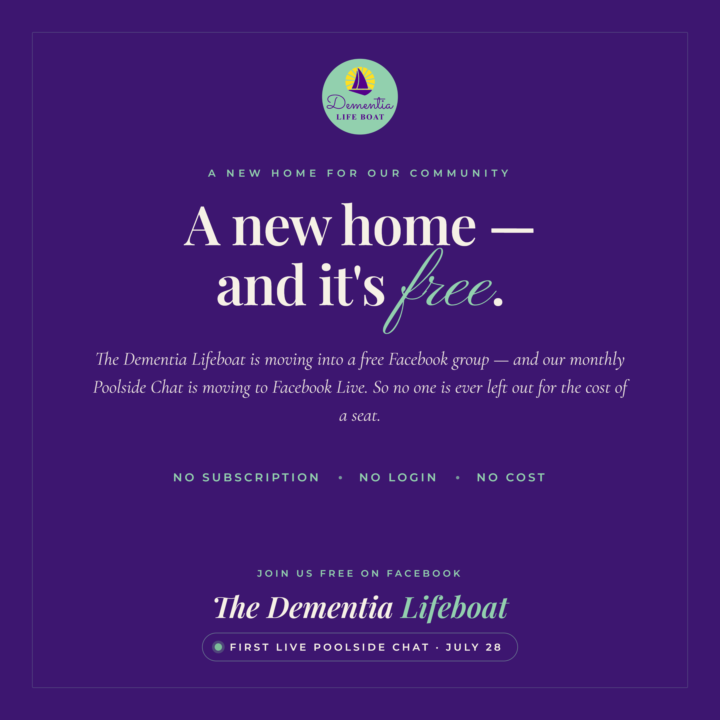
We're MOVING!
The Dementia Lifeboat community is moving off of Skool and into a free Facebook group — and our monthly Poolside Chat is moving to Facebook Live. This was a purposeful decision. I want this space to be available to every caregiver who needs it, without any barrier to entry. No subscription, no login, no cost. Just a community that shows up for one another. If you or someone you know is navigating dementia caregiving, this is the place. Come join us. 👉 Join the Dementia Lifeboat: https://www.facebook.com/groups/2138455819816838 Our first Facebook Live Poolside Chat is July 28th: https://www.facebook.com/share/1G3D6mJ4Si/
0
0
21d •
We are live now!
We have an exciting announcement to share with everyone! Join anytime between now and 6:30 PST! https://us02web.zoom.us/meeting/register/PRzPtXKIRf-NNdHzhSToUg
0
0
26d •
Jocelyn's Thursday Thought
I really like a superhero movie where there are good guys and bad guys. Villains and victims. I love a dramatic story or a great murder mystery. I love all those things when I am reading a book or watching a movie or a play. But in real life people are not that simple. Stories are not this black and white. People are not just good or bad. Most of the time the drama in our minds is an oversimplification of real life. Your mom isn't an evil villain even though you disagree with some of her choices and worldviews. You're not a victim even if she's not showing up like the mom you think she should be. There aren't good guys and bad guys in this story after all. There are just people who are complicated and lovely and flawed. People who love each other and have different opinions about what that means. People with thoughts and feelings and ideas and all of it is messy at times, but understandable and reasonable if you really pay attention. When we make another a villain, we are left being the victim. We give them (in our minds) way more power than they actually have and we are left powerless. Drama is so much better saved for the big screen. Let your life and the people in it just be dynamic. Everyone IS doing their best. Sometimes their best is pretty crappy, but if they could have done better in that moment - they would have. Trust me. Have a beautiful week! I love you all, Jocelyn
1
0
Jun 11 •
Jocelyn's Thursday Thought
I really like a superhero movie where there are good guys and bad guys. Villains and victims. I love a dramatic story or a great murder mystery. I love all those things when I am reading a book or watching a movie or a play. But in real life people are not that simple. Stories are not this black and white. People are not just good or bad. Most of the time the drama in our minds is an oversimplification of real life. Your mom isn't an evil villain even though you disagree with some of her choices and worldviews. You're not a victim even if she's not showing up like the mom you think she should be. There aren't good guys and bad guys in this story after all. There are just people who are complicated and lovely and flawed. People who love each other and have different opinions about what that means. People with thoughts and feelings and ideas and all of it is messy at times, but understandable and reasonable if you really pay attention. When we make another a villain, we are left being the victim. We give them (in our minds) way more power than they actually have and we are left powerless. Drama is so much better saved for the big screen. Let your life and the people in it just be dynamic. Everyone IS doing their best. Sometimes their best is pretty crappy, but if they could have done better in that moment - they would have. Trust me. Have a beautiful week! I love you all, Jocelyn
0
0
Jun 9 •
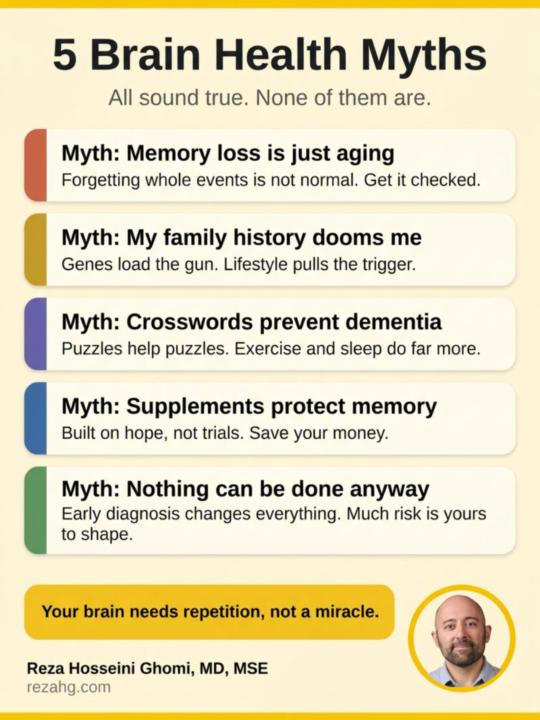
5 Brain Health Myths
5 brain health myths I hear almost every week. All of them sound true. None of them are. I am a brain health doctor. Here is what I spend a lot of my time un-teaching. Myth 1: Memory loss is just normal aging ↳ Slower recall is normal ↳ Forgetting whole events and repeating questions is not ↳ Do not wait it out. Get it checked. Myth 2: If it runs in my family, I am doomed ↳ Genes load the gun. Lifestyle pulls the trigger. ↳ Most risk is not destiny Myth 3: Crosswords will keep dementia away ↳ Puzzles make you better at puzzles ↳ Exercise, sleep, and blood pressure do far more for your brain Myth 4: Supplements can protect your memory ↳ The supplement aisle is built on hope, not trials ↳ Save your money for things with evidence Myth 5: Nothing can be done about dementia anyway ↳ This one bothers me most ↳ Early diagnosis changes planning, safety, and treatment ↳ A large share of risk is tied to things you can influence Here is the pattern under all five. People either panic or give up. Both reactions stop them from doing the boring stuff that works. The boring stuff is the good stuff. Move daily. Sleep enough. Treat your blood pressure. Stay connected. Protect your hearing. Not exciting. Just effective. Your brain does not need a miracle. It needs you to stop believing the myths that talk you out of basic care. 📌 Follow Reza Hosseini Ghomi, MD, MSE for myth-free brain health 💬 Which of these myths did you believe?
1
0
1-10 of 208

Active 2h ago
Joined Dec 18, 2024
United States
Powered by