Activity
Mon
Wed
Fri
Sun
Nov
Dec
Jan
Feb
Mar
Apr
May
Jun
Jul
Aug
Sep
What is this?
Less
More
Allistar Center
191
Free
8 contributions to Allistar Center

Jul 6 •
The Tesseract is live — your first report is on me 🌀
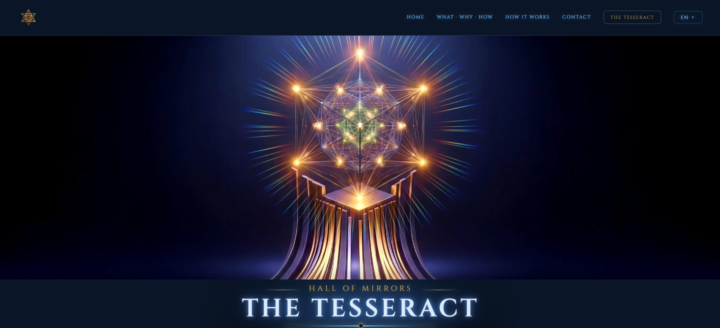
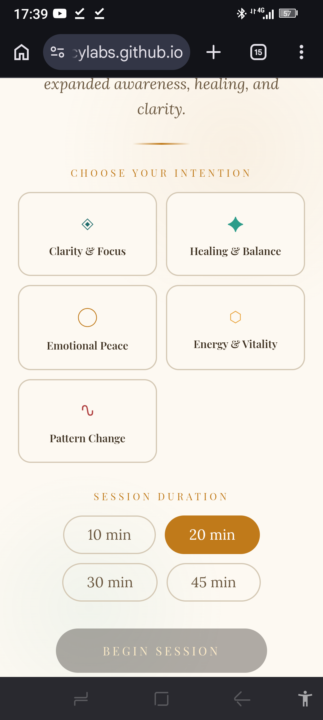
Hey everyone 🌀 Some of you have asked to try the Tesseract, so here it is — consider this a soft launch, just for this community first. When you log in, you get 10 Mirrors as a gift — enough for one full report, completely free, no card needed. If you want to explore further after that, it's €2 per report (10 Mirrors), minimum purchase €10 (5 reports). Home: https://tesseract.allistarcenter.com/ The tool itself: https://tesseract.allistarcenter.com/tesseract How it works (read this first if you're new): https://tesseract.allistarcenter.com/how-it-works A few honest notes: I've had a lot of you reach out wanting to try this personally, and I want to be upfront — I can't be the bridge for everyone individually right now. This is exactly why I built it the way I did: you can log in and run it yourself, completely privately. If there's something you want to explore that you'd rather not share with me directly — a personal decision, something private, something you're still working out for yourself — that's genuinely fine. Nobody sees your intention or your report but you. This is still actively evolving. I'm shipping changes regularly — some of you have already seen the tool change shape week to week. If something feels rough, unclear, or breaks, please tell me. Your feedback on anything — the wording, the experience, a bug, an idea — genuinely shapes what gets built next. This isn't a finished product handed to you; it's something being built partly with you. One thing worth knowing going in: the Tesseract is a mirror, not an oracle. It doesn't predict or tell you what to do — it holds your intention across 26 independent perspectives and shows you where your own thinking converges, and where it doesn't. Read the "How it works" page before your first run — it takes two minutes and will make your one free report meaningfully better.

1 like • Jul 7
Thank you @Krasimi Kolev !
May 15 •
The CIA Declassified a Consciousness Manual — Here's What's Inside
**🔍 A CIA-Declassified Consciousness Manual — And Why You Should Know About It** A friend recently shared something with me that I couldn't stop thinking about. It's not new. It's not a trending wellness product. It's a document that has been sitting in the CIA's public reading room since 2003 — and most people have never heard of it. The reference number is `CIA-RDP96-00788R001700210023-7`. Its real name is the **Gateway Intermediate Workbook**, published in 1977 by the Monroe Institute of Applied Sciences in Virginia. It is, in plain terms, a structured manual for expanding human consciousness. --- **📖 A Little Background** Robert Monroe was a radio broadcasting executive who, in the late 1950s, began experiencing spontaneous out-of-body states during relaxation. Instead of dismissing them, he spent decades studying and systematising them. In 1974 he founded the Monroe Institute, dedicated to researching human consciousness through structured audio and mental training. The Gateway Program was the Institute's flagship offering — a graduated series of exercises designed to help practitioners enter deep altered states, expand awareness, and develop voluntary control over their own consciousness. Here is where it gets interesting: in the late 1970s and through the 1980s, the CIA and the Defense Intelligence Agency were running serious — if secret — programs investigating whether human consciousness could be operationally useful. Programs with names like STARGATE, GONDOLA WISH, and GRILL FLAME explored remote viewing. The Monroe Institute's method attracted their attention because it offered a systematic, trainable path into the exact altered states remote viewers needed. Personnel were trained. Reports were written. Most of it stayed classified for decades. When the documents were finally released under Freedom of Information Act requests, the Gateway Workbook came with them. --- **📋 What Is Actually Inside the Workbook** The workbook is 21 pages. It is practical, not philosophical. Here is what it covers:
1 like • May 15
@Krasimi Kolev this is so wonderfully summarized! This is great! I still need to finish reading over it, but I have shared it with a private FB group I’m apart of. 💫🌟. Thank you!
1 like • May 15
@Krasimi Kolev is that ok I shared it with a private fb messenger group? Because the link to this post was public I inferred it was ok. But asking you just in case. I’m happy to remove it if you prefer. 🙏🏻
May 8 •
We Just Sent Our Paper to Two of the World's Top Quantum Gravity Physicists
🌟 MAJOR MILESTONE — THE LOCATIONAL VARIABLE EXPERIMENT Today marks a significant moment for Allistar Center and for this community. We have completed and submitted a full scientific paper titled: "Spatial Identity in Resonant Systems: Investigating Location-Dependent Frequency Signatures Through Environmental Coupling" The core idea is this: location is not just a coordinate. It is an intrinsic physical variable that encodes itself into the resonant frequency signature of any object through its environment. Every location in space has its own unique vibrational identity — measurable, reproducible, and detectable through FFT analysis. If this is confirmed experimentally, the implications go far beyond acoustics. Quantum mechanics describes reality in discrete quanta — energy, charge, spin are all quantized. General relativity describes spacetime as smooth and continuous. This incompatibility is exactly why a unified theory of physics has never been achieved. If every spatial location carries a unique discrete frequency signature — spacetime itself is granular. Not continuous. Quantized. And if spacetime is quantized, it enters the same framework as quantum mechanics — and unification becomes possible. This is what we are testing. With a copper sphere. A contact microphone. An aluminum sheet. And FFT analysis. The paper is formatted according to academic journal standards. References include Rovelli, Smolin, Penrose, Bombelli, and Planck. Today I also registered as an official researcher on ORCID (Open Researcher and Contributor ID: 0009-0007-4394-8722) and created an arXiv account for the submission. Endorsement requests with the full paper attached have been sent directly to both Professor Carlo Rovelli (Marseille, France) and Professor Lee Smolin (Perimeter Institute, Canada) — the two co-authors of the 1995 paper proving discrete structure in quantum gravity. Once endorsed, the paper goes live on arXiv, establishing a permanent global priority date for this research. First journal target: Foundations of Physics.
1 like • May 8
This is really amazing!
Jan 20 •
The work of Robert Edward Grant. Live Gaia Q&A with him Jan 20
I am curious if other folks in this group have been following his work. For example: his “rediscovery” of the geometric and mathematical/harmonic/vibrational relationships of the Giza pyramids and the supporting evidence that they were technologies used for ascension, communication, transportation, and more. I’ve been following him for a while. Gaia is having their first “Ask Me Anything” live streaming event Jan 20, 1pm PST. And Gaia invited Robert Edward Grant to be their first guest speaker. Attendees can also ask him questions. I’ll be joining.
1 like • Jan 25
@Янко Митев hi! The event was great. The host, Ben Stewart, was great as well. I didn’t see a recording of it but perhaps they will release the recording. There’s a free Gaia trial. 7 days I believe. If you search the Gaia website and find some context that excites you, Gaia has a free sharing option for friends and family. They allow members to share “certain” content for free. Just let me know the episodes and I can check.
1 like • Jan 26
@Янко Митев you are welcome!
Jan 21 •
GPT Model
Hi all, after reading everyone’s comments and discussing with Krasimi, I am sharing with you the GPT model. I built this using Bashar transcripts🙏 (1984–2024) that I found online recently. This model is a good tool to know if Bashar has addressed certain topics in his talks or not. That said, please use it with discernment, no GPT model is 100% accurate, and all models can introduce bias or occasional errors. I’ve instructed it to rely only on the transcript material and avoid adding outside information, but it may not be foolproof every time. Also, replies vary depending on how you frame the question and the version of ChatGPT you use (free version vs pro version). I hope it’s useful to you in some way. Here’s the link: https://chatgpt.com/g/g-69654eee0cf88191b1d483d92dbe20c6-bashar-wisdom
1 like • Jan 25
@Palash Vyas thank you for sharing this!
0 likes • Jan 25
@Palash Vyas Robert Grant discusses a related approach to bringing Architect+ AI into resonance to spiritual geometry and connection with the person interacting. , He refers to this geometry as the Monadic Spiral. (If I recall correctly). I can share my notes on the steps if you ever interact with Architect+ AI.
1-8 of 8
@kyle-roberts-7699
Ecstatic dance host. Engineer. In love with Pachamama, Mother Gaia.
Active 7d ago
Joined Jan 8, 2026
Oregon, USA