Activity
Mon
Wed
Fri
Sun
Aug
Sep
Oct
Nov
Dec
Jan
Feb
Mar
Apr
May
Jun
Jul
What is this?
Less
More
Owned by Kris Jim
Called to create for Jesus? Burdened with a mission to share? Afraid to share? Unsure how to share? I've been there. Join for support.
Do you need a way to share Jesus with loved ones & friends? Afraid to share Bible movies & series in case they change His Word? Let's check them out.
Memberships
Producer Launchpad
305 members • Free
Retirement Home Piano Gigs
56 members • Free
The Stone Wall
870 members • Free
Musician Freedom
215 members • Free
Evateachingopera
484 members • $9/month
🏛️ Coaching Academy
4k members • Free
Community Launch
15k members • Free
Prayer Bible Project Academy
22 members • Free
Christ Underground
15.1k members • Free
17 contributions to Mack's Music Collective
28d •
Talent or Consistency?
One of the biggest misconceptions in music education is that talent determines success. After teaching students of all ages, I've found something different. The students who progress the fastest are rarely the most naturally gifted. They're the ones who learn how to practice effectively. A student who practices 20 focused minutes with a plan will often outperform a student who practices an hour without one. Music isn't just about notes and rhythms. It's about learning how to solve problems, think critically, and develop discipline. Those skills stay with you long after the lesson ends. What do you think matters more: talent or consistency?

1 like • 28d
Consistency. It builds talent and teaches discipline
Jun 13 •
Saturday Quote
"If there is nothing new to be found in melody then we must seek novelty in harmony" -Georg Philip Telemann
1 like • Jun 13
And vice versa
Jun 12 •
The Blue Note
Characteristic of blues/jazz music, the "blue" note is a technique where a slight drop in pitch on the third, fifth, or seventh tone of the scale.

1 like • Jun 12
Yes, indeed, and I love the sound. On the piano and other instruments with fixed chromatic (half-step) tuning, we can approximate this by flatting the note, lowering it a half-step. On an instrument with flexible pitch we can do this or simply bend the pitch slightly lower, between the half-steps. I love the piano, but for blues, instruments with flexible pitch are great!
May 22 •
Hello All
Happy Friday to everyone! Hope everyone's Friday and week went well and hope your weekends are awesome! I returned home to a family emergency so I may be in and out of the community.
2 likes • May 23
🙏✝️
2 likes • May 24
@Channing Mack May my family's churches pray for her?
1 like • May 11
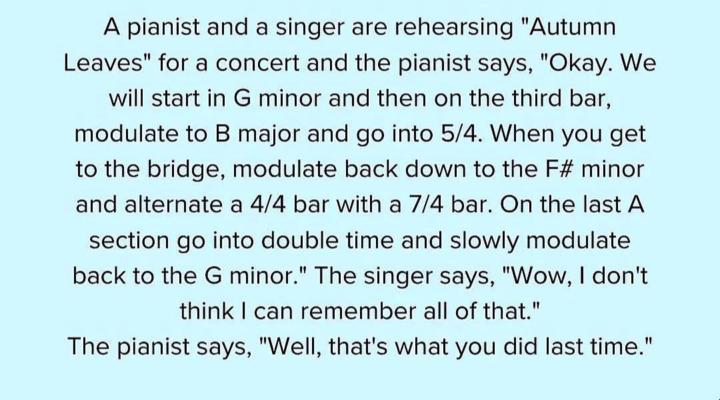
I think I've played for that singer before 🤣
1-10 of 17

@kris-jim-murdock-7407
Christian music minister, writer, & child cancer advocate, shining Jesus to the next generation. https://www.skool.com/christian-writers-support-6099/
Active 11h ago
Joined Jan 29, 2026
65084