Activity
Mon
Wed
Fri
Sun
Nov
Dec
Jan
Feb
Mar
Apr
May
Jun
Jul
Aug
Sep
What is this?
Less
More
Owned by Kevin
The Petanque Performance Academy is for players who wish to progress their game through in depth coaching and analysis. This group is open to all
Skoolers
154k
Free
247 contributions to Petanque Performance Academy

2d •
Would you be interested in a LIVE YouTube video
I created this little video today after last nights get together and it got me thinking that it might be fun to do a LIVE version tomorrow. Please watch and let me know if you think this would be good value to you as a player and I’ll set up a LIVE for tomorrow evening Serious About Pétanque? Watch This Match Analysis https://youtu.be/ApF9-S6jlE8
0 likes • 23h
@Lee Herring I have zero idea how to do that and it wouldn’t update on a video
2 likes • 19h
Turns out it’s not as easy as I thought so I’ll have to do this with more notice if I manage to work out how to proceed

2d •
A lot of balls don't land on the donnee.
I saw a Lacroix game yesterday. He again placed excellently. But his balls often don't land on the donnee but right in front of it. I see that much more often. I think 80-90% of the balls are not thrown on the donnee but somewhere for it. What do you think? How do you deal with this? You throw a little further because you know he comes down earlier? You make your donnee a little bigger, or a little longer in length so that the ball lands on the donnee anyway? Or are there other ways to deal with this?
0 likes • 2d
The landing spot or donnée is often just a generic area around the size of 4/6 boule clustered together. To hit an exact spot perfectly every time is difficult even for the pro’s. Often we don’t know what is underneath the landing area as I found last night when I threw a perfect boule, only for it to find a HUGE rock underneath and my boule raced off to the right and off the terrain. This was on a relatively easy terrain and everyone present fell about laughing 😆
0 likes • 2d
@Luis H. I have taken to using a used Nespresso capsule as a landing spot rather than a jack as I kept smashing the jacks into the woods and losing them. They are also very colourful and easy to pick out on terrains
3d •
A good decision isn't judged by its outcome
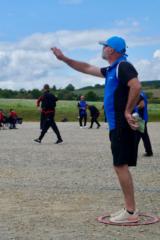
(preliminary warning: this post was written partly by AI - Claude - after a discussion about tactics and decision theory. The situation I was in a few weeks ago: 12-12 at the end of a very tight game, one boule in each team's hands: me, the shooter, and my opponent was pointing but had shot very well when needed. They have a point at 80cm on a very, very difficult pitch. I decide to shoot and let the difficult terrain take care of my opponent. I take out his boule, but he manages to point for the win. No need to say there was a very long talk about that particular tactical choice after the game 😉. Not with my partner though, we did agree on this beforehand) Picture a tight end in a game of pétanque. Two teammates can't agree: one wants to shoot, the other wants to point. The one who wants to point has the boule, so he points. The opponent shoots, misses, and the team keeps the point. The pointer turns to his partner: "See? I was right!" Was he right? Maybe. But what just happened doesn't prove it. The problem is that we'll never know what the other choice would have produced. If he had shot, he might have hit a carreau and the opponent player might have missed his last boule. Or he might have missed, leaving the opponent to point for 2. We only saw one version of the story, the one that actually played out. The other one stays forever in the realm of "what if…". Above all, the outcome depends partly on luck. An opposing shooter who succeeds seven times out of ten also misses now and then. A badly placed pebble, an unexpected bounce, and everything changes. Saying "it worked, so it was the right choice" is like saying it's fine to drive home after a few drinks because you got home safely. This mistake has a name: *outcome bias*. It's the tendency to judge a decision by what happens afterwards, rather than by what we knew when we made it. It shows up everywhere: in games, in business, in medicine, in everyday life. To judge a choice fairly, you have to put yourself back before the throw. What did we know? Was the ground smooth or stony? Was the opposing shooter on form? How many boules did each side have left? A good decision is the one that had the best chance of working *given that information*, even if, on that particular day, it went wrong.
1 like • 2d
That’s a great discussion point Xavier. I have a saying that all tactics are the BEST ever when they work and the WORST when they don’t. It’s a paradox of the game but deciding and committing is VIP and the outcome is out of your hands. As long as you commit to a choice and execute it well you should be happy
3d •
Tonight’s Zoom Match 6.30pm UK or 19.30 French time
Kevin O’Rourke is inviting you to a scheduled Zoom meeting. Topic: Kevin O’Rourke's Zoom Meeting Time: Sep 28, 2026 07:30 PM Paris Join Zoom Meeting https://us06web.zoom.us/j/85730565199?pwd=k6vuwUHdKgzCDx93EbKmtyxFUlTsj2.1 Join and take notes https://us06web.zoom.us/j/85730565199?pwd=k6vuwUHdKgzCDx93EbKmtyxFUlTsj2.1&mynotes=on Meeting chat link https://us06web.zoom.us/launch/jc/85730565199 Meeting ID: 857 3056 5199 Passcode: 876066 --- One tap mobile +15074734847,,85730565199#,,,,*876066# US +15642172000,,85730565199#,,,,*876066# US --- Join by SIP • [email protected] Join instructions https://us06web.zoom.us/meetings/85730565199/invitations?signature=4E5rRn0H-zq7sxLSDz3f_9VrUtEFQSfNcPLHCNTK4Dc
2
0
6d •
Sometimes singles is the hardest game
I just lost in the second game in a single tournament here in Bourg Saint Andéol. I’ve beaten the tough opponents in the first game and was confident going into the second game. I thought I had practised and worked out most of the terrains this morning whilst waiting for the competition and filming a little. However, nothing prepared me for the nightmare terrain that was chosen. I threw the Jack initially to 8 m and threw my first boule which promptly hit a stone and steamed off at a right angle and off the terrain!!!! I had a quiet word with myself and said shit happens through the second boule which hit another bastard stone and went 4 m to the back. It was at this days that I realised it would be much easier to shoot than to point. In the end, I lost quite a close game to a very good player, but whilst I was throwing 1 to 2 boule off the terrain he was only throwing one boule off the terrain. He won quite a few ends with 5/6 meter measures! Shooting was also difficult because of the stones and I don’t think I’ve ever lost to a terrain in my life. Although my opponent got to 13 before I did, I still don’t think he deserved the win. Have you ever lost to a terrain before?
2 likes • 6d
@Emmanuel Tacheau normally I can work a terrain out fairly quickly but this one beat me badly and I’ll have to be careful if I’m playing there tomorrow! However I scored 2 big ends on the hardest part when I threw 3 magnificent points which all stayed beautifully but time. Sadly this didn’t happen every end
2 likes • 4d
@Paolo Durandetto wow, that’s like playing on the moon!
1-10 of 247
@kevin-orourke-1847
I’m Kevin aka Pétanque Coach. I play the French game of Pétanque and offer free advice, game commentary and interviews via my YouTube channel.
Active 17h ago
Joined Aug 17, 2025
Wyton,Cambridge, UK