Activity
Mon
Wed
Fri
Sun
Oct
Nov
Dec
Jan
Feb
Mar
Apr
May
Jun
Jul
Aug
Sep
What is this?
Less
More
AI Automation Society Plus
3.5k members • $129/month
AI Bits and Pieces
877 members • Free
21 contributions to AI Bits and Pieces

Jan 24 •
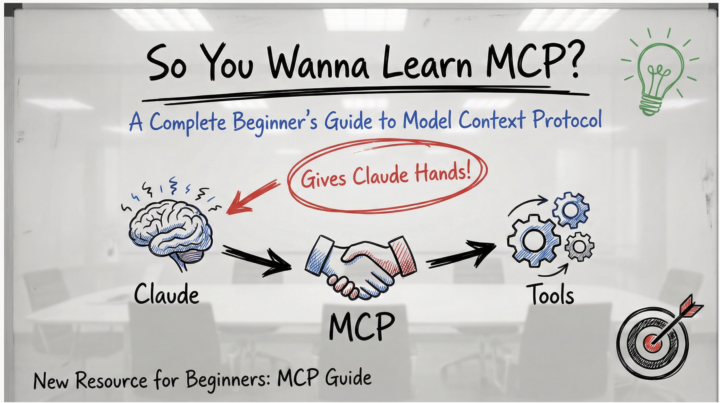
🚀 New Resource: So You Wanna Learn MCP?
Hey everyone! 👋 I just put together a complete beginner's guide to MCP (Model Context Protocol) - the new system that lets Claude actually connect to your tools and do real work. What's MCP? Think of Claude as having a really smart brain but no hands. MCP gives Claude those hands - letting it read your Gmail, work with GitHub, access Notion, search the web, organize your files, and connect to hundreds of other tools. The best part? Someone builds one MCP server and it works with Claude, Cursor, Cline, Windsurf, and any other AI app that supports MCP. No more reinventing the wheel. What's in the Guide? ✅ Visual explanations (diagrams, flow charts, analogies) ✅ Zero technical jargon - plain English throughout ✅ Step-by-step setup walkthrough (takes ~20 minutes) ✅ Hands-on tests to verify it's working ✅ Security tips for evaluating MCP servers ✅ 5 practical exercises to try immediately ✅ Troubleshooting guide Goal: Get you from "What is MCP?" to having your first server running in under 20 minutes. Pro Tips from the Community 🔥 Don't install 100 MCP servers at once! (h/t [Name if you have one]) Start with 2-3 that you'll actually use. Too many servers: - Bloat your context window - Slow down Claude's response time - Make it harder to figure out what's not working - Create unnecessary complexity Start simple. Add more as you need them. What to Try First? The guide walks you through setting up the filesystem MCP server - it's the easiest to configure and immediately useful: - Organize files - Batch rename - Create project structures - Search and analyze your documents Once that's working, expand to tools you actually use daily (GitHub, Slack, Notion, etc.) Let's Learn Together 🤝 This community thrives on sharing knowledge, so: ✨ Try the guide - Follow along and get one MCP server running 💬 Share your results - What worked? What was confusing? 🆘 Ask questions - No question is too basic. We all started here. 🧠 Share your tips - If you've used MCPs, drop your learnings below!

2 likes • 1d
@Matthew Sutherland @Michael Wacht It's 6:56 am, and my head is exploding 😂 But I'm enjoying it. Thank you!
0 likes • 8h
@Matthew Sutherland 🤣
Jan 27 •
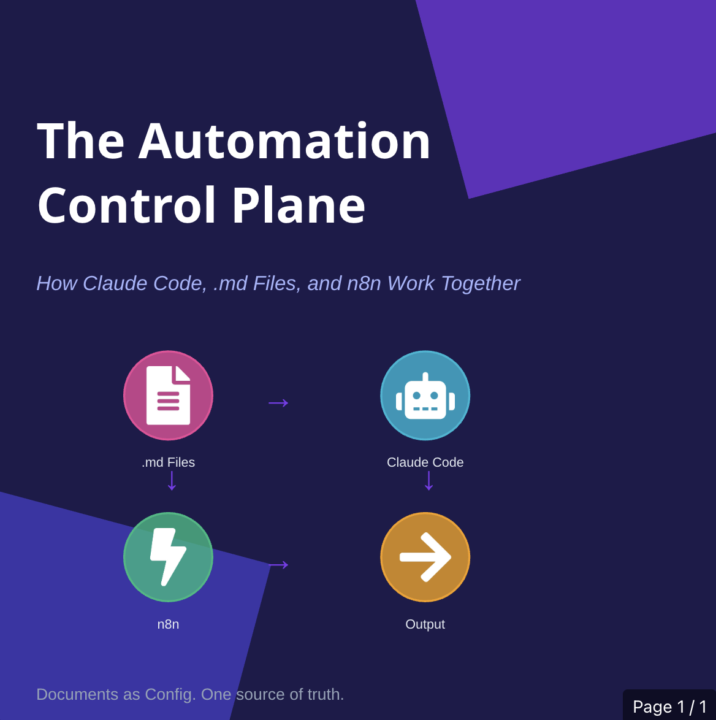
.MD+ ClaudeCode+ n8n = The Automation Control Plane
What if your documentation actually controlled your automations? Not described them. Not explained them after the fact. Controlled them. That's the shift: .md files become the source of truth. Claude Code reads them. n8n runs what Claude builds. Change the markdown, change the system. No more re-explaining context in every prompt. No more documentation that drifts out of sync within weeks. No more tribal knowledge that lives in one person's head. One place to define how it works. Everything else derives from there. TL;DR: - .md files = config, not docs - Claude Code = reads your rules, generates workflows - n8n = executes what gets built - Edit a document → system behavior changes - If you're tired of rebuilding the same patterns by hand, this is worth 10 minutes. Full article: Below⬇️
1 like • 1d
@Matthew Sutherland, I read your PDF today, almost 8 months after you posted it. Same question as yesterday. How much of this is still applicable today? My guess is that N8N doesn't play the same role, but I'm just guessing as I'm learning this. Whether the tools still play the same role or not, this seems like a solid, repeatable approach. Thanks!
0 likes • 8h
@Matthew Sutherland Thanks!!

Jan 18 •
GitHub 101: For Non-Tech People
See "check my GitHub repo" everywhere but have no clue what people are talking about? Same here. So here's a simple explanation. What is GitHub? Think Google Drive, but for code. The big difference: it tracks a detailed history of every change. Every save-point. Every edit. By who, when, why. Why do people use it? → Version control - Want to go back to yesterday's code? No problem. → Collaboration - Multiple people on the same code without chaos → Backup - Your work is safe online → Portfolio - For developers, their GitHub is their resume What is a repo (repository)? Just a project. Building a website? That's one repo. All code, files, and history in one place. The basic flow: Create a repo (new project) Write/change code on your computer "Commit" your changes (save-point) "Push" to GitHub (upload) Others can "pull" (download) and work with it Private vs Public This one tripped me up: → Private repo = only you (and who you invite) can see it → Public repo = everyone can see and use your code For client work: ALWAYS private. Their business logic, API keys, custom flows - that shouldn't be public. Best practices you need to know: → Use branches (parallel worlds for your code - test new features separately) → Write clear commit messages ("Fixed login bug" not "fix stuff") → Create a README.md (explains what your project does) → Use .gitignore (keeps passwords and API keys out of your repo) Practical example for AI automation: You're building an AI chatbot for a client: Create repo "client-x-chatbot" (private) Claude Code writes the code Push to GitHub after each feature Client gets access (transparency) Bug? See exactly what changed New client? Copy the repo and adjust Deployment story GitHub is often the middle step: Write code → Push to GitHub → Automatic deployment to production Platforms like Vercel or Netlify deploy automatically every time you push to GitHub. This is called CI/CD (Continuous Integration/Continuous Deployment).

0 likes • 1d
@Ai Stromae, thank you!

Jan 20 •
Working in Multiple IDEs Without Losing Your Mind (or Your Context)
Hey builders! 👋 I've been deep in the weeds figuring out how to organize my dev environment while working across Claude Code, Cursor, Windsurf, VS Code, and Google Antigravity — all on the same machine, often on the same projects. This was spurred by my upcoming switch from a Windows to Mac (arrives tomorrow 💻🤩) and a desire to have a clean dev environment before just dumping all of my project files onto it. The problem? Each IDE has its own config system, and without a clear folder structure, you end up with: - Project context bleeding between unrelated projects - AI assistants mixing up client/project information - Branding files scattered everywhere - No idea which version of a project is "current" The key insight is understanding how Claude Code loads CLAUDE.md files — it walks UP the directory tree. So if you accidentally put a CLAUDE.md in a parent folder, ALL child projects inherit it. Context leakage nightmare. I worked with Claude to design a folder structure that keeps everything isolated while still allowing shared global commands/skills across all projects. I attached a link to a full visual guide showing: - Exactly where each IDE stores global vs project config - The recommended folder hierarchy - The 5 critical rules to prevent context leakage - What each IDE actually "sees" when you open a project Multi-folder guide I put together with Claude 👉 https://admirable-centaur-607433.netlify.app/ 👈 Would love to hear how others are handling multi-IDE setups, and also get a sanity check on this one. Do you use a similar structure? Something totally different? Looking forward to hearing how you guys are doing this - thanks in advance for any insights! 🚀
0 likes • 1d
@Lutfiya Miller, I'm just going through this and learning in September 2026, so some things may have changed since your post. I'm guessing your system is humming by now. How's it going? Thanks for sharing this.

Mar 10 •
🤯Mishaps and Brain Twists: What ACTUALLY Happens When a No-Code Builder Installs Claude Code on Windows
Let me paint you a picture. 🎨 First, a little context about me. I am a low code/no code builder through and through. Lovable? That's my comfort zone. Claude Code? Open Claw? No, really — These terminal-based tools are about as far from my natural habitat as you can get. However. I've just finished binge-watching four Claude Code videos from Nate Herk in AIS+ and I am 🔥FIRED UP! These videos a great, and I am excited to get started. My interpretation of Claude Code is it's basically like having a senior developer living inside your terminal, building apps for you while you sip coffee. And the skills, the loops, all the good stuff I picked up from those videos — I am READY to put it all to work. I want that life. I deserve that life. So I go to install it. What I thought would happen: Type one command. Done. Sip coffee. What actually happened: A 2-hour odyssey involving Git Bash, hidden folders, PATH variables, and at least three existential crises. 🤷 😂 🛠️ The Setup: Windows Is Not macOS Here's the thing EVERYBODY tells you upfront — Claude Code loves Mac and Linux. Windows? Windows gets the "bless your heart" treatment. The official docs mention something called Git Bash, which is basically a way to trick Windows into pretending it's Linux. Fine. I install Git for Windows. Straightforward enough. Then I try to paste a command into Git Bash. Ctrl+V doesn't work. Right-click. Paste. Nothing. 🫠 Turns out you have to use Shift+Insert to paste in Git Bash. A fun little secret the universe decided not to tell me. The PATH Problem (A Love Story) After installing Claude Code, I type claude into Git Bash and get: bash: claude: command not found🤦 It installed. I can see the file sitting there on my computer. But my terminal doesn't know it exists. This is the computer equivalent of your friend standing right next to you while you call their name and they don't respond.

1 like • 2d
Wow, @Michael Wacht! I've felt your pain in other tech situations, but it's been a while. In 2010, I switched to a Mac and never looked back. Now I'm gonna try to build something new with Claude Code. Thanks for sharing your experience.
1-10 of 21

@kerry-doyle-4578
Marketing agency founder and operator for 35+ years. Exploring new ways to use AI.
Active 5h ago
Joined Feb 6, 2026
Detroit, Michigan USA
Powered by