Activity
Mon
Wed
Fri
Sun
Nov
Dec
Jan
Feb
Mar
Apr
May
Jun
Jul
Aug
Sep
What is this?
Less
More
AI Automation Society
463.3k
Free
AI Scaling
47
Free
20 contributions to AI Scaling

Feb 4 •
[Competition] Get Access Operations Scaling Coaching (For Free)
Each month I'll be gifting a top engaging members full and complete access to our $5000 flagship program (absolutely for free). I've charged $4000-10k/mo for helping owners and their teams scale, and I'm going to help the person whose the most engaged with their problem. This is perfect if you 1) Have a business you want to improve its revenue, profit, or enterprise value or 2) get the tools and training to found your own bottleneck scaling agency full time It includes 1) Full complementary "gold tier" membership ($4000/yr) to this Skool. Its the end product that we'll build, how to find, target and breakthrough bottlenecks in production, project management, and internal team management. Literally learn all of the systems. 2) One dedicated focus worksession with me (3h work block). It can be used to help you systemtize and make a business more profitable, or help you get clients or to have me co-work through whatever problem, or even spend that focus lab hanging out. Whatever you'd like. When you win, you can be as selfish as you want it to be with this time (within reason lol). 3) Permanent bragging rights ;) and the envy of your peers >>>> How to claim this prize <<<<< 1) Have the most engagement in the Skool community at the end of each calendar month (We'll screenshot the 1st of each month) and the top 10 on leaderboard get something good too (Secret) 2) OR Eventually get to level 6 (to access the coursework) before we make it paid. 3) All members that score above 100 points of engagement will get a bonus for trying >>> How do you level up? <<<<< Each like is worth one point -- so post, engage, comment. Make valuable posts. Share insight. Improve or test or iterate upon ideas, or poke holes at them. Do stuff, and share what works. Build relationships here, talk to others, if they like you they'll like your stuff (and vice versa). You could just leave comments on my posts, but test, do, seek, and share and you'll win. Off to the races :)
![[Competition] Get Access Operations Scaling Coaching (For Free)](https://media3.giphy.com/media/v1.Y2lkPTQ3ZDA4Y2UwZGFuYzF1dGJiMG92cXluZW12NTVhazJrYWVqNjZnbnNseWRldjl6MiZlcD12MV9naWZzX3NlYXJjaCZjdD1n/QJvwBSGaoc4eI/100.gif)

2 likes • Feb 4
Dont miss out on this guys @lurkers
Jan 28 •
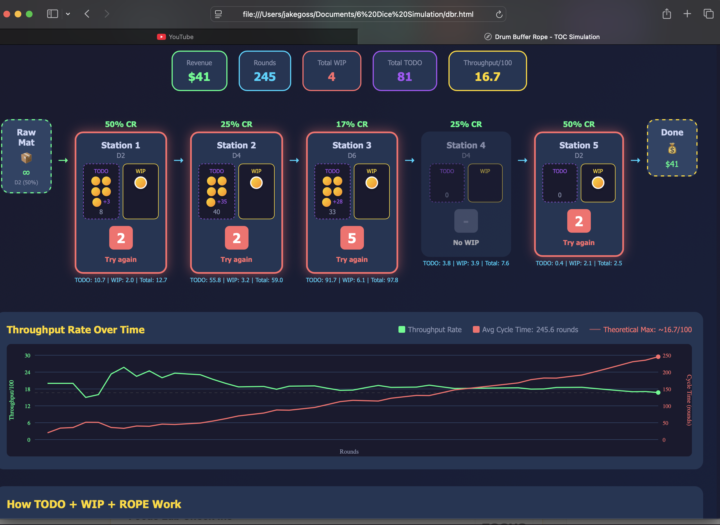
Why Doing More Actually Kills Your Business (The $0 Drum)
I built a simulation to prove something that sounds counterintuitive: working less can make you more money. Let me show you. (Pic related) The Simulation I created a game that models any multi-step production process—whether that's an agency, a community or a department like sales, ads, content, and especially fulfillment. Here's how it works: - Work flows through multiple stages (stations) - Each station rolls a dice to complete their task - Roll a 1? The token moves to the next stage's queue - If a token reaches the end, the team earns $1 The dice simulate real-world completion rates. A D6 (six-sided die) gives you a 17% chance per round. A D4 gives you 25%. This models the natural variation in how long tasks actually take. I ran two scenarios: Scenario 1: No Control (Push System)Everyone works as fast as possible. "Do more" is the mandate. Scenario 2: Drum Buffer Rope (Pull System)Work is synchronized to the bottleneck. The constraint sets the pace for everyone. The Results The throughput was basically identical. Read that again. Both systems produced the same output. Why? Because the bottleneck is the limiting factor. If your constraint is running at 100% capacity, the system literally cannot produce more. It's physics. But here's where it gets interesting: Same output. 10x faster delivery. Fraction of the resources. What This Actually Means Imagine cycle time is measured in days. Your sales team says "Yeah, it'll take about five days." That's technically true—five days of actual work time. But in the push system, clients are waiting 50 days because their project is sitting in queues behind hundreds of others. That 45-day gap is where: - Refunds happen - Reputation dies - All your marketing spend (ads, content, outreach) gets wasted - You get called a scammer - Not because you're evil. Because you neglected the client experience while chasing "more." The Trap Everyone Falls Into When things get backed up, here's what most founders do:
1 like • Jan 28
I have a question, in terms of service based businesses with multiple clients Usually the process is (1) Leads gets awareness about business (2) They book a call and get a quote (3) They pay (4) Team fulfills deliverables - for this example 1-2 weeks to fulfill it (5) waits for feedback (6) end So I realized the main drum (bottleneck) there is the fulfillment of deliverables because first the intake which is leads booking a call - we cant really stop people from booking a call I mean also yeah if we have resources, we could definitely hire more people and expand the number of teams to fulfill deliverables My question mainly is what is going to be your approach on this stuffs? like how would you control the people that wants your product but you are aware that you cant really fulfill them all at once especially with a growing amount of numbers - and as you mentioned above, people typically promises 5 days fulfillment to a client but it will take 50 days because of the number of stacked queues before them
Jan 21 •
The Strategist Plans the Route When It's Sunny
I had a conversation with James Lim, a productivity guru an hour ago with a problem that's been rattling around in my head for a few months. We were talking about productivity systems—shocking, I know—but he said something that hit different: "The strategist makes a map when the day's dry, but when it's wet and you're late, you beat yourself up. When has it ever worked to never get lost?" I've been thinking about that a lot. The Problem With Only Planning for Peak Performance Here's what I've been doing wrong: I map out my ideal week. I look at all the areas of my life and work—content creation, client calls, health, fitness, sleep—and I design what peak performance looks like in each one. Four focused hours on scripting. Daily workouts. Eight hours of sleep. Perfect meal timing. Structured prospecting calls. And you know what? It works great. For about three days. Then I have a bad night's sleep. Or a client call runs long. Or I get sucked into a research rabbit hole. And suddenly, I'm behind. The strategist's perfect plan starts crumbling, and the performer (the actual me, sitting here at 11pm, tired and scattered) feels like a failure for not keeping up. James introduced me to this concept of upper and lower control limits—borrowed from quality control charts, of all things. The idea is simple but profound: The upper limit is what the strategist wants. The lower limit is what the performer needs to maintain baseline function. Why the Gap Matters The problem with focusing solely on peak performance is that you create a binary: either you're crushing it, or you're failing. There's no middle ground. No grace. No acknowledgment that sometimes you're operating at 60% capacity, and that needs to be okay. When you only have an upper bound, you're essentially telling yourself: "Perform at 100%, or you're not performing at all." And the moment you drop below that, the whole system collapses. You stop tracking. You stop showing up. Because if you can't do it perfectly, why bother doing it at all?
2 likes • Jan 23
Just woke up and read this gold mine, (1) Honestly I have a lot of things to say - and number 1 is that I'm just really so blown out but the QUEST framework by the fact that it can be applied to almost anything 😂🔥 (2) In terms of planning our week - adding this time block and all that and planning our day where we try and work at 100% making it binary as you mentioned is basically like making a car with a redline - then assuming that everyday we need to redline always (3) I like the analogy in business, health, and other areas of life where they have grace they are not binary based unlike that way we first plan out are routine and calendar - so why not apply it also there right? (4) Track inputs not outputs is such a game changer - one of the reasons we spend a lot of hours on a day (which will destroy the whole chain of routine - which will then keep us behind) is because we are setting a specific goal in terms of what should the output be of your work by the end of the day - rather than being "oh spend 4 hours of productive work here on this field, but time for the next routine" So yeah - Imma try to implement this also for me especially I have a filled out calendar and routine built Thanks for this Jake!
Jan 22 •
> Focus Lab Check Ins
When you complete a focus hour (5,50,5), celebrate what you did with a comment. (Here's the deck https://docs.google.com/presentation/d/1wdzpZKQEh0ac2tZB_4qd9I3e2AYmIw3ejZB-4oeQrnw/edit?usp=sharing) Feel free to answer in this modern Scrum way 1) What have you done 2) What are you doing next 3) Are you stuck or blocked?

2 likes • Jan 22
Im joinin in! imma try and finish everything on my side of tasks
Jan 18 •
Pareto Charts & How to use them
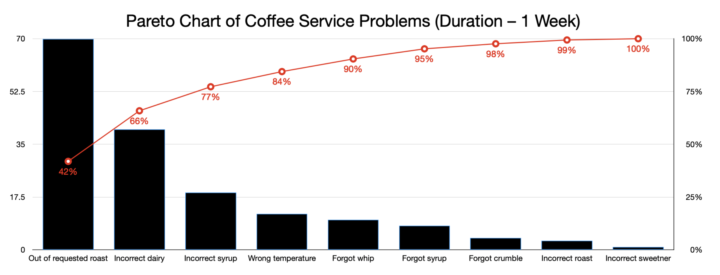
You've heard of the phrase "20% of the work gives 80% of the results" and thats the only thing people know of Pareto, an Italian polymath from the 1800s. But Pareto developed this as a framework to identify problems, and treat them at their source. The inverse of this is 20% of the problems block 80% of the results. Check pic related, as an example for coffee service problems or one for a company with undesirable customer service. As you make one, you're putting this under the Solve Problems board -- so people can see what are the problems within that department, preventing each QUEST from staying ontrack. Each day (under a daily tracker) if the day, process, department, project, etc is not green (E.g. is off track), then you increase a simple tally mark of what caused it... if its a new root cause, you increase it by one. If a problem has multiple sources, then you also increase those by one. At the start (or end of the day) a person can just answer "why didn't we hit the goal today" and then log down the reason why with a simple +1 tally mark. The bar chart is simply what is the % of frequency over the total of 100%, thats it. This translates to the bar chart, and over time we see that one problem source is the one that is the most frequent (the vital few). So you solve for that -- and suddenly the bottleneck from that stops, the dosage of the project was effective and solved it, and starts to trend downward as others start to trend upward. I've been working out of a writing/journaling version of this, I'm not quite tally marking as we go but making daily reflections and writing why, and then I realized that I keep repeating or updating myself that I have this problem and I'm working through it. But to condense it down, in a single chart, per Quest to say "why did we not post 1X today" -- oh because I took the day off, or I had too many things I otherwise wanted to do, or I wasn't focused, etc can go down deeper to a unified root cause of "lack of discipline"... Suddenly this was a huge 100% of reasons.
2 likes • Jan 18
This chart is utterly helpful! - I realized that many businesses or even people themselves write down mistakes or problems that they face constantly on a frequent basis but never really tally down on how much it happened (e.g. oh this happened okay let's write that down on the "what happened" list - rather than "oh this happened - okay tally it down, then oh it happened again - tally it down again") As I go my way around this community and the lessons you've been teaching - suddenly analytics, metrics, KPIs are starting to look real juicy 😂 - back then those kinds of charts bores me but when I started working with a client and especially when I started learning here - I am now realizing the significant value it gives!
1-10 of 20

@kenzie-alangilan-5137
I build and document real automation systems using GHL, Make, and n8n while learning in public.
Active 188d ago
Joined Jan 5, 2026