Activity
Mon
Wed
Fri
Sun
Aug
Sep
Oct
Nov
Dec
Jan
Feb
Mar
Apr
May
Jun
What is this?
Less
More
Owned by Kenyetta
Free sewing community with Ms. K. Clear lessons, troubleshooting, and skill drills for beginners and returning sewers.
Memberships
Lisa’s Sewing Shop & Learning
55 members • Free
AI Clarity for Professionals
5.4k members • $17/month
10 contributions to Sewing with Ms. K

Mar 8 •
Improve Sewing Skills
Hello, thank you for allowing me to join your group. I am trying to improve my sewing skills. Looking forward to leaving with you all.

0 likes • Mar 9
Welcome Margaret
Feb 14 •
Zippered Pouch Instructions.
Here are the instructions and supply list for our Mini-Make Session. Join along or simply watch to get inspired. --- Student Supply List (Small Zippered Pouch) Required Materials Fabric (2 pieces) Outer fabric:** 2 pieces, 8" x 6" Lining fabric:** 2 pieces, 8" x 6" Interfacing (recommended)** Fusible interfacing or fleece: 2 pieces, 8" x 6"(for outer fabric) Zipper 1 zipper, 9" (nylon coil is easiest for beginners) Thread All-purpose polyester thread Tools • Sewing machine • Fabric scissors or rotary cutter + mat • Pins or clips (clips are easier near zippers) • Seam ripper (everyone needs one!) • Ruler or measuring tape * Fabric marker/chalk • Iron + ironing surface • Zipper foot** (recommended, but not required if machine can stitch close to zipper) Optional but helpful • Hand sewing needle (for quick fixes) • Topstitching thread (if you want bold stitches) • Zipper pulls (if using zipper tape by the yard) --- Instructor Sheet (Beginner Zippered Pouch) Project Small Lined Zipper Pouch (fully enclosed seams) Skill focus: zipper installation, lining, turning, topstitching Cut List (per pouch) * Outer fabric: **2 @ 8" x 6"** * Lining fabric: **2 @ 8" x 6"** * Interfacing (optional): **2 @ 8" x 6"** * Zipper: **1 @ 9"** ### Seam allowance + settings * **Seam allowance:** **3/8"** * **Stitch length:** **2.5 mm** (normal) * **Topstitch length:** **3.0 mm** (optional) * Press as you go. A pressed pouch looks “store-bought.” --- ### Prep (2–4 minutes) 1. If using interfacing, **fuse** it to the wrong side of the **outer fabric pieces**. 2. Make sure zipper works smoothly. **Open zipper halfway** before final stitching (important). --- ### Step 1 — Attach zipper to first side (Right sides together) 1. Place **Outer fabric** right side up. 2. Place zipper **right side down** along the **8" edge** (zipper tape aligned with fabric edge). 3. Place **Lining** right side down on top (like a sandwich): * Outer (bottom) + Zipper (middle) + Lining (top)
0
0
Feb 13 •
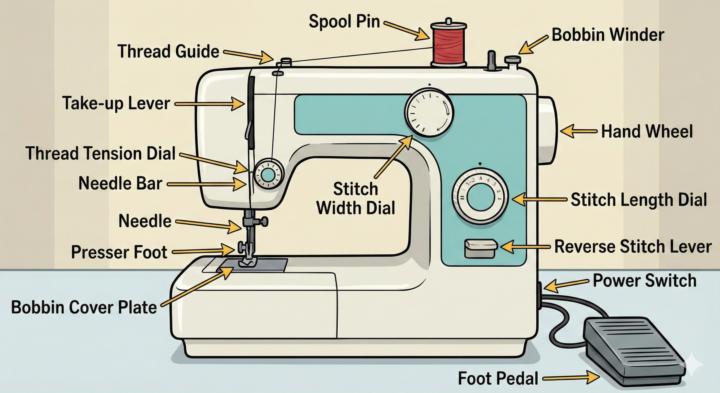
🧵 Sewing Machine Parts: Quick Map (So You Stop Guessing)
If a sewing machine ever felt “intimidating,” it’s usually because the parts have names… and nobody explained them in plain language. Here’s your simple map. Save this post — we’ll reference it often. ### 1) Spool Pin Holds your spool of thread (the top thread starts here). ### 2) Thread Guide Little checkpoints that keep the thread traveling the correct path. ### 3) Take-Up Lever This is the thread “elevator.” It pulls the thread up and down so stitches form correctly. **Tip:** Always start threading with this at the top. ### 4) Thread Tension Dial Controls how tight the top thread pulls. Too tight = puckering. Too loose = loops. ### 5) Needle Bar + Needle The needle bar holds the needle and moves it up/down. The needle does the piercing and stitch-forming. ### 6) Presser Foot The “hand” that holds fabric down while you sew. No presser foot down = messy stitches. ### 7) Bobbin Cover Plate The door that covers where your bobbin sits (bottom thread area). ### 8) Bobbin Winder Used to fill your bobbin evenly with thread. ### 9) Hand Wheel Turn this **toward you** to raise/lower the needle by hand. ### 10) Stitch Length Dial How long each stitch is. Short = stronger/denser. Long = basting/looser. ### 11) Reverse Stitch Lever Sews backward to lock your stitches at the start and end. ### 12) Power Switch + Foot Pedal Power switch turns the machine on. Foot pedal controls speed. --- ## ✅ Quick Challenge (Do this today) Comment with: 1. The **3 parts** you recognize right now 2. The **1 part** you want me to explain next Example: “Spool pin, presser foot, needle — I need help with tension dial.” Next post: I’ll explain **threading order** (the #1 reason machines “act up”).
0
0
Feb 9 •
Still stuck? Post here (After GPT)
Start with our pinned Sewing Assistant GPT for quick troubleshooting. If you’re still stuck after trying the first fix, post here and I’ll help. To get a fast diagnosis, include ALL of this: • Machine brand/model (or a clear photo of the front) • Fabric type (cotton/denim/knit/etc.) • Needle type/size + thread type (if known) • Stitch setting + stitch length • Clear photos of your stitches: TOP side + UNDER side. What have you already tried (re-threaded? new needle? reloaded bobbin?) Common issues welcome: birdnesting, looping, tension, skipped stitches, thread breaking, uneven seams, jammed bobbin. Comment with your info + photos and I’ll reply with the first fix to try..
1
0
Feb 5 •
Ms. K — Sewing Assistant (Beginners))
Need help, I am here to assist! Simply click the link for simple troubleshooting questions and fixes. https://chatgpt.com/g/g-6983e4c6ef3481919eb51be771db6730-ms-k-sewing-assistant-beginners . If the GPT doesn’t solve it: Post your issue in the Help Desk pinned post with photos of stitches (top + underside) + machine/fabric/needle/thread/settings.
0
0
1-10 of 10
@kenyetta-caldwell-2745
Hey, I’m Kenyetta—your sewing coach in your pocket. ✂️🧵 Tips, fixes, fit help & community support. Let’s sew!
Active 115d ago
Joined Jan 19, 2026