Activity
Mon
Wed
Fri
Sun
Nov
Dec
Jan
Feb
Mar
Apr
May
Jun
Jul
Aug
Sep
What is this?
Less
More
Bedrock Nation
177
Free
16 contributions to Bedrock Nation

Apr 17 •
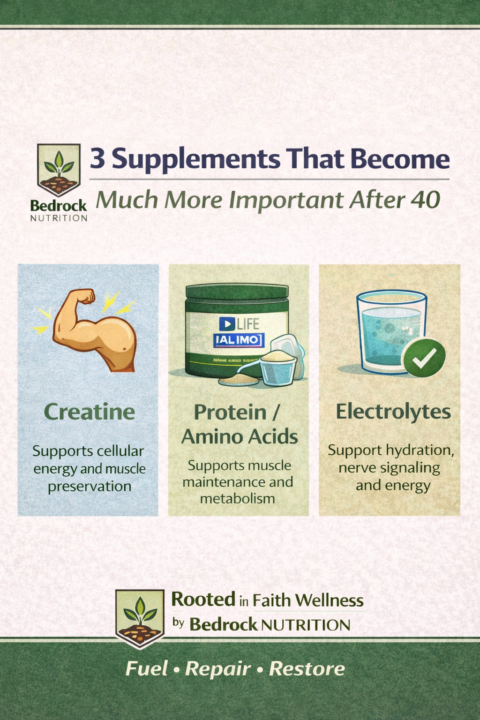
Part 1: The 3 Supplements That Become Even More Important After 40
One of the biggest shifts that happens after 40 is not just hormonal… It’s metabolic and muscular. Many men & women notice: • slower recovery• increased fatigue• more difficulty maintaining muscle• changes in metabolism• brain fog or lower resilience to stress While lifestyle is always the foundation, there are a few key nutritional tools that can make a meaningful difference when used appropriately. Three in particular stand out. 1️⃣ Creatine For decades creatine was treated as a bodybuilding supplement. But research has increasingly shown that creatine plays a much bigger role in the body. Creatine supports cellular energy production by helping regenerate ATP — the energy molecule every cell depends on. This is important for: • muscle strength and recovery• mitochondrial function• brain energy metabolism• fatigue resistance• healthy aging Your brain alone uses more than 20% of your body’s energy, and creatine helps support that demand. If you want to go deeper on this topic, read this post: 👉 Creatine Is Not Just for the Gymhttps://www.skool.com/bedrock-nation-8489/creatine-is-not-just-for-the-gym?p=6421708f 2️⃣ Protein / Essential Amino Acids Muscle preservation becomes increasingly important with age. After about age 35–40, we naturally begin losing muscle mass if we are not intentionally supporting it. Adequate protein intake helps: • maintain lean muscle mass• support metabolism• stabilize blood sugar• support recovery and repair Many people struggle to hit their protein targets, especially early in the day. This is one reason I often recommend essential amino acids in the morning as an easy way to support muscle protein synthesis and help people reach their daily protein goals. 3️⃣ Electrolytes Electrolytes are one of the most overlooked pieces of metabolic health. They play a critical role in: • hydration• nerve signaling• muscle contraction• energy production• blood pressure regulation

0 likes • Aug 19
I use I.AM.AMINO in the morning when I first get up. I use LOAD mid day mixed in a hydrate.
Jul 18 •
7/18/26 Food For Faith: Finding Faith in Tragedy
On 6/30/26, my 33 year old brother, Daniel, died unexpectedly in a tragic car accident. There are moments in life that simply don't make sense. As Christians, we often want answers. We want to understand why tragedy happens, why prayers seem unanswered, and what God is doing in the middle of our pain. But sometimes, this side of heaven, those answers don't come. In this week's Food for Faith, I'm sharing from a very personal place—not because I have everything figured out, but because I believe faith isn't about having all the answers. Faith is choosing to trust God's character when we cannot understand His plan. The Bible is filled with people who walked through suffering, loss, and uncertainty. Joseph. Shadrach, Meshach, and Abednego. Even Jesus in the Garden of Gethsemane. Their stories remind us that God's greatest work is often happening in the moments that make the least sense to us. Romans 8:28 tells us that God works all things together for good for those who love Him—not that all things are good, but that nothing is beyond His ability to redeem. If you're walking through grief, heartbreak, disappointment, or a season that has left you asking "Why?", I pray this message encourages you. 📖 Scriptures referenced: • Isaiah 55:8–9 • Romans 8:28 • Genesis 50:20 • Daniel 3:17–18 • Matthew 26:39 I'd love to hear from you in the comments: Has there been a time when you couldn't see what God was doing, but later recognized His faithfulness? May this week's Food for Faith remind you that even when life doesn't make sense, God is still good, He is still present, and He is still writing a story that isn't finished yet.

1 like • Jul 19
I am so sorry for your loss. Not knowing is so hard and painful for us in this world. Someday in heaven I hope you find out abd you will see him again. 💜
Jan 3 •
Bedrock Reboot Course Discussion Post
This post will be a place where those participating in the Bedrock Reboot Classroom, can post their journal entries, as well as their assignments, including their day 34 before and after "wins."
2 likes • Feb 1
Day 1 for me, cleaned out house yesterday and today. Started detox box today. Carnivore
0 likes • Feb 4
@Leanna Cappucci not yet, but I will be doing it soon. Getting everything in the house prepared for the fasting.
Jan 16 •
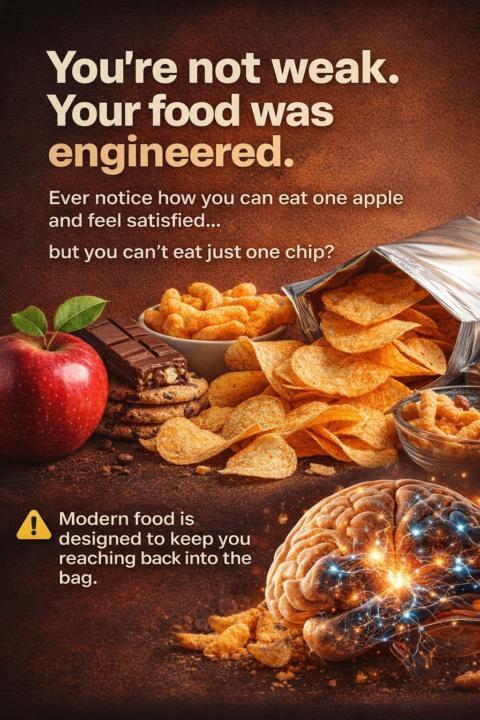
THEN vs NOW: (Part 1) How 150 years of “modern food” quietly rewired human biology
Did humans suddenly require processed grain at 8:00 AM to survive?Or did we get handed a story—and build our daily life around it? The “Breakfast” story (and why it mattered): The idea that “breakfast is the most important meal of the day” didn’t come from ancient wisdom—it was heavily amplified by modern marketing. A widely cited example is a 1940s General Foods campaign used to sell cereal and promote a “good breakfast” as a performance requirement for work and school. To be clear: humans have always eaten in the morning sometimes.But the mandate—“eat immediately, eat carbs, eat packaged”—is modern. THEN (human default): For most of human history, food was: - Seasonal + local - Protein-forward (when available) with fibrous plants - Naturally time-restricted (periods of scarcity were normal) - Minimal ingredients (because “ingredients lists” didn’t exist) Your nervous system was designed for alertness when hungry (“hunter mode”).That’s not starvation—that’s adaptive biology. NOW (the modern food environment): Over the last ~150 years, the biggest shift isn’t that we eat more.It’s what we eat—and how engineered it has become. 1) Ultra-processed food became the default Today, over half of calories in the U.S. come from ultra-processed foods. And historically, processed/ultra-processed foods rose from under 5% to over 60% of the food supply across the last two centuries. Ultra-processed = food designed for shelf life + hyper-palatability, not human thriving. 2) The rise of “always eating” We went from “eat when you can” to structured grazing: - breakfast snack - lunch snack - dinner dessert Constant stimulation → constant insulin signaling → constant appetite noise (for many people). 3) The metabolic disease curve didn’t come out of nowhere Adult obesity prevalence is now around 40% in the U.S. That’s not a willpower failure. That’s an environment failure. And yes—many things contribute (stress, sleep, toxins, sedentary life, meds, etc.).But food is the daily signal that hits your hormones, gut, brain, mitochondria, and immune system.
2 likes • Jan 17
Growing up I hardly ate breakfast. Then when I married and had children I was very nieve and believed that we needed 3 meals a day🫠. Now I look back and realize what an idiot I was. I have learned so much from @Leanna Cappucci . Thank you for sharing your knowledge! ❤️🙌
2 likes • Jan 18
@Cindy Williams my family did the same with 8pm snack before bed.
Jan 16 •
Then Vs Now (Part 2): 5 Food Stories We Inherited (and How to Rewrite Them)
Most of us aren’t making “food choices.”We’re living inside food stories—handed down by culture, marketing, school, and convenience. Here are five of the biggest ones… and the rewrite that sets you free. 1) The Story: “Breakfast is the most important meal of the day.” What it trained us to do: eat on the clock, not on cues—often starting the day with sugar + starch. Rewrite:“Metabolic flexibility is the goal—not mandatory morning carbs.”Some people do great with breakfast. Some do better delaying it. The win is choosing based on your body, not a slogan. Try this: - If you eat early: make it protein-first (eggs, meat, yogurt, collagen + protein, leftovers). - If you’re not hungry: don’t force it—start with water + minerals, then eat when hunger is real. 2) The Story: “Snacking keeps your blood sugar stable.” What it trained us to do: graze all day → constant insulin signaling → cravings never fully shut off. Rewrite:“Stable blood sugar comes from strong meals, not constant eating.”Many people stabilize when they shift from snacks to real meals. Try this: - Build 2–3 anchored meals (protein + fiber + fat). - If you “need” a snack: choose protein (jerky, eggs, Greek yogurt, cottage cheese, meat sticks). 3) The Story: “Low-fat = healthy (and saturated fat is the villain).” What it trained us to do: fear real food fats → replace them with ultra-processed “low-fat” products loaded with sugar, thickeners, and industrial oils. Rewrite:“Whole-food fats are functional. Ultra-processed swaps are the trap.”Your hormones, brain, and cell membranes need real building materials. Try this: - Choose: olive oil, avocado, butter/ghee, tallow, coconut (as tolerated). - Reduce: “low-fat” products that compensate with sugar + additives. 4) The Story: “Whole grains are a required health food.” What it trained us to do: treat grains as a foundation—even when they spike cravings, bloat the gut, or wreck energy. Rewrite:“Carb tolerance is individual. Essentials are protein + micronutrients.”Some thrive with certain carbs. Many don’t—especially with insulin resistance, PCOS, fatty liver, autoimmune issues, gut inflammation, or perimenopause.
1 like • Jan 17
Story 2, it used to be constant snacking
1-10 of 16

@karen-dewolf-4648
Follower of Jesus❤️. Married to Dan since 2014. I have 2 sons Anthony and Jonathan, and 2 stepdaughters Kamryn and Danielle. 2 cats Mo and Rini
Active 38d ago
Joined Nov 10, 2025
Northwestern Pennsylvania