Activity
Mon
Wed
Fri
Sun
Nov
Dec
Jan
Feb
Mar
Apr
May
Jun
Jul
Aug
Sep
Oct
What is this?
Less
More
Law of Assumption Mastery
111
5.0
$69/m
4 contributions to Understanding Neville Goddard

Aug 30 •
Victim mode
WHAT IF YOUR PAIN BECAME PART OF WHO YOU ARE? She was a widow. Two years had passed since she lost her husband. Slowly, she had found her way back into a normal routine. She had people around her who loved and supported her. Life had started to feel manageable again. Romance wasn't even on her mind. In her mind, love had ended when her husband died. Then she met someone. He had experienced a similar loss. He understood things other people couldn't. He started getting closer to her, and she liked him. And that's where something unexpected happened. Because if she allowed herself to fall in love again, something inside her would have to change. For two years, she had been the woman who lost her husband. The woman who survived something devastating. The woman everyone protected, supported and felt sorry for. Her grief had become part of her identity. So what happens when the woman who has been grieving suddenly has something beautiful to look forward to? Who is she then? She couldn't answer that. So she stayed attached to the story she already knew. The relationship didn't happen. He eventually walked away. And strangely enough, his leaving gave her something familiar again. Pain. Proof that she was right to stay where she was. Proof that love really wasn't for her anymore. Her victim identity had been reinforced. And this is where we need to be careful with the word victim. Being a victim of something terrible is real. Making the pain your permanent identity is something different. You can honour what happened to you without making what happened to you the definition of who you are. Sometimes the hardest part of healing isn't releasing the pain. It's releasing the version of yourself that was built around the pain. Because when you have spent years being the abandoned one, the betrayed one, the widow, the unlucky one, the one who always gets hurt... who are you when life finally gives you something good? This is where Neville Goddard's work becomes uncomfortable.


1 like • Aug 30
This is powerful and definitely something for me to look more closely at❤️
Jul 11 •
EYPO
"Everyone Is You Pushed Out." This is probably the most misunderstood teaching Neville Goddard ever shared. It also took me the longest to accept. When I first heard it, I felt uncomfortable. My immediate thought was, "So you're telling me that if someone hurts me, I created that?" I rejected the idea for a long time because it sounded like blame, and I'd already spent enough of my life blaming myself for things that weren't my choice. Then I went back to Neville's lectures and started paying closer attention. He wasn't saying that people don't have free will or that painful experiences should be excused. He was teaching that the version of ourselves we consistently identify with influences the way life is reflected back to us. If I keep seeing myself as someone who is overlooked, abandoned, criticised, or never enough, those assumptions become familiar. They shape my expectations, my reactions, and the roles people naturally play in my experience. When I started changing my self-concept instead of trying to change other people, something unexpected happened. Certain people began treating me differently. New people entered my life. Some relationships quietly disappeared because they no longer matched who I believed myself to be. That was the moment Neville's teaching stopped being a theory and became something I could actually see. "Everyone Is You Pushed Out" isn't an invitation to blame yourself. It's an invitation to become aware of the story you're living from, because that story is always expressing itself through your experience. You don't change your life by controlling people. You change your life by changing the person who is experiencing it. Have you ever tested this teaching for yourself, or is it still the one that feels hardest to believe?

1 like • Jul 11
The way this makes sense!
Jun 16 •
Beliefs
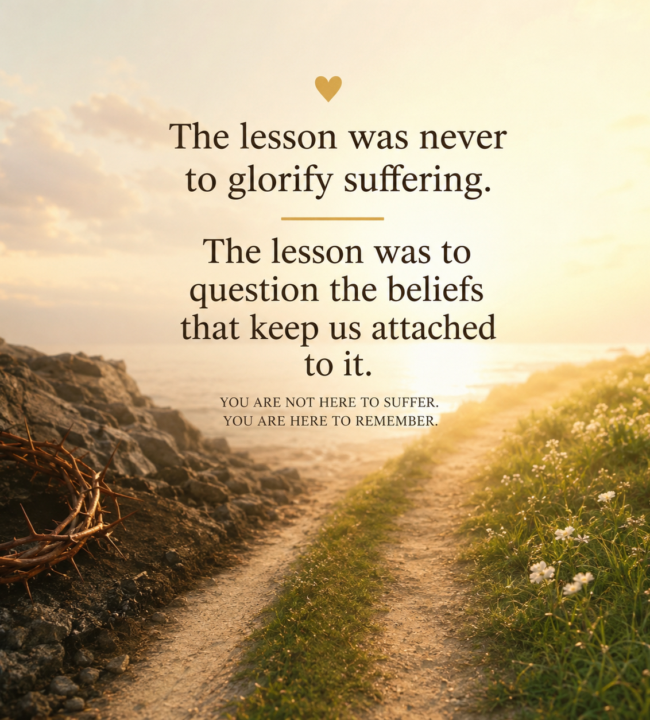
Story time again. Growing up in a religious community, I was taught that life should be lived through pain and suffering because that's what Jesus did. Without realizing it, I turned that belief into a way of living. Whenever happiness appeared, I felt uncomfortable with it. When money flowed, I found ways to return to scarcity. When love was offered, I questioned it, sabotaged it, or pushed it away. Looking back, I can see that I was simply living from the assumptions I had accepted as true. But when I started reading the Bible for myself, I noticed something interesting. Most of Jesus' life wasn't about suffering. It was about challenging beliefs, healing people, teaching faith, and showing others what was possible. He repeatedly told people that they could do what he did and even greater things. Neville Goddard taught that the Bible is a psychological drama unfolding within us. From that perspective, Jesus represents the awakened awareness of who we really are. So what if the lesson was never to glorify suffering? What if the lesson was to question the beliefs that keep us attached to it? Many of the limitations people live with today aren't facts. They're inherited assumptions that were never examined. The moment I started questioning mine, my life began to change.
1 like • Jun 16
Sounds like me💕
Jun 2 •
Instant manifestation
This is too beautiful not to be shared. As I've mentioned before, I have two children, a boy and a girl. On Sunday, we bought a new bike for my son. The moment my daughter saw it, her little face lit up. She was so happy for her brother, telling him how beautiful it was and how much she loved it. My son went outside to show it to his friends, and that's when something happened that completely melted my heart. My daughter is only three years old. She doesn't have the filters, doubts, or limitations that adults learn over the years. She started singing about how much she loved her pink bike. The only problem was... she didn't have one. Yet there she was, picking flowers and carefully placing them on her imaginary bike. She was riding it around the garden, smiling, laughing, completely immersed in the experience. She wasn't asking for a bike. She wasn't complaining that she didn't have one. She wasn't focused on what was missing. In her little world, the bike already existed. She was enjoying it before she could see it. My husband and I stood there watching her, both of us in tears. Not because she didn't have a bike. But because we were witnessing something so pure that most adults have forgotten how to do. She wasn't hoping. She wasn't waiting. She wasn't checking whether it was coming. She was simply living in the feeling of already having it. So we got in the car and bought her one. And only after we came home with her beautiful pink bike did it hit me. This is what Neville Goddard was trying to teach. Children don't struggle with imagination because they don't argue with it. My daughter didn't manifest a bike because she wanted one. She manifested it because, in her heart, she already had it. Sometimes the greatest lessons don't come from books, coaches, or techniques. Sometimes they come from a three-year-old girl riding a bike that only she could see. Until everyone else saw it too.

1 like • Jun 2
I love this! Of course, I have a story for you too!
1-4 of 4

Active 53m ago
Joined Apr 5, 2026