Activity
Mon
Wed
Fri
Sun
Oct
Nov
Dec
Jan
Feb
Mar
Apr
May
Jun
Jul
Aug
Sep
What is this?
Less
More
Agent Empire
1.7k members • Free
AI Architects
818 members • Free
Build Market Close
563 members • Free
Clief Notes
48.1k members • Free
377 contributions to Clief Notes

1d •
Machine Gun Rabbit is live... Built with Claude Code, hosted free...
Built a live website for my band with Claude Code and GitHub Pages, and the thing that stuck with me was how much the planning mattered more than the coding. I started with the Github... https://jdvanleenen-sys.github.io/machine-gun-rabbit/ Then got a domain... Optimized using @Ry Mac methods... Now live! www.machinegunrabbit.com It's a one-page site for Machine Gun Rabbit, my band out of Calgary (party band, From ABBA to AC/DC...). It's for people who catch a show or find us on Instagram: it shows where we play, the set, the band, and points them to follow or book us. Biggest takeaway: the win wasn't speed, it was locking the brand before building. I had a real brand guide done first, so when Claude Code built the site it matched the band instead of guessing. Deploying from the terminal was also simpler than I expected. New repo, push, flip on GitHub Pages, live URL in about a minute. Because the asset paths were relative, the CSS didn't break on the live site the way it can.

1 like • 1d
Well done sir!

1d •
Which AI Governance segment are you most interested in?
1.AI governance as a business function, not just compliance. 2.The regulatory landscape - EU AI Act risk tiers, US sectoral rules, and any local requirements. 3. Role clarity: provider vs deployer vs modifier. 4. Risk-based classification of AI use cases - not all AI use carries the same stakes. 5. Human oversight requirements. 6. Data provenance and IP exposure 7. Model accountability chains 8. Transparency and disclosure obligations 9. Incident response for AI failures 10. Governance as an iterative process, not a one-time policy
1 like • 1d
@Nuno Silva I don’t think I’m saying they’re not relevant. I’m just saying make the correlation in the post because governance can cover a very broad Spectrum I think maybe you’re reading into what I was saying and maybe I’m reading into what you’re reading into what I’m reading just saying so it’s all good.
1 like • 1d
@Nuno Silva I just have so much going on that like when I read something like that it just takes me into so many different places so having a little bit more focus on where my brain is supposed to go is helpful. Caïus governance lives at all different altitudes, and by his own statements, he’s focused on executives and helping them understand governance and fundamentally that’s not the right altitude for ICM.

Jul 10 •
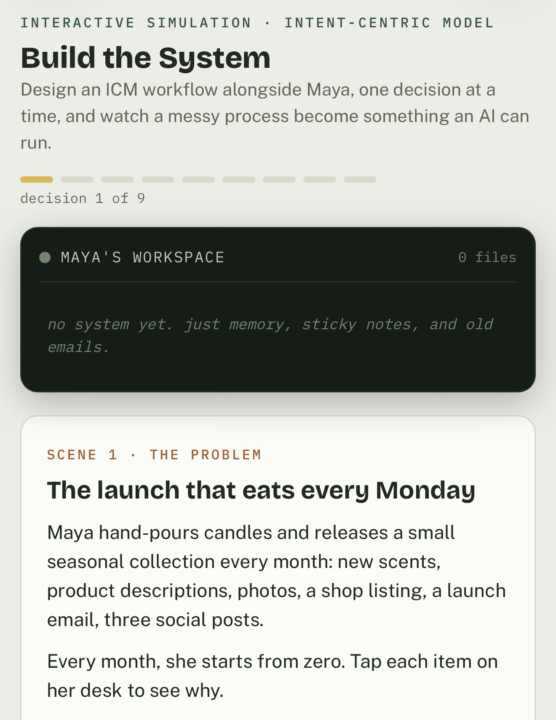
New to ICM? Get hands on learning experience here
Step-by-step interactive guide from idea to output. Design an ICM workflow alongside Maya, one decision at a time, and watch a messy process become something an AI can run again and again. Right now, Maya has to try to remember what needs to be done and where each piece of information is kept. She needs a better solution. https://claude.ai/public/artifacts/7c9618f4-8324-4048-902c-cbcf77c9c102 Let’s build one with her. 😀
1 like • 1d
Very well done Carla. Your level 7 chops are shining!
0 likes • 1d
@Carla Bosteder Dm is always open

👑
7d •
New Workflow Audit
Built a guided way to turn work you know by heart into something you and your AI can actually use. generates a HUGE packet for you. Workflow Audit Package - The Vault · Clief Notes This is inspired by something I do in my Corporate workshops and also wanting to build something sustainable to help out the Premium and VIP members. Start with a copy-and-paste interview prompt: your AI asks one question at a time about what comes in, what you do, where things get messy, what goes out, and the decisions you want to keep. It works for business owners, consultants, subject matter experts, creators, or anyone with a recurring task they want to understand and improve. You can answer in rough words or by voice; no technical background is needed. Once you have checked the interview, give it to the included builder skill with the blank HTML template. Your AI audits the answers and creates a detailed, editable workflow package with a map of your work, evidence for where improvement could matter, open questions, practical prompts, and a recommended folder structure based on ICM: ordinary folders and readable files that give the AI the right context at each step. Open the package in your browser, correct anything it got wrong, download your copy, and use the first-test plan on a completed example you can check. Everything you need to start is in the kit; the start guide explains both copy-and-paste and file-upload options. Workflow Audit Package - The Vault · Clief Notes

0 likes • 2d
@Kylie Monarreshi already
0 likes • 2d
@Kylie Monarres you just went to level three in like two seconds
2d •
HELP! I Didn't Automate My Inbox Yet. I am Building the Foundation First...
I don't have a real automation running yet. My days are all different, so I didn't have one email task that I could record and repeat. I went a different way instead. I set up a Claude Desktop Project for my email and calendar, and I'm doing some homework before I automate anything. What I put in it: - I gave it my rules for what Claude can and cannot touch. - I told it how I want my replies to sound. - I listed the key people whose emails always stay manual. - I saved my go-to replies. - I wrote out the daily routines I run. What I plan to automate, with my approval: - I want it to summarize my unread emails so I can see what needs attention. - I want it to draft my routine replies, like a decline, a thank you, or a note saying I'll get back to someone next week. - I want it to block focus time on my calendar. - I want it to read a scheduling email and offer back the times I'm free. What stays manual: - I handle anything about money, invoices, or contracts myself. - I handle anything legal myself. - I handle emails from key clients myself. - I handle personal or sensitive conversations myself. My guardrails: - Nothing sends without my approval. Claude drafts the reply, and I send it. - I keep "Ask before acting" turned on, so it checks with me before it does anything. - It archives instead of deleting. If Claude got something wrong and it would cause real problems, I keep that task manual. What's next: I'm running a deep research pass on what actually works for people who want less time in email but still can't miss the important things. After that, I want to turn my setup into a skill so it runs the same way every time. The Project is the starting point, and I'll share what I find. I am open to ideas! Let me know what works for you.
2 likes • 2d
I was half kidding
2 likes • 2d
I just set the rules on the boundaries and on the profiles and then I just set up my Kron jobs and let them rip
1-10 of 377

Online now
Joined Aug 2, 2026
INTP
Powered by