Activity
Mon
Wed
Fri
Sun
Feb
Mar
Apr
May
Jun
Jul
Aug
Sep
Oct
Nov
Dec
Jan
What is this?
Less
More
Owned by John
Get serious about peptides! Stack Tracker + community: The best price on the most advanced peptide tracking app & join the elite bio-hacker network.
Memberships
Longevity and Biohacking Labs
212 members • Free
Biohacking Elite
255 members • Free
Hub Biohackers International
98 members • Free
Peptide Association Community
884 members • Free
The Longevity Alliance
553 members • Free
Tony Huge Evolution
3.6k members • Free
Precision Health w PA Courtney
133 members • Free
Biohackers Buyers Club
101 members • Free
Good Looks Plus Shenanigans
730 members • Free
9 contributions to Tony Huge Evolution
18d •
⚠️ Risk — Part 4: How Supplement Companies and Biohack Influencers Weaponize the Same Tricks
If Part 3 explained how pharma and regulators inflate peptide risks to push you away from unapproved molecules… Part 4 shows how supplement brands, coaches, influencers, and “health educators” inflate risk in the other direction — to push you toward their products and protocols. It’s the same weapon. Just pointed the opposite way. 💸 1. The “Peptides Are Dangerous — My Product Is Safer” Move Brands that can’t sell peptides will often frame peptides as: - risky - unregulated - scary - “too strong” - “hormone-disruptive” …and magically position their supplement, tonic, or proprietary blend as the clean, natural, safe solution. The relative risk trick appears as: “Peptides increase cancer risk by 20% — my product reduces inflammation by 40%.” Both numbers mean nothing without absolute context. But the fear-hope combo converts. 🎤 2. Influencers Use Relative Risk to Manufacture Authority Influencers love quoting relative risk because: - it sounds like research - it sounds smart - it’s easy to dramatize - consumers have no idea how to read it A hazard ratio of 1.1 becomes: “This peptide increases risk by 10%.” Meanwhile, their own product “reduces risk by 15%.” Numbers without context create instant credibility, even if the influencer has never read a full study in their life. 🛒 3. Supplement Companies Sell “Risk Reduction” Instead of Benefits Instead of proving their product works, they: 1. Inflate risks of peptides or drugs 2. Use vague mechanistic worries (“may affect hormones”) 3. Present their product as a “risk-free” alternative 4. Quote impressive-sounding relative changes (“improves methylation by 25%”) 5. Give you zero absolute data It’s fear-based marketing disguised as health empowerment. 🧬 4. The Mechanism Scare Tactic Just like the media, supplement brands say things like: - “activates the same pathway linked to X danger” - “could overstimulate receptors.” - “may disrupt hormone signaling.” Mechanism ≠ outcome. But “mechanism” sounds scientific enough to scare you into buying an alternative.

25d •
⚠️ Risk — Part 3: How Pharma, Media, and Regulators Use Risk Framing to Steer the Narrative
⚠️ Risk — The Numbers They Don’t Want You to Understand First, an apology for taking so long to publish the next part. Things with our outlets are doing so well that we are experiencing a lot of growing pains along the way... namely in staffing. We are doing the best we can and appreciate the patience. If Parts 1 & 2 showed you how the math gets manipulated, Part 3 shows you who benefits from it — and how the peptide world got dragged into a narrative war it didn’t even know it was in. Peptides sit at the intersection of three powerful agendas: - Pharma, which frames anything “unapproved” as dangerous - Media, which monetizes fear - Regulators, who use exaggerated risk to justify policy action Each group uses relative risk framing as its main weapon. Let’s break it down. 💊 1. The Pharma Playbook: “Unapproved = Unsafe” Here’s the trick: Pharma never has to prove a peptide is dangerous. They just have to make you feel like it’s dangerous. They do this by: - Highlighting small relative risks while ignoring absolute data - Citing mechanism-level “theoretical dangers” - Calling anything non-FDA-approved “high risk” - Funding or amplifying studies with dramatic hazard ratios - Using PR firms to push the “safety concern” narrative to journalists Meanwhile — and this is the part the public never hears — many approved therapeutics rely on the exact same biological pathways peptides modulate. Growth hormone signaling. Melanocortin receptors. Angiogenesis. Cell healing pathways. Metabolic regulation. Same biology. Different branding. 📰 2. The Media Incentive: Fear = Clicks Peptide articles follow the same template: - Step 1: Use a vivid case. - Step 2: Add a theoretical mechanism. - Step 3: Insert “may increase risk” language. - Step 4: Inflate using relative risk. - Step 5: End with a safety appeal: “Experts warn…” Media doesn’t need evidence. It needs engagement. A headline like: “Peptide X Doubles Risk of Dangerous Condition” will always outperform:
27d •
⚠️ Risk - Part 2: How Peptide “Danger” Headlines Inflate Risk
⚠️ Risk — The Numbers They Don’t Want You to Understand First, an apology for taking so long to publish the next part. Things with our outlets are doing so well that we are experiencing a lot of growing pains along the way... namely in staffing. We are doing the best we can and appreciate the patience. If you thought general health headlines were misleading, peptide coverage is a whole different level of distortion. Because peptides aren’t FDA-approved drugs, and because most human data is sparse, the media can weaponize relative risk and case reports to create the illusion of enormous danger — even when the real underlying risk is negligible. Let’s walk through the tactics. Once you see them, you’ll never unsee them. 🧨 Tactic #1: Turn a Case Report Into a “Trend.” Most peptide scare stories begin with something like: “A patient using peptide X developed Y condition.” That’s one person. One physiology. One scenario. But the headline will say: “Peptide X linked to dangerous complication…” Linked? One case is not a link — it’s a story. This is one of the press’s favorite moves: Use a single case to imply a pattern that doesn’t exist. Relative risk doesn’t even apply here — there isn’t enough data for a comparison. But the story still lands because emotion fills the gaps that data doesn’t cover. 📰 Tactic #2: Use Words That Sound Like Causation Peptide headlines avoid saying “causes.” They use softer but scarier language: - “Associated with.” - “Linked to” - “Could increase risk.” - “Raises concern for.” - “Potentially dangerous effects observed.” These phrases are the linguistic equivalent of smoke machines. They create atmosphere, not evidence. “Associated with” can mean: A person took a peptide, and something happened at some point afterward. But headlines don’t clarify timelines, confounders, dose, source, purity, or context. You’re simply left imagining the worst. 📈 Tactic #3: Use Huge Relative Risk Without Showing the Baseline This is the big one.
1
0
29d •
🚨 Quick Community Ask — Help Us Map the Real Challenges in Peptides & Biohacking
Hey everyone — we’re running a short anonymous community survey, and your input would seriously help shape what we build next. This is not a marketing funnel. This is not a lead capture. And you will never be marketed to because of it. This survey exists for one reason: 👉 To understand the real challenges people are facing with peptides, supplements, sourcing, tracking, biohacking, protocols, confusion, and mixed information… …so we can build smarter tools, guides, and resources that actually solve those problems. If you want a copy of the final aggregated data, you can request it at the end, free. No catch. It only takes about 3–4 minutes, and your input genuinely moves the entire community forward. 🔗 Take the survey here: The Future of Supplement & Peptide Tracking Thank you in advance — the more people who contribute, the clearer the signal we get. Let’s make this next year the one where confusion drops and clarity wins. 💥

Dec '25 •
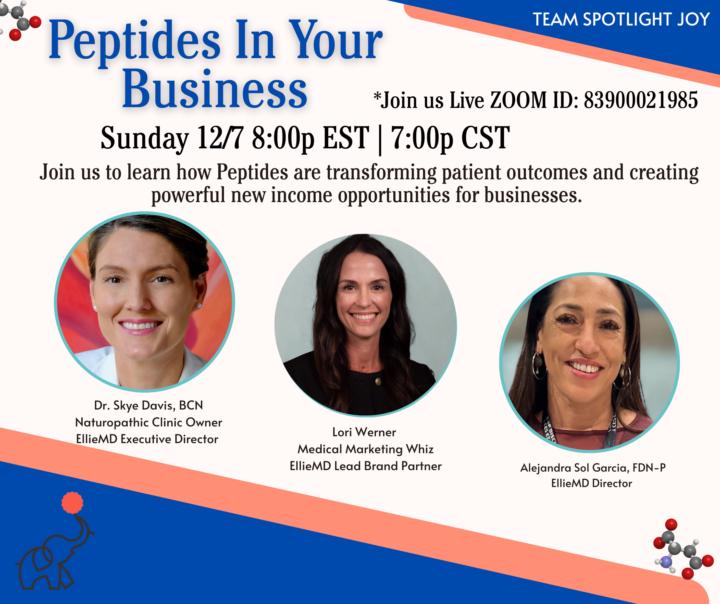
📣 Community Update — Let’s Support Alejandra Tonight!
Our good friend Alejandra Sol Garcia is joining an expert panel this evening for a big conversation on the future of peptides — and it would be amazing if we could all show up and support her. 🧬 Wednesday PEP TALK 📅 12/10 ⏰ 5:30 PM PST 🎙 Topic: The Future of Peptides — featuring an expert panel 🔐 Zoom (secured):https://us02web.zoom.us/j/83900021985 When you join, drop in the chat that you’re there to support Alejandra — let’s show her some love and represent the community strong. And, give a big shoutout to our crew over at Skool for helping to keep us connected and coordinate these opportunities to participate in the industry:👉 https://www.skool.com/the-peptide-daily-brief Please set a reminder and share this invite with a few others to help boost the crowd. Thanks, everyone! ⏰🔥
0
0
1-9 of 9
@john-bastiat-1751
John | The Peptide Daily Brief — Powered by Stack Tracker - research peptide insights, protocol vault & exclusive deals. No hype, just research.
Online now
Joined Oct 28, 2025
Powered by