Activity
Mon
Wed
Fri
Sun
Oct
Nov
Dec
Jan
Feb
Mar
Apr
May
Jun
Jul
Aug
What is this?
Less
More
The NEW STANDARD
161 members • Free
DMT Academy
199 members • Free
Anabolic Index (Steroids)
127 members • $9/month
All Roads Lead To Latin
205 members • $5/month
AF Coaching
311 members • $20/month
Optimized Living
5.2k members • Free
Pharmacology Teaching System
238 members • Free
BIOHACKING | TONY HUGE
4.4k members • Free
DivineBougie
2.2k members • Free
10 contributions to Pharmacology Teaching System

1 like • 8d
There has not been alot of discussion on here about that. There are plenty of forums out there that discuss AAS sourcing. TSS in particular

15d •
retatrutide hgh
i wanted to talk about my experience running a cycle, im 20yo and i started the cycle in late february and finished in late may, it was 4IU hgh daily (2 in the morning, 2 in the night), and gradually increasing the amount of retatrutide, i started at 5mg(month), then increased to 10mg the second month, and then increased again to 15mg(had to lower it to 5mg after 2 weeks because it was too strong), got to say that it fulfilled every expectation i had before trying it, for side effects i have to attribute it to the dose, because at 5mg i only had mild headaches (probably want even because of reta) but at 15mg i had stomachaches, severe diarrhea, couldn’t even eat small amounts of foods i used to eat like nothing, truly i wouldn’t try 15mg(month) of reta ever again, as for HGH, despite being 20 i grew 1inch in 2 months at 4IU, feet grew from 9.5 to 10.5 size, and hands were noticeably bigger, it also augmented the positive effects of retatrutide. At first i thought that it was a scam because of the expectations i had from online posts, it also was kind of hard to source and thought that i would get scammed by some mf in taipei, but i bought everything with Welon Peptide Solutions and it turned out to be safe and reliable. If you’re wondering for numbers, in the spam of the cycle, I dropped from 170lbs(77kg) to 143lbs(65kg), and grew from 177cm(5’10)to 179cm(5’11). Definitely would recommend if you have the option to do it. If you have questions (experience wise) i will try and answer all i can. Won’t post photos or information because of privacy yk
0 likes • 8d
That is quite the cycle. Were you in a hurry to lose weight? How much muscle mass did you lose? If it were me I would have started at 1mg of Reta a week and run that till it stalls and then bump it to 2mg and so on. I think I topped out at 5mg after 5-6 months and was pleased with the change. Now I just do 1mg MWF. Just cuts down on food noise so I don't eat everything but still eat. For the HGH were you lifting also or just taking HGH? Did your feet and hands revert to normal size after stopping HGH. Its good that you got some height out of the cycle. I surprised you gained any height while in a calorie deficit. The wonders of HGH I guess.
May 8 •
Brain health / cognition / memory
Not sure about yall, but Alzheimer's is in the wood pile for me. With that in mind I am very curious about brain health and performance. I am curious what you do to help your brain/cognition/memory. I am currently taking creatine (10g ED) for the brain and muscle benefits. I have tried P21 and Dihexa. The jury is still out on Dihexa. I think I will give it another swing once I get through the month of May(its a busy month). P21 seemed to help, but now it seems scarce so doing follow research is not happening. I suspect some of you have way more knowledge, about brain performance, than me since my idea of prepping my mind for study was to pound coffee.
0 likes • Jun 20
@E Rock thanks for the info. I will look into your recommendations
0 likes • Jun 20
@E Rock what is your protocol for Cerebrolysin?

Apr 20 •
First cycle
In your opinion what would recommend for somebody that is young but plans to run more cycles blast and cruise or pct?
2 likes • Apr 20
Do you want to have kids later? If so PCT. If I remember rightly you are still on the young end. PCT is probably the answer until you are sure you don't want kids and that is "you have a vasectomy" sure. We have talked before and you know what I think. I would be glad to bounce ideas off each other because shutting down your nuts is a big deal in the long run. When I say ideas not just the PCT part but what its like on the TRT side and having kids. I've done both. Really some people know they don't want kids, others just think they don't want them and its they just don't want them now.
2 likes • Apr 21
@Julian Wright yeah I hear you. You might have to look into HCG to keep the nuts good. There is some good YT and info out there. Look for stuff from Dr Crisler.

Apr 11 •
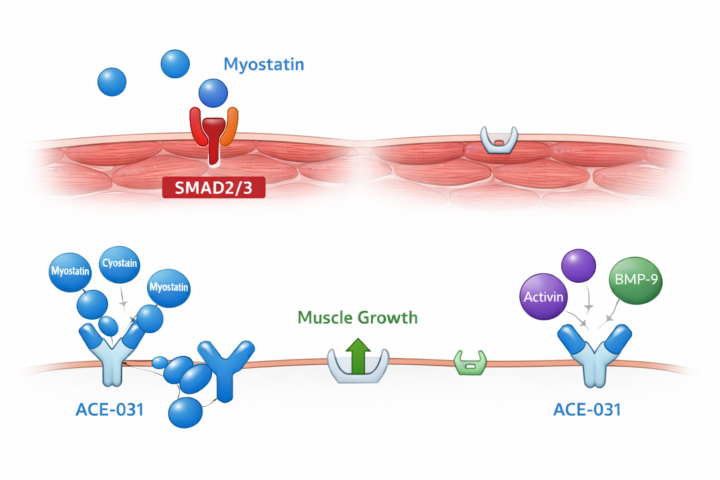
How an Experiment Tried to Turn Off the Muscle’s “Brake”
The human body is not designed for unlimited growth. There is a molecular system whose purpose is exactly that: to impose a limit. At the center of this system is a protein known as 🔵myostatin (GDF-8)🔵. Its role is straightforward:to inhibit skeletal muscle hypertrophy. How it works under normal conditions Myostatin binds to a receptor on the surface of muscle cells called ActRIIB. This interaction activates an intracellular signaling pathway: 🔴SMAD2/3🔴 The outcome is a clear biological signal:reduce muscle cell growth and differentiation. This is a regulatory mechanism, not a defect. What ACE-031 does ACE-031 is a recombinant fusion protein engineered to interfere with this process. Instead of blocking the receptor at the cellular level, it operates differently: it circulates in the bloodstream and functions as a soluble decoy receptor. This means it binds myostatin before it can reach its natural receptor. What happens at the molecular level When myostatin is sequestered: ⚠️it cannot bind to ActRIIB ⚠️SMAD2/3 signaling is not activated ⚠️the inhibitory signal is effectively removed The result is a physiological environment more permissive to muscle growth. The critical detail ACE-031 is not selective for myostatin. It also binds other ligands within the same signaling network, including: - activins - members of the BMP family, such as BMP-9 These molecules are not limited to muscle regulation. They also play key roles in vascular homeostasis and endothelial signaling.
1 like • Apr 11
I may understand what you are getting at in the "The Critical Details" part but you might want to break it down Barney style for people.
1-10 of 10
Active 2h ago
Joined Jan 25, 2026