Activity
Mon
Wed
Fri
Sun
Oct
Nov
Dec
Jan
Feb
Mar
Apr
May
Jun
Jul
Aug
Sep
What is this?
Less
More
Pharmacology Teaching System
238 members • Free
5 contributions to Pharmacology Teaching System

Apr 25 •
It’s Not About Blood Sugar
There’s something interesting happening in metabolic medicine right now, and not everyone is seeing it clearly. Dulaglutide isn’t just “another glucose-lowering drug.” It’s a signal of where modern pharmacology is heading: targeting entire systems, not isolated symptoms. When you activate the GLP-1 axis, you’re not just lowering blood glucose. You’re influencing appetite, gastric emptying, hormonal signaling, and even eating behavior. That changes the game. But here’s the part many people overlook: It’s not magic. It doesn’t replace discipline. It doesn’t fix poor habits. It’s a powerful tool within a system that still depends on basic physiology: energy balance, hormonal regulation, and adherence. The real value isn’t just the drug itself. It’s what it represents: 🟢Therapies that work with biology, not against it 🟢Fewer spikes, more stability 🟢Less aggressive intervention, more intelligent regulation And if you look at what’s coming next, this is only the beginning. The real question isn’t whether these therapies work. It’s whether we know how to use them correctly. If you have any questions, feel free to reach out‼️
2
0

Apr 12 •
It’s Not Lack of Discipline, It’s Biology (RETRATUTIDE)
For years, the conversation around fat loss has been oversimplified: ⭕️Eat less and move more.⭕️ While that sounds logical… it’s incomplete. Because it ignores something fundamental: the human body is not designed to lose weight easily. In fact, it is designed to resist it. When you reduce calories over a sustained period, your body activates a series of adaptive mechanisms: 🔴Basal energy expenditure decreases 🔴Thermogenesis is reduced 🔴Hunger signals increase 🔴And energy storage becomes more efficient This phenomenon is known as metabolic adaptation. It’s not a lack of discipline. It’s your biology doing exactly what it was designed to do: survive. From an evolutionary perspective, weight loss meant potential danger. So the body responds as if it’s facing scarcity even when it isn’t. This is where modern science begins to shift the paradigm. Instead of fighting these mechanisms… current research is focused on modulating them. One of the most compelling developments in this field is Retatrutide, an investigational peptide that targets multiple metabolic pathways simultaneously. What makes it different? It doesn’t simply suppress appetite in isolation. It interacts with hormonal systems that regulate: 🟢Satiety at the central (brain) level 🟢Glucose response and metabolic control 🟢And the balance between energy storage and expenditure This introduces a new perspective: Fat loss is no longer just a constant battle against your body… it becomes a process that is biologically supported. This doesn’t mean habits don’t matter. But it does mean that, for the first time, they can work with your physiology instead of against it. And when that happens… the entire experience changes. ✅️Less resistance. ✅️More control. ✅️More sustainable outcomes. So the real question is no longer: “Why is it so hard for me to lose weight⁉️” But rather: “What is happening inside my body… and how can I work with it instead of against it⁉️”
1
0

Apr 11 •
How an Experiment Tried to Turn Off the Muscle’s “Brake”
The human body is not designed for unlimited growth. There is a molecular system whose purpose is exactly that: to impose a limit. At the center of this system is a protein known as 🔵myostatin (GDF-8)🔵. Its role is straightforward:to inhibit skeletal muscle hypertrophy. How it works under normal conditions Myostatin binds to a receptor on the surface of muscle cells called ActRIIB. This interaction activates an intracellular signaling pathway: 🔴SMAD2/3🔴 The outcome is a clear biological signal:reduce muscle cell growth and differentiation. This is a regulatory mechanism, not a defect. What ACE-031 does ACE-031 is a recombinant fusion protein engineered to interfere with this process. Instead of blocking the receptor at the cellular level, it operates differently: it circulates in the bloodstream and functions as a soluble decoy receptor. This means it binds myostatin before it can reach its natural receptor. What happens at the molecular level When myostatin is sequestered: ⚠️it cannot bind to ActRIIB ⚠️SMAD2/3 signaling is not activated ⚠️the inhibitory signal is effectively removed The result is a physiological environment more permissive to muscle growth. The critical detail ACE-031 is not selective for myostatin. It also binds other ligands within the same signaling network, including: - activins - members of the BMP family, such as BMP-9 These molecules are not limited to muscle regulation. They also play key roles in vascular homeostasis and endothelial signaling.
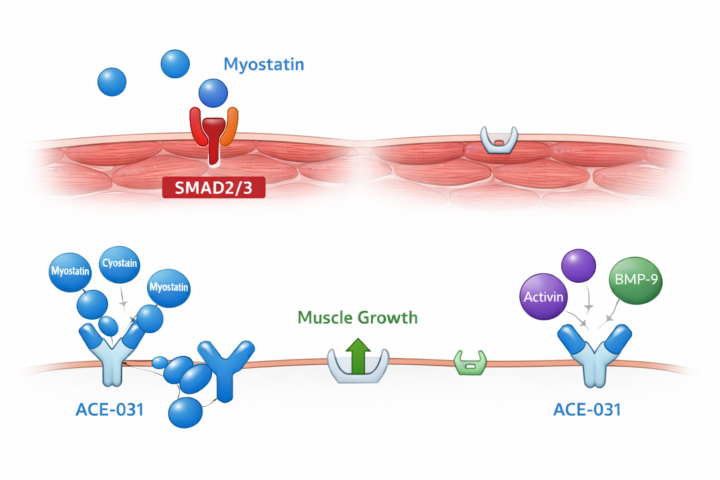
1 like • Apr 11
@Joe Hart Got you, that’s fair. Let me simplify that part: Think of ACE-031 like something designed to block one specific signal (myostatin), which normally limits muscle growth. But instead of only blocking that one signal… it ends up blocking several similar ones too. So in simple terms: It doesn’t just remove the “muscle brake” It also interferes with other systems the body needs (like blood vessel signaling) That’s the “critical detail.” It works, but it’s not precise. And more importantly, it’s not something with established safe use, so the concern isn’t really “how often” it’s used, but the lack of control and predictability.
Apr 10 •
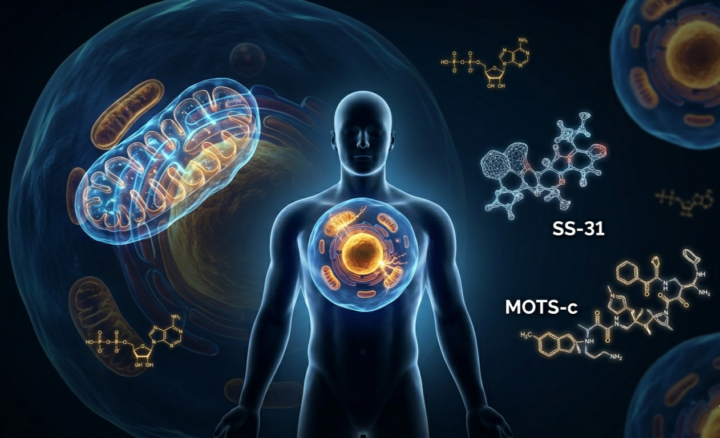
Energy doesn’t start with coffee… it starts in the mitochondria (SS-31, MOTS-c)
Your body’s energy isn’t just about sleep, diet, or training. At a cellular level, it depends on how efficiently your mitochondria function. Mitochondria are responsible for producing ATP through oxidative phosphorylation, the primary energy source that powers nearly all cellular processes. When this system operates efficiently → energy levels remain stable When it becomes impaired → fatigue, reduced performance, and slower recovery tend to appear. What happens when mitochondrial function declines? At the cellular level, this often involves: Decreased ATP production Increased generation of reactive oxygen species (ROS) Accumulation of oxidative stress Over time, this reduces overall cellular efficiency and can directly impact how the body performs and recovers. The focus is not simply on producing more energy, but on improving how efficiently that energy is generated and maintained. Because mitochondria are not just energy producers, they also play a role in metabolic regulation, cellular signaling, and stress response. Emerging research is exploring compounds that interact directly with mitochondrial function, such as: SS-31 → associated with mitochondrial membrane stability MOTS-c → linked to metabolic and energy regulation These approaches aim to target energy production at its source: the cell itself. Do you feel your energy is stable throughout the day, or do you experience noticeable crashes?
2
0
Dec '25 •
Rules for the Skool 🤙
Hey everyone, im adding a couple of rules, nothing too harsh and should be easy to follow, theres been an extreme amount of spammy “like for like” threads here, its a problem. 1. No “Like for Like” posts, keep your posts high quality (introductions, cycle posts/reviews, ask insightful questions). 2. No harassment or slander to any members. 3. No advertisements of any other Skool course at all. 4. No explicit content 5. No back seating or arguing with owners without providing concrete evidence of your statement (you are paying us to help you). 6. No flooding threads (keep responses simple, dont send 4 responses answering the same questions, one response message is all you need, and dont try and flood to gain likes.)
0 likes • Apr 5
🤝
1-5 of 5