Activity
Mon
Wed
Fri
Sun
Aug
Sep
Oct
Nov
Dec
Jan
Feb
Mar
Apr
May
Jun
Jul
What is this?
Less
More
Owned by Jessica
A sacred hearth for women to use magic, ritual, tarot, crystals, crafting, and seasonal living to rebuild & celebrate their voice inside and out
Memberships
Herbs, Insulin & Diabetes Help
24 members • $29/month
AmyBlackthorn School of Magic
166 members • Free
The Sanctuary with Carey Kaas
339 members • Free
Skool Homeroom
200 members • Free
Junk Journal Fantasy Club
678 members • Free
Multidimensional Nerd
57 members • Free
Green Witch School
136 members • Free
Witchy Craft Circle
31 members • Free
Witch-Craft
58 members • Free
10 contributions to Full-Time RV Roadmap

May 7 •
Excuse my absence
We’ve been in the North Carolina mountains the past 3 weeks and the internet is practically 0. As well as the cell service. So excuse my absence but I promise I’ll be back in a few days. Heading towards the interstate. 🤞


0 likes • May 7
lol that's one way to unplug and get some time away from all this.
Apr 28 •
How to Stay Connected with Family While Living Full-Time
One of the genuine emotional challenges of full-time RV life is navigating the distance from family. Here's how full-timers stay close from the road: MAKE VISITING PART OF THE PLAN One of the best surprises of full-time RV life: family comes to visit you. Grandkids want to see the RV. Siblings plan weekend meetups. Parents suddenly have a reason to go somewhere new. Build family visit weeks into your travel calendar. THE DIGITAL TOOLBOX — Video calls: FaceTime, Zoom, and Google Meet work great on the road — Group texts and family group chats keep daily connection alive — Shared photo albums (Google Photos, iCloud) let family see your travels in real time — Marco Polo (video messaging app) is popular with full-timers for staying close with family COME BACK FOR THE THINGS THAT MATTER Birthdays. Holidays. Illness. Weddings. Graduations. Full-timing doesn't mean disappearing. You're mobile — use that mobility to show up for what matters. THE GUILT PIECE Many full-timers feel guilt about being far away from aging parents. Honest take: proximity doesn't equal presence. Many people live 30 minutes from family and see them twice a year. Being intentional about connection matters more than the distance. THE SURPRISE Most full-timers say their family relationships improved after going on the road. Less routine obligation, more intentional visits. More genuine connection. 💛 Is staying connected with family one of the bigger concerns on your list — or do you feel like that part is solvable?

0 likes • Apr 28
This one is actually a non-factor. Where I live right now I can't see my family really. They're too far to make visits so I see my brother once or twice a year when he's nearby for a few hours... and my father lives just far enough where I can only go a few times a year for a day or two. Most of my family lives really far, I'm in NY. Some are in Missouri, some are in Florida, some in Arizona, nearest live in OH. Technically doing the extended trips or RV living, I'd see them more.
Apr 22 •
🚨 I need your brain for a sec 👇
Quick poll, and yes, your answer actually matters (I check these, I promise 😄) If you could wave a magic wand and add ONE thing to this community, what would it be?
Poll
7 members have voted

2 likes • Apr 22
Said other because I couldn't decide between 1 & 3
Apr 16 •
RV Storage - Where to Put Everything in a Smaller Space
One of the practical realities of RV life is learning to live with less storage, and to use the storage you have better. Here's how experienced full-timers handle it: THE GOLDEN RULE If it doesn't earn its space, it doesn't come in the rig. Everything you bring should either be used regularly or serve a critical function. OUTSIDE STORAGE BAYS Most RVs have exterior storage compartments. Use these for: — Outdoor gear (chairs, table, grill, mat) — Hoses and utilities (sewer hose, water hose, electric cord) — Tools and maintenance supplies — Pet gear and food bags INSIDE STORAGE STRATEGIES — Cabinet risers: Double the vertical capacity of kitchen cabinets — Over-door organizers: Bathroom, pantry, closet doors — Vacuum seal bags: For off-season clothing and bedding — Magnetic strips: For knives and metal items in the kitchen — Collapsible everything: Bowls, colanders, pots where possible WHAT FULL-TIMERS STOP BRINGING — Duplicate kitchen gadgets — Books (Kindle replaces hundreds of paperbacks) — Just-in-case clothing — Decorative items with no function — Full-size appliances when compact versions exist THE ADJUSTMENT PERIOD The first few months, most full-timers still have too much stuff. After 6 months, they've naturally sorted out what they actually use. After a year, the rig feels exactly right. 📦 When you imagine packing for full-time RV life, is there a category of items you're already worried about fitting?

2 likes • Apr 18
@Mary Walker I could see me having a stash housed somewhere to visit occasionally
2 likes • Apr 19
@Mary Walker haha, see that would be me. at least 3, I could see it lol
Apr 17 •
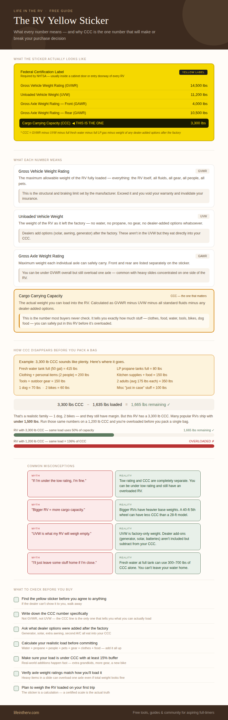
RV Yellow Sticker Guide
Remember the yellow sticker we talked about the other day? Well, here is a guide that gives you a little more insight about it. And as they say...you don't know what you don't know. We didn't know or understand it until our 3rd RV.
2 likes • Apr 17
thats very cool, I find all of this very interesting
2 likes • Apr 18
@Mary Walker really makes you rethink things
1-10 of 10

@jessica-vazquez-5481
I am a soul led Creative & Intuitive Guide with 20+ years experience building communities and worlds. I help women reclaim themselves & their life
Active 7h ago
Joined Mar 29, 2026
Central NYS