Activity
Mon
Wed
Fri
Sun
Aug
Sep
Oct
Nov
Dec
Jan
Feb
Mar
Apr
May
Jun
What is this?
Less
More
Owned by Jason
Grow your business with more confidence, consistency, & less chaos, so your business feels aligned, without the self sabotage, burnout or anxiety.
Performance Psychologist & Business Coach helping founders scale by raising their operating standard & redesigning the structure behind their growth.
Memberships
Claude for Coaches
1k members • $47
The DJPS Academy
2.1k members • Free
Scaling With High Ticket
996 members • Free
LY
Launch Your Skool
216 members • Free
Viral Coach Training Material
26.7k members • Free
The Modern Founders Academy
258 members • Free
7 contributions to The Modern Founders Academy

Feb 14 •
What are you actually building right now?
Quick one. What are you actually building right now? Not just “a business” or “content”. Like… who do you help, and what do you help them get? Write it in one sentence below. Let’s get clear.

2 likes • Feb 15
Such a good question, and love that you are demanding specificity here! I am building a community for high-achieving founders to raise their operating standard by redesigning the structure behind their growth. I am not focused on motivation, surface productivity, or generic mindset work. I redesign how founders operate so that their growth becomes sustainable, aligned with their life, and structurally sound. I've been doing this work for around 17 years now since studying as a psychologist, and now finally deciding to lock in something specific, focused and targeted to create real impact!

Feb 11 •
The Modern Founders Mindset course is now live
The Modern Founders Mindset course is now live in the classroom. We are opening this curriculum to the community because high-performance operators need systems, not more information. Access to these lessons is unlocked at Level 3. This is not a barrier for new members, it is a way to encourage you to engage, share your perspective, and build a consistent rhythm within the group. The depth of this material goes far beyond standard advice. It covers the architecture of beginning , how to treat fear as information rather than a warning, and the neuroscience of using repetition to rewire your identity. You will learn how to design your environment to make motion automatic and how to manage your energy cycles so you can handle high-stakes pressure without burning out. Once you have completed the modules and built your foundation, I recommend checking out Jason Staniforth’s community, Performance Mindset 4 Business. As a qualified psychologist and coach, Jason provides the specialized environment needed to dive deeper into these concepts once your initial structural proof is in place. Drop a comment below with the specific area where you are currently feeling the most friction so we can get you moving.
2 likes • Feb 12
Hey guys! Looking forward to connect with you all and support you on your journey! Make sure you are maximising the materials in The Modern Founders Community as well, if you are serious about levelling up your business, this is the place to be.
Feb 5 •
The Growth Illusion
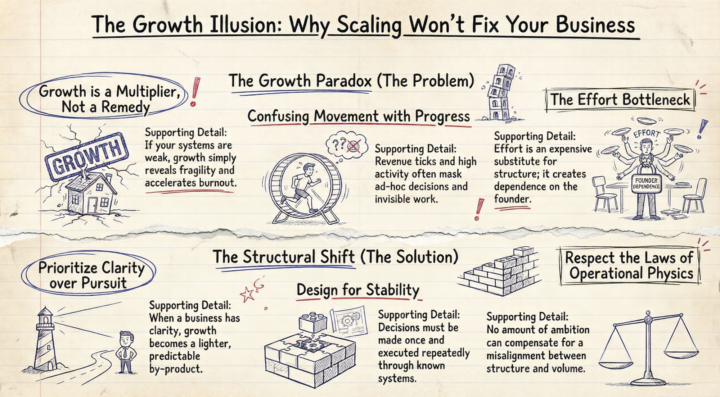
Growth has become the most abused word in modern business. Most founders believe growth is something to be achieved; in practice, growth is something that is revealed. If you are chasing revenue to fix your internal chaos, you are simply paying to accelerate your own collapse. The Growth Paradox The prevailing assumption in the founder community is simple: if progress stalls, the answer must be more. More effort, more leads, more headcount, and more intelligence applied at greater speed. When this fails to stabilize the business, the founder rarely questions the model; they question their own discipline. This is the Growth Illusion. The illusion is the belief that growth is driven by desire and exertion. In reality, growth is driven by the structural reality in which a business is operating. You have been taught to push harder and scale sooner without first understanding whether your business can actually carry the weight of that growth. Growth does not strengthen a business; it magnifies it. Every increase in volume places stress on what already exists. Every new client applies pressure to delivery, and every new hire tests the clarity of your ownership. Growth as a Multiplier, Not a Remedy Growth is a multiplier, not a remedy. If your systems are weak, growth reveals fragility. If your decisions are unclear, growth amplifies confusion. If your execution relies on memory and heroics, growth accelerates burnout. This is why businesses that appear to be succeeding on the surface often feel increasingly unstable from the inside. Revenue climbs, yet you feel more trapped. The team grows, yet coordination worsens. Opportunity expands, yet focus collapses. Growth did not create these problems; it simply made them impossible to ignore. Many businesses do not break because they fail to grow; they break because they grow before they are ready. The Misdiagnosis of Progress One of the most persistent errors you can make is confusing movement with progress. Activity increases, revenue ticks up, and new initiatives are launched. On the surface, it looks like advancement.
2 likes • Feb 9
This is fire! I totally agree with this! This is the exact reason people jump around strategies or programs without seeing any real result or, the actual problem they joined for, being solved. They feel good because they are busy, and busy feels like progress. But busy can also just be busy. Busy being busy but not actually moving anything forward! The trap i see is that people spend so much time and energy trying to be busy so that they feel productive, that they become attached to the things they have been busy with, and then are reluctant to let them go. This reluctance robs them of time which means they feel they don't have the capacity to actually entertain the tasks that would in fact help fix the problems they have. These people need to make clearer, sharper, and more well-informed decisions, and I already see how your mimic system can help to support founders in having the data to make these decisions with speed and accuracy.
1 like • Jan 30
Honestly this system is RIDICULOUSLY GOOD!
Jan 11 •
Rest is part of the work
Rest is not the opposite of work. Rest is a part of work, don’t let anyone tell you otherwise. You don't build muscle while you lift. You build muscle while you sleep. The same applies to your business ideas. If you don't rest today, you will be weak tomorrow.
1 like • Jan 11
AMEN to this!!!!
1-7 of 7

@jason-staniforth-2040
Psychologist & Performance Mentor. I Help Coaches, Creators & Agency Owners To Enjoy Life & Business Without Burning Out
Active 11h ago
Joined Jan 7, 2026
ENFJ
East Midlands, UK
Powered by