Activity
Mon
Wed
Fri
Sun
Aug
Sep
Oct
Nov
Dec
Jan
Feb
Mar
Apr
May
Jun
What is this?
Less
More
Memberships
Inspiring Philosophy Academy
56 members • $25/month
8 contributions to Inspiring Philosophy Academy
5d •
Sneak Peak: What’s Coming
We’ve got some exciting things in the works at IPA. This week we’re beginning development on a brand-new course covering Bayesian Epistemology and Rational Belief Formation alongside one of the leading scholars in the world working in this area. The goal isn’t just to teach Bayes’ Theorem. We want to help you understand how rational belief revision actually works, how evidence affects probability, how cumulative cases are built, and how these principles apply to questions about Christianity, history, miracles, science, and everyday reasoning. We’re also going to be building practical tools alongside the course, including: 📊 A Bayes Calculator 📈 Evidence-weighting tools 🧠 Interactive probability visualizations 🔬 Resources to help you apply Bayesian reasoning to real-world arguments and evidence If you had a chance to learn a topic with us: what topic? And what scholars would you want to hear from?

1 like • 5d
I think covering divine hiddenness, especially as it relates to theists who get nothing but silence from God during times of extreme pain and/or doubt, would be greatly helpful. Or a cumulative case for theism using Bayes (not sure if it would be too much to cover in one course).
0 likes • 1d
@Ben Heinrichs Are you referring to Schneider's work? I'm not familiar with the literature on this, but I've just heard his name mentioned regarding the Darwinian PoE. Not sure if it connects with Christian theism in particular.
7d •
Advice for Reading Swinburne's The Existence of God
Hey, everyone. A couple days ago, I decided to start reading The Existence of God. Chapter 1 was pretty easy to comprehend and keep all the concepts straight in my mind, but once I got to chapter 2 where there are sections on both scientific and personal explanations, keeping track of all the definitions started to get really difficult, and I felt like I was highlighting multiple things on every page. If you've gone through the book, could you please offer some advice on how to get through it without feeling overwhelmed, yet being able to retain all the very specific, intricate definitions that Swinburne stipulates for the various types of explanations? Additionally, I'm in the section on personal explanations where he mentions Davidson's account of personal explanations in terms of scientific explanations, and I'm not seeing how his argument goes through for a non-reductionist/broadly dualist view of personal explanation that involves intention. From what I understand, he's saying that Davidson is including intentions themselves as reducible to combinations of brain states and their connections to the rest of one's body, correct? If so, it seems that Swinburne then says that intention is not reducible to brain states and their connections to one's body by this analogy: there are properties like redness that are immediately perceivable, but one does not need to know anything about the perceived object with the property of redness reflecting a particular wavelength that corresponds to the color red. So analogous to the case above, one does not need to know about a one's particular brain state and its connections to know what one's own intention is. Is this just how a typical argument for, at the least, property dualism is made?
Mar 10 •
Question on Nick Meader's Book on the Resurrection
Has anyone here read Nick Meader's book, "Resurrection: Extraordinary Evidence for an Extraordinary Claim"? I was reading chapter 5 last night, and it seemed like he really breezed through how well physical-first or mind-first views of reality fit what we observe about the world, and there was plenty about what a mind-first view even is that was not clear to me. I will put specific questions down later, but for now, I'm just curious as to whether anyone else felt a bit perplexed in this section of the book.
0 likes • Mar 12
@Tim Howard I gotta go back to the chapter tomorrow night and let you know.

Feb 24 •
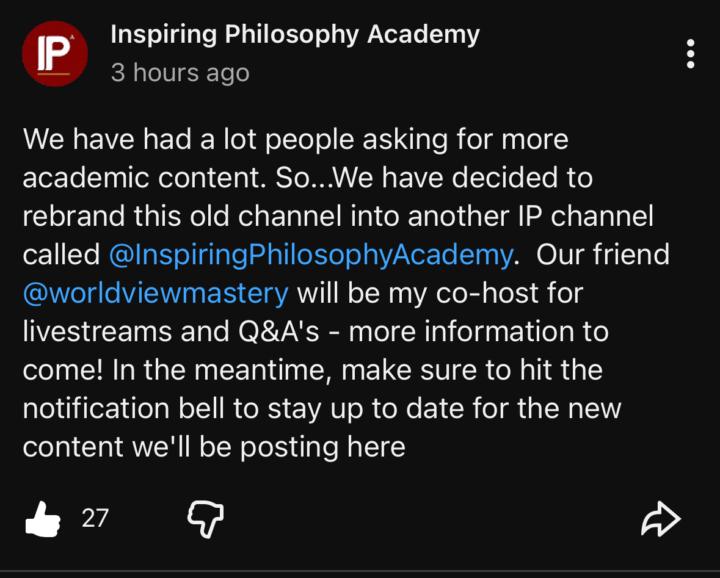
InspiringPhilosophy Academy
Go ahead and subscribe and turn on notifs yall 🔥 https://youtube.com/@inspiringphilosophyacademy?si=Bv_lOVi6UWErK-hE
1 like • Feb 24
Already done. Feels like home after over a year away from the channel!
Feb 24 •
Canceled
I’m so sorry guys, but I have to cancel today’s meeting. This is because I am deathly sick right now and I will not be getting better anytime soon.. Thanks, Tim
1 like • Feb 24
Praying you get better soon.
1-8 of 8