Activity
Mon
Wed
Fri
Sun
Jun
Jul
Aug
Sep
Oct
Nov
Dec
Jan
Feb
Mar
Apr
May
What is this?
Less
More
Memberships
CSCS Accelerator Community
142 members • Free
9 contributions to CSCS Accelerator Community
Apr 9 •
CSCS accelerator course
Hey Guys! I’m new here. I bought the course on Monday, but I don’t know how can I have access to the lectures and the other course materials. Could someone help me please?

1 like • Apr 9
On canvas; https://canvas.instructure.com/courses/11867148/pages/lecture-library-all-recordings?module_item_id=131044363
Mar 25 •
Significance of training Fascia
During my undergrad, a master’s student was agressively endorsing Myofascial release (“you’re an idiot if you don’t do it as an athlete.”) Overtime, I’ve had joint issues, chronic pain, and new issues weekly which inhibits my progress or at this point my retention of performance. Despite resting, hydrating, supplementing. I’m wondering how much Fascial health/training/maintenance has to do with overall physical health and performance. I’m hearing more and more about the levels of effects of Fascia, (Human Garage also has a lot of information on this; https://www.youtube.com/@HumanGarage). (Sidenote: After gutting an animal I started to consider how the amount of fascia and how affects the quality of the meat.) If anyone is interested; here is a discussion on it. Secret of Athleticism - World's #1 Fascia Coach - Chong Xie (Hyperarch Fascia Training) https://www.youtube.com/watch?app=desktop&v=l67YsR_c050

Mar 6 •
CSCS Practice Question #15
A collegiate tennis player reports excessive anxiety before matches and difficulty maintaining attentional focus during competition. A sport psychologist recommends interventions designed to improve arousal regulation and attentional control. Which of the following strategies would MOST likely improve the athlete’s performance? I. Use imagery rehearsal to mentally simulate competitive situations II. Implement controlled breathing techniques to regulate physiological arousal III. Use positive self-talk cues to maintain task-relevant focus IV. Provide knowledge of results feedback after every attempt A. I and IV B. I, II, and III C. II, III, and IV Answer in the poll, then explain your rationale below in the comments! I'll follow up with my breakdown of the question after enough people have responded. From Chapter 8: Psychology of Athletic Preparation and Performance
Poll
20 members have voted
0 likes • Mar 11
Proper Breathing can regulate PNS, Rehearsal can help assist neuromuscular innervation, self talk keeps mind on topic. -Results feedback can cause hypercriticism and self-analysis.
Mar 6 •
CSCS Practice Question #16
A strength coach is designing an in-season resistance training session for experienced rugby athletes. The primary goal is to maintain maximal strength and power while minimizing residual fatigue before competition in 48 hours. Which of the following session structures would be MOST appropriate? A. Perform Olympic lifts first (3–5 sets × 2–3 reps at 80–90% 1RM) followed by heavy squats (3–4 sets × 2–4 reps at 85–90% 1RM) with 2–3 min rest intervals B. Perform heavy squats first (5–6 sets × 6–8 reps at 75–80% 1RM) followed by accessory hypertrophy exercises (3–4 sets × 8–12 reps) with 60–90 s rest C. Perform circuit-style resistance training including multi-joint and single-joint exercises (3 rounds × 12–15 reps each) with in an explosive manner with minimal rest Answer in the poll, then explain your rationale below in the comments! I'll follow up with my breakdown of the question after enough people have responded. From Chapter 17: Program Design for Resistance Training
Poll
21 members have voted
0 likes • Mar 11
A = Rest intervals and %RM are for strength and power
Mar 4 •
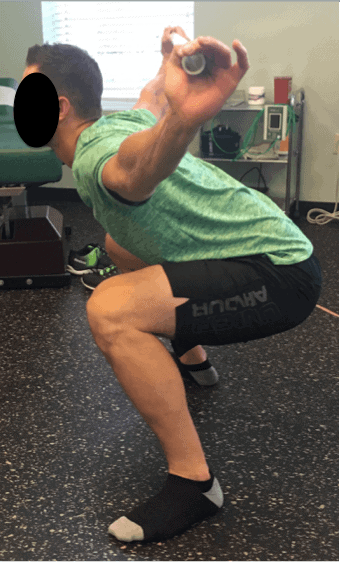
CSCS Practice Question #13
An athlete performs an overhead squat as shown. Which of the following cues would serve this athlete the best? i. Shorten your stance width by ~2 inches ii. Widen your stance width by ~2 inches iii. Keep the cervical spine neutral and in line with the torso iv. Drive the knees out and forward v. Push the bar straight up, elbows pointing slightly out vi. Reduce ROM or load until technique improves A. i, iii, and v B. ii, iv, v, vi C. iv, v, vi Answer in the poll, then explain your rationale below in the comments! I'll follow up with my breakdown of the question after enough people have responded. From Chapter 15: Resistance Training Technique
Poll
29 members have voted
0 likes • Mar 4
Shorten/widen stance would be dependent on biomechanics and range of motion particular to the individual, not necessarily fully understood from the image. 4,5,6 are general proper form instruction.
1-9 of 9
@james-face-1681
Live in Hawaii. Train strength and endurance. Always seeking to optimize performance.
Active 35d ago
Joined Feb 8, 2026
Powered by