Activity
Mon
Wed
Fri
Sun
Jul
Aug
Sep
Oct
Nov
Dec
Jan
Feb
Mar
Apr
May
Jun
What is this?
Less
More
Memberships
Make $1k-$10k in 30 days
189 members • $10/month
RC Agency Owners & Freelancers
5.7k members • Free
Chase AI Community
68.4k members • Free
AI Finance Academy
5.7k members • Free
AI Automation Agency Hub
325.8k members • Free
NextGen AI
41.4k members • Free
AITECH Institute
109 members • Free
Business Builders Club
8k members • $33/month
Die smarten Hausverwalter
132 members • Free
32 contributions to Software Engineering

21d •
Looking for a collaborator
Hi, I hope you're doing well! I'm currently looking for a collaborator. Would you be open to a conversation? Let me know if you're interested. Looking forward to hearing from you! Whatsapp : +31 6 10671603 Telegram : softluna517

0 likes • 20d
please dont post same thing again and again

22d •
I am looking for a senior software engineer from India.
I need a robust Windows-based application that can grab IRCTC Tatkal tickets faster than manual entry. The core job is full-cycle automated booking: log in, search, select quota and passengers, and confirm payment without human intervention. Two advanced capabilities are non-negotiable. First, the program must solve IRCTC’s captcha in real time—either through a reliable OCR/AI routine or an external service like 2Captcha, Anti-Captcha, or a comparable API you prefer, as long as the response time stays under a couple of seconds. Second, the tool should let me manage and run multiple IRCTC credentials side by side so several bookings can fire simultaneously without sessions colliding. Speed matters more than a pretty interface, yet the UI should be clear enough for power users who may tweak train numbers, class, dates, or passenger lists on the fly. I’m comfortable if you build in C#, .NET, or Python with Selenium/WebDriver, multithreading, and direct HTTP calls—use whatever combination keeps latency low and stability high. Requirements: - Proven experience with IRCTC Tatkal automation tools - Strong command of .NET (C#), WinForms/WPF, and HTTP request handling - Familiarity with IRCTC site structure, session management, captcha/OTP integration, and booking flow - Ability to quickly identify and fix issues caused by recent IRCTC updates - Must have updated or maintained Tatkal software before ----------Please do NOT apply if: - You’re unfamiliar with IRCTC’s booking system - You’re looking to experiment or learn on the job - You haven’t worked on Tatkal automation tools previously This is a time-sensitive and performance-critical project, so only serious and experienced developers should reach out. ---- If you meet the criteria and have successfully handled similar updates before, please message me directly with your experience and past work samples. Key expectations • You already have proven experience building or maintaining IRCTC Tatkal automation tools; this is not a first-time experiment.
0 likes • 21d
Hi, Your project caught my attention because I have a technology partner who specializes in exactly the kind of high-performance software architecture, AI integration, and automation systems required for complex applications like this. My partner, Adnan Hafeez, is a CTO and Software Architect with 15+ years of experience building large-scale software platforms, AI-powered systems, OCR/computer vision solutions, desktop applications, and low-latency enterprise architectures. He has led the development of platforms serving millions of users and has extensive expertise in .NET, C#, Python, distributed systems, multithreading, API integrations, secure credential management, and performance optimization. Some highlights of his background include: • 15+ years of software engineering and architecture experience • Expert in .NET, C#, Python, AI/ML, OCR, Computer Vision, and automation systems • Built and scaled platforms with 7M+ registered users and 2M+ monthly active users • Designed distributed architectures with 99.99% uptime and high-performance transaction processing • Extensive experience with secure system design, encryption, workflow automation, and API-driven platforms • Strong track record of maintaining and evolving complex production systems under changing business and technical requirements If you're looking for someone with senior-level architecture and implementation expertise, I'd be happy to connect you directly with Adnan so you can discuss your requirements, technical expectations, timelines, and whether his experience is the right fit for your project. Let me know if you'd like an introduction, and I'll arrange a direct conversation. Best regards, Muhammad Ibrahim Bajwa [email protected]
27d •
Building Software That Actually Scales
Introducing TechCognify. We focus on building software that is not only functional, but scalable, reliable, and aligned with real business goals. Our approach is simple: - Understand the problem - Design with clarity - Build with performance in mind - Deliver solutions that support long-term growth
1
0
29d •
From Learning to Building — Inside TechCognify’s Internship Program
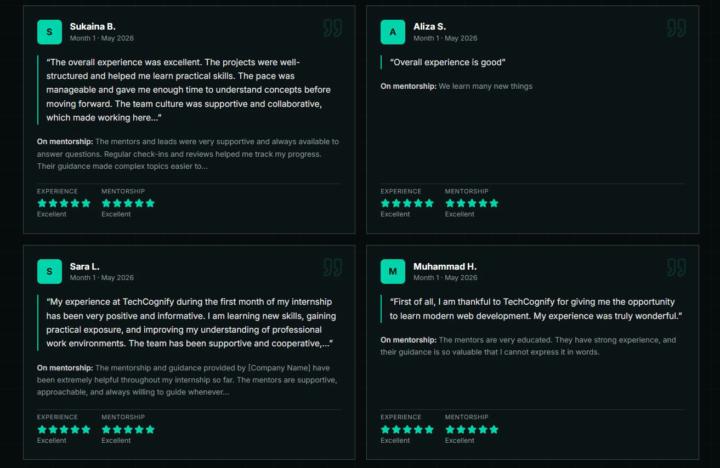
At TechCognify , one of the most rewarding experiences for me has been mentoring students from different universities across Pakistan through our Advanced Internship Program — Cohort 01. I started this initiative because during my own learning journey, I realized how difficult it was to learn real-world skills, build production-level projects, and understand how to actually turn those skills into freelancing or career opportunities. Please Visit to know more about the program and the structure of mentorship we followed, https://lnkd.in/dbi6MApD Today, Alhamdulillah, more than 178 interns are enrolled in our completely FREE, remote-based 15-week SaaS Mentorship and Internship Program. The interns have now successfully completed their first month, where the primary focus was building strong web development foundations. During the first phase, interns learned: • Git & GitHub workflows • HTML, CSS & responsive design • Modern JavaScript (ES6+) • REST APIs fundamentals • React.js fundamentals • Component architecture & state management Alongside the learning sessions, interns also worked on practical projects to apply these concepts in real scenarios instead of only following tutorials. This program is designed around real-world execution and mentorship. Every weekend, interns attend live cohort sessions, receive tasks, submit projects, participate in reviews, and continuously improve through structured feedback. We also built the TechCognify Interns LMS to manage the complete cohort experience with attendance analytics, quizzes, community interaction, project reviews, feedback systems, and progress tracking — making the internship feel closer to a real engineering environment rather than a traditional internship. I’ll make a separate post soon sharing more details about the Advanced Internship LMS Portal as well. One of the most beautiful parts of this journey has been reading the interns’ feedback after their first month. Many students shared how the program helped them gain confidence, understand the industry roadmap, improve their practical skills, and finally start building real projects instead of just watching tutorials.
1
0
29d •
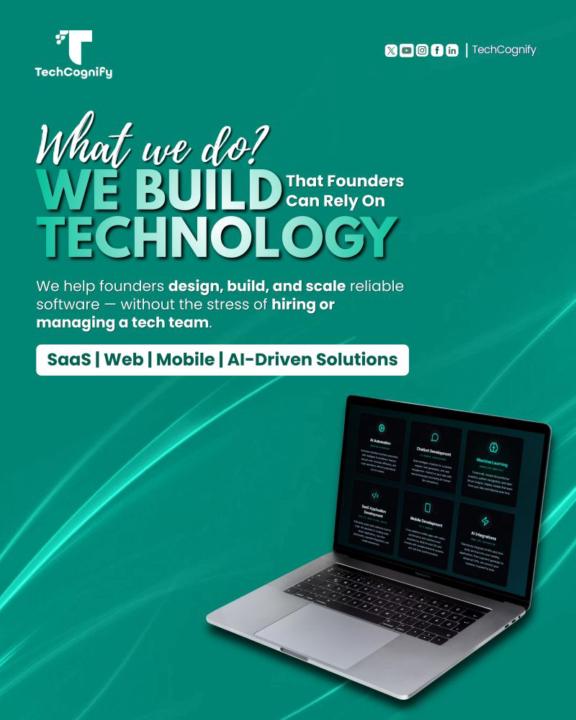
Build Great Tech — Without the Hiring Headaches
Building great technology shouldn't mean drowning in hiring headaches. At TechCognify, we partner with founders to design, build, and scale reliable software — so you can focus on growing your vision, not managing a tech team.
1
0
1-10 of 32

@ibrahim-bajwa-5271
Software Engineer building AI-powered SaaS systems & scalable products. NUST SE grad focused on real-world impact through clean architecture.
Active 3h ago
Joined Nov 24, 2025
Islamabad Pakistan
Powered by