Activity
Mon
Wed
Fri
Sun
Jun
Jul
Aug
Sep
Oct
Nov
Dec
Jan
Feb
Mar
Apr
What is this?
Less
More
Memberships
Research Career Club
664 members • Free
3 contributions to Research Career Club

7d •
Why non-thinking time is important for your research
Most breakthroughs in your thinking happen when you’re not “doing research” at all — they show up when you’re painting a wall or scrubbing the kitchen. When you stop actively focusing on a problem and switch to something simple and physical, your brain shifts from focused work into what neuroscientists call the default mode network. This network kicks in when you’re doing low-demand tasks: showering, walking, gardening… or painting a room. In that state, your mind quietly replays ideas, makes unexpected connections, and spots patterns you missed at your desk. What looks like “not working” is actually your brain running a background computation on your research questions. For researchers, this is gold. You spend hours reading, coding, analysing data, writing — that’s loading your mental “buffer” with information. But consolidation and genuine insight often require off-line processing, where the system is free from the pressure to perform. If you never step away, you’re constantly stuffing more in without giving your mind time to organise it, which leads to the familiar feeling of staring at a problem and going nowhere. In my own work on carbon capture and process engineering, many of the cleanest model tweaks or paper angles have come to me while doing something completely unrelated, like DIY, walking, or tidying the house after a long day at the office. Most researchers respond to feeling stuck by forcing more screen time. But the real career impact often comes from trusting these “non‑academic” moments enough to step away and let your subconscious do its job. How about you? When you step away from your desk, what’s the one activity (like your painting) where good ideas quietly show up? Drop your answer below 👇
2 likes • 7d
Whenever these shifts in my mind happen, shedding light on my research problems, I take notes on my mobile or on a piece of paper to later start thinking about whether the idea was feasible or not. And it is exactly as you have written: ideas come out when you are doing something else. Also, it has happened to me that I thought about something that could be interesting but could not make a note, and it completely vanished from my mind when I wanted to sketch it up... This is why I adopted the quick note method, whenever possible.
12d •
5 steps that cut the time I spend on responses to reviewers for my academic journal submissions from 3 weeks to 4 days.
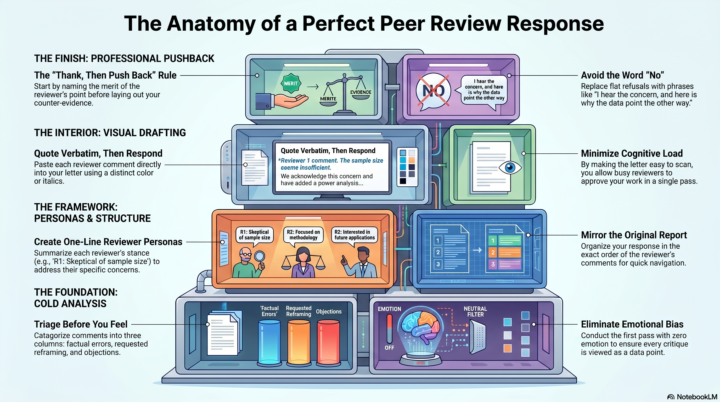
(Steps 4 and 5 are the ones nobody teaches.) Most researchers treat "major revisions" as a near-rejection. It isn't. It is an invitation to publish, with conditions. Here are the rules I use, and now teach my PhDs and postdocs. 1) Triage before you feel Open the decision letter and make three columns: factual errors to fix, reframing the reviewer wants, and objections you will push back on. No emotion on this pass. 2) Write a one-line summary of each reviewer "R1: wants a broader intro, sceptical of the sample size. R2: accepts the contribution, wants tighter results. R3: silent on methods, has issues with our writing." Knowing who each reviewer is before you write the response saves you from arguing with the wrong one. 3) Answer in their order, not yours Reviewers reread their own comments. If your response letter jumps around, they scan for their point and get annoyed when they can't find it. Mirror the structure of the original report. 4) Quote, then respond Paste each reviewer comment verbatim in a different colour or italics. Respond underneath. As journals are short of good reviewers, such an approach will lower their cognitive load, and they can approve your work in a single pass. 5) Thank, then push back When you disagree, open with one sentence that names the merit of the reviewer's point, and then lay out your counter-evidence. Never use flat "no". Use a specific "I hear the concern, and here is why the data point the other way". One paper. Cleaner response letter. Faster turnaround. Save this for your next major revisions letter.
0 likes • 8d
@Antonio Martins Hi Antonio. Very interesting your comment especially the part of the "major revision". Thinking about my last three published papers, all of them required major revision, but it is true that I also felt facing a big barrier, even more the first one.
1 like • 8d
I totally agree with this post. Thanks for sharing it, Dawid 😀 . I would like to share my thoughts and experience with these steps, some of which you may have published on LinkedIn some time ago. Throughout my recent publications, I have been thinking about how small things make a huge difference in the final decision—provided, of course, that the technical issues are correctly addressed or politely refuted based on evidence. By following these steps, I even received a final letter in which the reviewer appreciated the way the revision was handled.
Feb 24 •
Beware of predatory journals
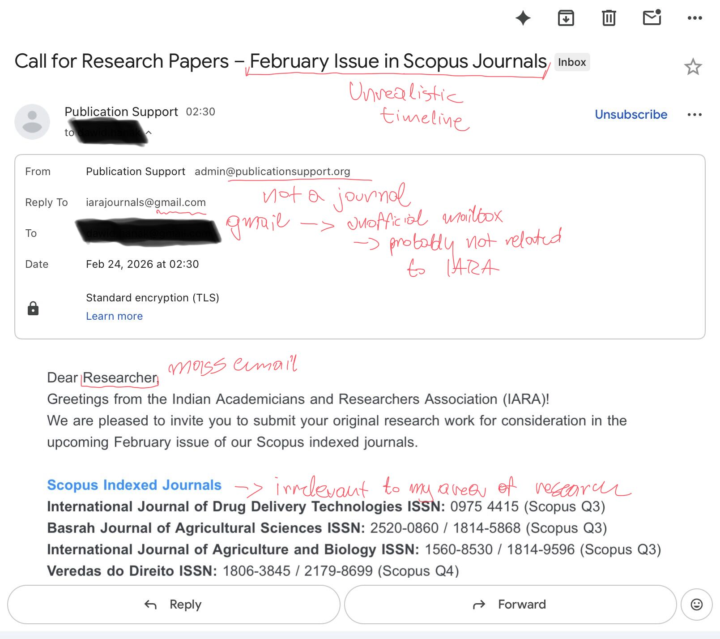
I got an email at 2:30 AM. "Dear Researcher, submit to our Scopus indexed journal." I deleted it this morning. Here's how I knew it was a trap: 1. The reply address was Gmail. Not a publisher domain. Not a journal domain. Gmail. Anyone can create one. 2. The greeting said "Dear Researcher." Not my name. Not my field. Not my work. 3. The "February issue" email arrived in late February. No real peer review happens in 48 hours. 4. And every journal listed? Drug delivery. Agriculture. Law. Nothing close to my research. These emails don't want your science. They want your submission fee. So before I submit anywhere, I run this check: → Verify indexing inside the database — not in their email → Check if the journal was discontinued → Look for real editorial board names and affiliations → Confirm peer review has an honest timeline → Make sure the scope matches my actual work If even one answer is "I'm not sure" — I don't submit. Your research took months or even years to produce. Don't let an email from predatory journal decide where it lives. P.S. Think. Check. Submit is a free checklist. Use it before every submission. It takes 10 minutes and protects your entire career.
1 like • Feb 27
Thanks for sharing @Dawid Hanak .This in happening very often to me. From an specific time which I can not recall now, I started having my inbox/spam flooded with such e-mail. Most recently, an email from a known publisher was sent inviting me to be the editor of a special issue. In the content, they mentioned the journal official e-mail. But the red flag was the sender email, the domain was such @1_admin_journal'sname, and it sounded very rare. I took the official e-mail address from the journal's page, which matched the e-mail address the sender included in the content, and asked then for more information, copying in the text the I had previously received from the sender. They nave answered me, so it was more than clear. We must take much care. Greetings.
1-3 of 3
@humberto-santos-8284
Hi there, I am Humberto Santos, a PhD student at University of Zaragoza, Spain. My current research focus on the life cycle assessment of LHTES.
Active 7d ago
Joined Feb 24, 2026