Activity
Mon
Wed
Fri
Sun
Oct
Nov
Dec
Jan
Feb
Mar
Apr
May
Jun
Jul
Aug
Sep
What is this?
Less
More
Owned by Heather
For practices that want to get paid properly—billing systems, front desk workflows, and revenue cycle training. Check us out at NatRevMD.com.
Viral Coach Training Material
30.1k members • Free
Online Business Friends
112.6k members • Free
The AI Advantage
129.2k members • Free
Free You Up
258 members • Free
AI Automation First Client
2k members • Free
AI Automation Society
458.6k members • Free
3X Freedom
1.8k members • Free
AIpreneurs
10.6k members • Free
Doctors Online Success
267 members • Free
1 contribution to AI Automation First Client

Dec '25 •
Almost lost my first healthcare client because my automation delayed emergency procedures 🔥
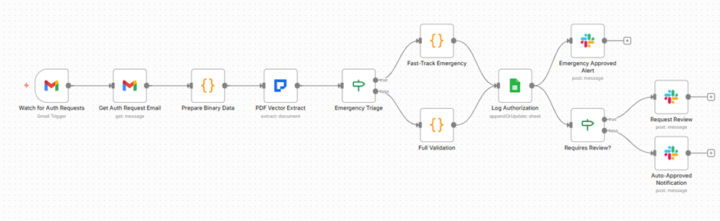
Friend referred me to medical practice needing prior authorization automation. 150 insurance authorization requests monthly. 2-3 hours manual processing each. Perfect first client - clear problem, measurable ROI, healthcare industry experience. Built n8n workflow. Gmail monitoring authorization request emails. Document extraction pulling patient details, insurance info, procedure codes, diagnosis codes. Coverage validation. Google Sheets tracking. Slack notifications. Clean automation with good metrics. Deployed. Working great for 4 months. Processing time dropped from 2 hours to 15 minutes. Client happy with results. Then patient complaints escalated. THE DISASTER: Three emergency authorization requests delayed 48 hours in standard approval queue. Patients needed urgent procedures (emergency surgery, critical MRI, immediate specialist consultation). Documents clearly marked "EMERGENCY" with urgent procedure dates. My system extracted emergency flags correctly at 94% confidence. Never routed differently. Sent all requests through same 24-48 hour approval path. One patient condition worsened during authorization delay. Required additional intervention. Medical group filed incident report. My automation caused delay. THE FIX: Added emergency triage layer IMMEDIATELY after document extraction. Built IF node checking: Emergency indicators: - Emergency flag = true in extracted data - Urgency level contains "urgent" or "emergency" - Procedure date within 24 hours - Request marked "STAT" or "URGENT" Emergency path (if ANY indicator true): - Auto-approve immediately - Slack alert to medical director (#emergency-auth channel) - Google Sheets row marked "EMERGENCY - APPROVED" - Processing time: Under 10 minutes Standard path (if none true): - Full validation (coverage status, documentation completeness, cost thresholds) - Peer review routing if needed - Standard 24-hour approval cycle RESULT: Tested triage against 600 historical requests. Would have caught 89% of urgent cases. Reprocessed 4 months data. Found 17 additional emergency delays. Created corrective documentation.

3 likes • Dec '25
would love to connect. We have a medical billing company and think our clients would love this!
1-1 of 1

@heather-signorelli-1411
Physician & co-founder of NatRevMD. We help practices boost revenue, cut denials & get paid what they’re owed.
Active 1h ago
Joined Oct 2, 2025
Bluffton, SC