Activity
Mon
Wed
Fri
Sun
Nov
Dec
Jan
Feb
Mar
Apr
May
Jun
Jul
Aug
Sep
Oct
What is this?
Less
More
RNS-Ravens Nest
7.2k
Free
The Iron Forge Brotherhood
59.5k
4.9
Free
Prime Protocol
80
Free
Peptides4Power 🫑
2.1k
Free
Peptide Resource Center
137
Free
Peptides for Newbies
8.2k
Free
Gray Peptides Academy
289
5.0
$37/m
Prayers and Peptides
95
Free
Bio Health Peptides Proteins
2.3k
5.0
$5/y
4 contributions to Peptides: Out of the Shadows
5d •
⚡ Updated - DARK HORSE READY INVENTORY CLEARANCE ⚡
The full Ready Inventory Clearance is now live. Rather than releasing the inventory a few products at a time, everything being cleared out is now available in one place. This allows you to see the entire list and combine anything you want into one order. Weekly Specials will continue and will be clearly marked in the order form as prices are reduced. Limited quantities • First come, first served • While supplies last. 👇 READY INVENTORY CLEARANCE ORDER FORM https://ezformz.net/f/dark-horse-ready-inventory-clearance-d3eys5


1 like • 5d
Signal vial I assume
Jul 13 •
TRANMOO Order Moving Forward — Final Add-On Window for this session
We have reached the $1,000 vendor free-shipping threshold, and I will be invoicing and placing the order for all currently committed kits once participant funds have been collected and product availability has been confirmed. Although the vendor promotion has been extended through July 20, request for this order submission will close out Tuesday, July 14, at 8:00 PM ET. Anyone who wants to participate in this order must submit their product request with payment before that deadline. Invoices will be immediately upon request and payablesame day. Once all funds have been collected and inventory availability is confirmed, payment will be sent and the order placed with the vendor. The vendor promotion will remain available through July 20, for any additional orders after Tuesdays close for this order submission.
0 likes • Jul 20
Dam next time
1 like • Jul 20
I just joined discord and telegram just waiting to get accept
Jul 6 •
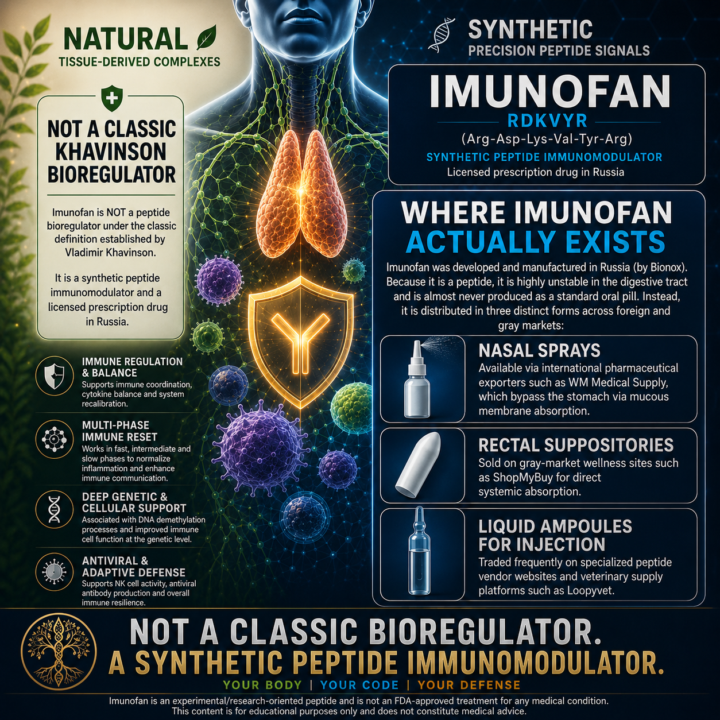
Imunofan — An Immune Reset Code?
Think of Imunofan as a reset signal for immune coordination. Not an immune booster. Not an immune suppressor. Not something designed to simply make the immune system louder. Imunofan is better framed as a synthetic peptide immunomodulator, not a classic Khavinson peptide bioregulator. The official Imunofan material describes it as an immunomodulatory drug and a synthetic analog of thymopoietin, and PubMed describes Immunofan as a chemically designed hexapeptide derived from modification of thymopoietin. Imunofan is a synthetic peptide built from six amino acids connected like six links in a chain: arginine, aspartic acid, lysine, valine, tyrosine and arginine. Scientists shorten that exact sequence to Arg–Asp–Lys–Val–Tyr–Arg, or R–D–K–V–Y–R. It is the complete six-part chain working as one signal—not six separate ingredients—that gives Imunofan its identity. Imunofan is not one of the classic ultra-short two- or three-amino-acid cytogens we have been discussing. It is a longer synthetic immune-regulating peptide, often described as being developed from the active center of the natural thymus hormone thymopoietin. In plain English, Imunofan is aimed at immune regulation — especially macrophage activity, inflammatory signaling, antioxidant defense, antiviral immune response and deeper immune-cell communication. How Does It Work? The “Immune Reset Button” Effect Imunofan is not about pushing the immune system into attack mode. It is about helping the immune system reset, organize and respond with better timing. Think of your immune system like a security network. Macrophages are the cleanup and response crews. Cytokines are the communication signals. Antibodies are the targeted defense tools. Natural killer cells are the rapid-response team. DNA regulation is the command software running underneath the system. When that network is balanced, the body can respond to threats without creating unnecessary chaos. But when the immune system becomes disorganized, the signals can get messy.
0 likes • Jul 6
Is it considered a bio regulator
Jun 5 •
🍻 TGIF Check-In
Happy Friday everyone. How was your week? Whatever's on your mind, feel free to share. Sometimes it's nice to talk about life outside of compounds, protocols, and research. Hope everyone has a great weekend. Looking forward to hearing what you've been up to.

2 likes • Jun 5
Thank god 🫶🏻💯
1-4 of 4

Active 1d ago
Joined Apr 23, 2026