Activity
Mon
Wed
Fri
Sun
Jan
Feb
Mar
Apr
May
Jun
Jul
Aug
Sep
Oct
Nov
Dec
What is this?
Less
More
Memberships
Shangriballa - Non Dual Group
89 members • Free
33 contributions to Shangriballa - Non Dual Group
3d •
Daoist keys to naturalness
"Nothing frustrates the mind more than its attempts to be spontaneously natural without any intention to do so." — Jason Gregory
0 likes • 3d
Trying to be natural on purpose is inherently frustrating. The moment the mind intends spontaneity it undermines it. This tension appears across spiritual traditions worldwide. It takes the form of a struggle between the deliberate, self-aware ego and the deeper, adaptive, mystical unconscious. Eastern mystical traditions confront this conflict most directly. Their philosophies and practices are largely attempts to resolve the paradox of effortfully returning to what is effortless. For thousands of years, thinkers and practitioners have wrestled with this same problem: how to allow naturalness without imposing intention upon it.
0 likes • 3d
Reference: White Moon on the Mountain Peak, by Damo Mitchell
5d •
Happy Birthday?
Yesterday I received the most unexpected birthday present. While getting ready for sleep, I entered a state of trance and quickly experienced qualified primal fears (fear of death, fear of others, fear of scarcity....) At first awareness would be drawn to the fear and identified with it, "I" was afraid, scared, dread. Then the fear would become familiar, less intense, letting an observer emerge. Eventually the observer would take a step back, and fears would become mere elements on a scenery. Ultimately, awareness moved from identification with fear to a stable observation position. The mind enjoyed the rest of the trance freely moving from one state to the other. Today no milk, has my fear gone away?

5d •
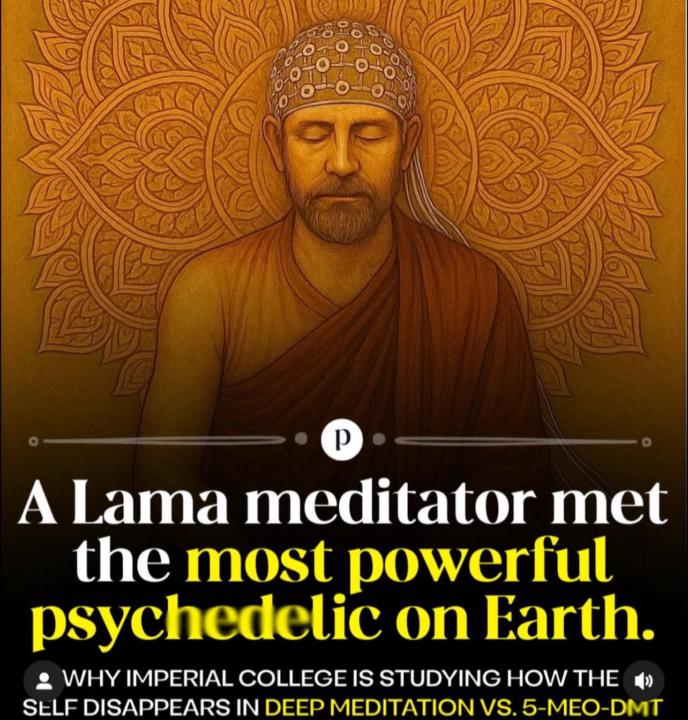
Giving 5MEO to a Lama and advanced meditator
We've all heard the spiritual talk: "Meditation can dissolve the ego," or "True enlightenment is just a moment away." But how does that stack up against a chemical shortcut, like a powerful psychedelic? Imperial College London, led by Dr. Chris Timmermann, decided to find out. They put one of the world's most advanced Mahamudra meditators—a Lama with 17 years and over ten thousand hours of practice—into the lab. The question that drives this research? Can the sense of self switch off in more than one way? The Experiment: Nond Gual vs. 5-MeO-DMT This was a first-of-its-kind experiment. They directly compared the Lama's brain and self-awareness across three different conditions, all within one protocol: - Nond Gual Meditation: The Lama entered a deep meditative state where the boundary between "me" and the world softened. He reported clarity and equanimity. - Low Dose 5-MeO-DMT: A small dose of the psychedelic, which brought imagery, emotional shifts, and a quieter sense of self. - High Dose 5-MeO-DMT: A stronger dose that completely removed the body and the environment, leaving only a bright, empty awareness. The Lama described the awareness as subtle, with no notion of the "gross aspect of self". They tracked brain data, psychological ratings, and interviews moment-by-moment. 🧠 What the Brain Waves Told Us Brain rhythms are just electrical waves that shift with different states of mind. The recordings revealed some seriously intriguing differences: - Nond Gual Meditation & Low Dose 5-MeO: The brain became quieter and more stable. Alpha activity (linked to calm focus and a quiet mind) increased, and gamma activity (linked to active thinking and intense sensory processing) dropped. - High Dose 5-MeO: This was a different beast entirely. Gamma activity increased, and the signal became chaotic. The brain signal showed high Neural Entropy (a measure of chaotic brain signal), matching the flood of intense internal experience. - - The Big Takeaway: An AI trained on the Lama's nond Gual brain activity recognized the low dose of 5-MeO as similar—they shared an overlapping neural signature. But the AI did not recognize the high dose.
2 likes • 5d
Wow, this paper is a self-doubt killer.
8d •
Effortless Mindfulness and traumas
Effortless mindfulness frames trauma work as shifting the “place you are aware from.” Core points: 1. Do not drop into traumatic material from the thinking mind. First shift into open, spacious awareness. 2. From that wider awareness, let traumatic sensations or memories appear as objects in the field, not as your identity. 3. Maintain separation: awake awareness is stable, the trauma content moves inside it. 4. Let awareness “receive” the sensations without pushing for catharsis or narrative. 5. If intensity rises, widen awareness again until regulation returns. 6. Work in short cycles. No deep immersion. Integration happens by repeated brief contact from a safe vantage. It is a regulation approach, not a replacement for clinical treatment.
1 like • 8d
How glimpses function. • They start in ordinary, thought-based awareness and open you to the awareness that’s already present beneath thinking. • Through the shift you recognize pure, open, spacious awareness itself. • Some glimpse practices explicitly invite dropping out of head-centered identification into a more open or heart-centered way of sensing awareness. • Once you experience that open or heart-mind awareness, you can carry it back into ordinary consciousness as a stable orientation to life rather than only as a temporary state.
8d •
See nothing, see the world
"When I look back, I see nothing. This is wisdom. When I look forward, I see the world. This is love." — Nisargadatta
1
0
1-10 of 33
@fathy-akrouf-4008
Exploring non-dual wisdom through direct experience and energetic practices. Inviting what remains when the sense of separation dissolves.
Active 9h ago
Joined Oct 19, 2025
ENFP
Powered by