Activity
Mon
Wed
Fri
Sun
Jul
Aug
Sep
Oct
Nov
Dec
Jan
Feb
Mar
Apr
May
What is this?
Less
More
Memberships
Handball Coaches by eduk84life
113 members • Free
8 contributions to Handball Coaches by eduk84life

26d •
Thursday Question 👀
When do you think it makes sense for young players to leave their club to take the next step? And when, if at all, is the right moment to go abroad? Curious to hear your thoughts – let me know in the comments below.

1 like • 22d
My comment regarding the female youth development next national step - for example moving to another club: - If she is truly a "talent" and has the right mindset, girls often lose their "challenge point" in local leagues very early - Physicality is often developed at an early stage - Young players need ongoing challenges in order to develop - A dual playing right—taking a leadership role in their youth league alongside a junior role in a lower-level team in the second women's league—may be a solution (e.g., in Austria: Elitecup A Bewerb WJU16 & WHA Challenge untere Tabellenhälfte) moving abroad: - During the youth stages, I would be cautious because: - A dual career (education & apprenticeship) is, in my opinion, "non-negotiable" in today's women's handball. Therefore, moving abroad would only make sense if the player joins a fully integrated elite academy (e.g., in Romania, Scandinavia, Germany, etc.). - Moving should only happen if the player is mature enough - They must be honest with themselves: "Are you ready to make the necessary sacrifices, and are you mature enough to develop into a leading player in a domestic senior league in another country?"
Apr 14 •
Performance Analysis Webinar
We’ve got another webinar coming up with Julian Rux from Handballytics.de This one is all about how we can use data in a way that actually helps us—not just collecting numbers, but turning them into better decisions for our teams. How can we: - Identify what really matters in a game? - Use data to guide our training? - Make smarter coaching decisions under pressure? That’s what Julian will break down for us—with practical ideas we can apply straight away. A great chance to steal like a coach:Take the insights, adapt them, and use them to make your team better. Looking forward to Friday—feel free to drop your questions already 👇

2 likes • Apr 14
In youth development we often rely on the "coaches eye test" which leads many times to subjective decisions. We also rarely have the budget for pro-level tracking technology. From the perspective of a youth handball academy, which is already doing the basics like periodic atheletic testing and tracking biological maturation -> what is the most underutilized, "low barrier" data point that you see would be the best for youth program tracking? How can we build a long-term profil for athletes that drive a multi-year development decision rather that just collecting "noise" (for example like goal statistics at child or teenage level)?
Apr 8 •
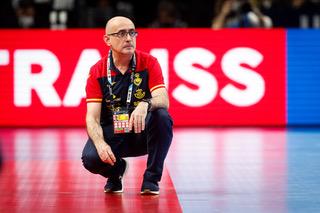
“Ask Jordi Ribera – Lessons from the Top Level”
We’re excited to host a Q&A with Jordi Ribera One of the most respected coaches in international handball. Can’t make it live? No problem – drop your question below and we’ll bring it into the Q&A 👇
1 like • Apr 14
Spain’s youth development system has been outstanding, especially considering the recent performances of the U19 squad at the World Championship 2023. With players like the Cikusa twins on the rise, hopes for the future are high. Overall question: When a senior team like Spain undergoes a generational shift, what is the biggest hurdle/challenge in translating a player's physical or individual dominance at the youth level into the high-level complexity required to thrive in the senior squad’s system?
1 like • Apr 14
Looking at recent developments of the game (especially in europe at the EHF tournaments) we see that statisically the amount of 9-meter throws decreases (https://www.researchgate.net/publication/369903587_Decreasing_number_of_distance_shooting_in_handball_-_trend_of_nowadays_male_handball_competition) and the amount of players contacts, 6-meter breakthroughs as well as the ball possessions per game increases. As the game becomes way faster and physically more challenging, how must youth development (considering physical conditioning) change or evolve so that young players can "survive" these impacts while still executing complex game tactics?
Apr 13 •
WIN OR LEARN MONDAY 🧠
Sometimes you win. Sometimes you learn. One thing you would do differently next weekend after what you saw in the last game?
2 likes • Apr 13
@Timo Issing thanks for bringing that up, as I have heard this argument from many different coaches (also from other sports). I do not want to argue against 6v6 entirely, but I do want to highlight the EHF recommendations on this topic: https://ehfel.eurohandball.com/news/en/how-handball-can-become-a-lifelong-sport-and-activity There are two specific aspects I want to pinpoint when it comes to small-sided games: 1) No Hiding: In a 6v6, dominant players often take over, and players who still need to develop specific skills end up just "sitting on the wings." With smaller groups like 3v3, we force them constantly into situations where they have to make a decision. Especially when working with young players, I like to focus on aspects like: how often does every player touch the ball? How many shots has a player taken during training? How many decisions has the player made? This isn't a concept I invented, but rather something I learned through discussions with other (far more successful) coaches. 2) Cognitive Noise: When I want players to learn a specific attacking or defensive movement (especially youth athletes), the 11 other players on the court can be distracting and difficult to process for a developing brain. By implementing small-sided games, we strip away those excess variables so they can actually learn to recognize patterns. Once those patterns are learned, we can then put them to the test in a full 6v6.
0 likes • Apr 13
@Timo Issing, just a few thoughts on that question: - How many of your training exercises involve transition play? Is there so much downtime between actions that players have time to overthink the play beforehand? You might want to look for ways to remove that "thinking time" to force faster, instinctual decisions - How often do you emphasize tempo handball during your exercises so that chaotic, unstructured situations (like 2v1 or 3v2) organically occur? - How often do your players get to experience a "fast and easy goal," where the physical effort is high, but the tactical complexity is very low?
Apr 6 •
WIN OR LEARN MONDAY 🧠
Easter often means intense games, tight schedules, and lots of emotions. What was your biggest learning from this weekend?

0 likes • Apr 8
We played a great youth tournament in prague. Players learned a lot and some players celebrated their comeback. Looking forward towards the final phase of the season.
1-8 of 8

Active 1d ago
Joined Jan 11, 2026
Graz