Activity
Mon
Wed
Fri
Sun
Aug
Sep
Oct
Nov
Dec
Jan
Feb
Mar
Apr
May
Jun
Jul
What is this?
Less
More
Memberships
Dementia Caregiver Collective
16 members • Free
Undependent Women's Community
121 members • Free
7 contributions to Dementia Caregiver Collective

11d •
Why Every Family Needs a Care Plan (Before the Crisis)
One of the biggest myths and the cause for the most debates in dementia caregiving is that families will "figure it out" when the time comes. Unfortunately, that's usually exactly when clear thinking becomes the hardest. Circumstances like a hospitalization, a fall, a wandering episode, a medication mistake, an exhausted spouse who simply can't do it anymore. These moments don't just create family stress, they expose the lack of a plan, and I want to assure you, it's not for lack of trying or wanting to have a plan, but the best time to build a care plan isn't during a crisis it's before one arrives. Dementia Is a Journey of Constant Change Unlike many illnesses, dementia is an everchanging evolution for your loved one. Abilities change, needs change, family roles change. What worked last month, or last week, or even this morning may no longer work today. That's why a care plan isn't a document you create once and forget. It's a living ROADMAP that grows alongside your loved one's changing needs. The goal isn't to predict every challenge. It's to reduce chaos when those challenges inevitably appear. A Care Plan Is More Than Medical Information When people hear "care plan," they often picture a folder full of medications, doctor's names, and insurance papers. Those things matter. But a truly helpful family care plan goes much deeper. It answers questions like: - Who is the primary decision-maker? - Who can step in if the primary caregiver becomes ill? - What routines help your loved one feel calm? - What situations tend to create anxiety or confusion? - How will family members communicate updates? - What financial and legal documents are already in place? - When will we know it's time to ask for additional help? The more these conversations happen before they're urgently needed, the easier difficult decisions become. Care Plans Reduce Family Conflict Many family disagreements don't happen because people don't care. They happen because nobody ever discussed expectations.

2 likes • 11d
The care plan is SO important. While it is sometimes difficult, it is really a gift to yourself, to your loved one and to your family.
3 likes • 11d
@Karen Saxe Eppley so sorry it’s challenging, but as you say, better now!
Jun 3 •
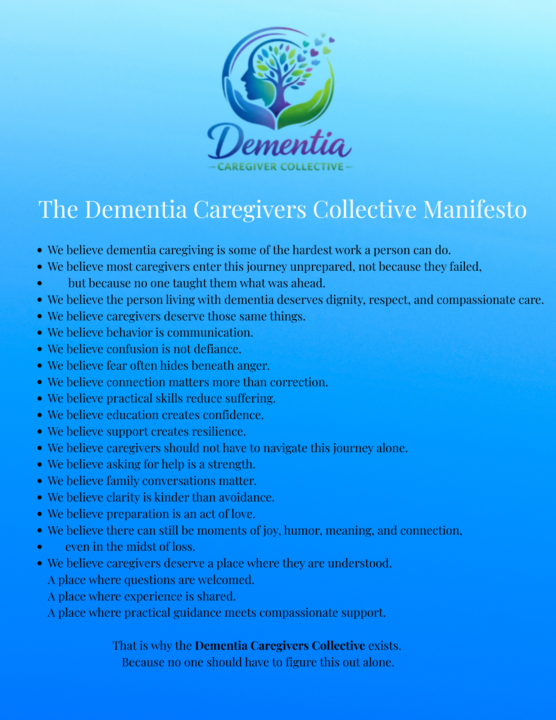
The Dementia Caregivers Collective Manifesto
Every community has a purpose. Every movement has a reason. Today we're sharing the Dementia Caregivers Collective Manifesto, the heart behind everything we do. Before there were articles, support groups, resources, or trainings, there was a simple belief: Family caregivers deserve better support. They deserve education. They deserve understanding. They deserve a place where they don't have to explain why this journey is so hard. This manifesto is our promise to the caregivers we serve and a reminder of what we stand for. If you're caring for someone living with dementia, we hope these words remind you of something important: You are not alone. Take a moment to read it and let us know which part speaks to you most. Robin & Donna
2 likes • Jun 3
Our hope is that you feel heard and supported.
Apr 22 •
When Your Patience Runs Out (And the Guilt Moves In)
There are days when patience runs out. When you feel irritated. Exhausted. Even resentful. And then… the guilt shows up. We want to say this clearly: Those feelings do not make you a bad caregiver. They make you a human being under strain. Support isn’t just about learning skills. It’s about having a place where you don’t have to pretend you’re okay.
1 like • May 6
Very well said.
May 1 •
Shifting the energy for calm
When someone with dementia becomes upset, the instinct is often to fix the situation quickly. But what helps most is slowing it down. Think of it this way: Emotion settles before logic returns. So instead of explaining… Start with:“I can see this is really upsetting.” Then pause. That pause gives their nervous system time to settle. And that’s often where things begin to shift.
0 likes • May 1
Very good advice - not easy - but powerful!!
Apr 30 •
Never the same day twice
There’s a quiet pressure many caregivers carry: “I should be able to handle this.” But dementia caregiving isn’t something most people were ever trained for. And it changes over time. What worked last month… may not work now. That’s why ongoing support matters. Not because you’re doing something wrong, but because the situation keeps evolving.
2 likes • Apr 30
So true!! it is really moving target,
1-7 of 7

@donna-descoteaux-5293
I am a medical social worker (LCSW) and psychotherapist in CO. I am honored to be working with Robin Helm, OT on the Dementia Caregivers Collective.
Active 23h ago
Joined Feb 18, 2026
Powered by