Activity
Mon
Wed
Fri
Sun
Jul
Aug
Sep
Oct
Nov
Dec
Jan
Feb
Mar
Apr
May
What is this?
Less
More
Memberships
AI for Contractors
118 members • Free
Castore: Built to Adapt
978 members • Free
Peptide Researchers
6.7k members • Free
18 contributions to Castore: Built to Adapt

5d •
The Body Doesn’t Adapt to Effort. It Adapts to Priority.
A few years ago I started noticing something that bothered me. The athletes working the hardest were not always adapting the best. Sometimes it was the opposite. The most exhausted people in the room were often the ones drifting furthest away from the thing they actually wanted. A powerlifter trying to maximize force production was also doing daily HIIT, cutting calories aggressively, sleeping five hours a night, chasing fat loss, pushing hypertrophy volume through the roof, and relying on stimulants just to feel “on” enough to train. On paper it looked disciplined. In reality it looked like biological static. The body has an extraordinary ability to adapt, but it is not infinitely democratic in how it processes stress. It behaves more like a lighthouse searching through fog than a checklist trying to satisfy every request equally. It keeps asking one question: “What is the dominant signal here?” That question matters more than most people realize. Because adaptation is expensive. Every adaptation carries an energetic cost. Tissue remodeling costs energy. Recovery costs energy. Protein synthesis costs energy. Neural efficiency costs energy. Mitochondrial turnover costs energy. Even resilience itself has a metabolic price tag attached to it. Which means the organism has to prioritize. This is where a lot of modern training culture accidentally creates confusion. People stack goals on top of goals until the system loses clarity entirely. Maximal strength. Aggressive fat loss. Peak conditioning. Extreme hypertrophy. Minimal sleep. Maximum productivity. Constant stimulation. Then they wonder why everything starts feeling muddy. The body is not refusing to adapt. It is adapting perfectly to the environment it perceives. That distinction changes everything. One of the most useful concepts in physiology is the SAID principle: Specific Adaptation to Imposed Demands. But I think people often interpret it too mechanically. They hear it and think: “If I lift heavy, I get stronger.”

1 like • 3d
Great post Great post post conversation 👍🏻
Aug '25 •
The Coach’s Protocol — Pulling Back the Curtain
The members have spoke and I listened....Most coaches talk about principles. Some share theory. Very few show you exactly what they do themselves. about to change that. I’m opening up my personal playbook, the protocol I run on myself, to show you how I structure my training, nutrition, supplementation, peptides, and recovery strategies to stay at the top of my game. This isn’t a “one-size-fits-all” plan. It’s the real system I use, built from: - Lab data and cellular feedback loops - Peptide science and mitochondrial optimization - Periodized training matched to performance goals - Nutrition timing dialed to physiology, not fads You’ll see the exact tools, dosages, timing, and reasoning I use and how I adjust based on metrics, recovery, and results. If you’ve ever wondered how a coach integrates the science into a living, breathing system… this is your chance to see it in action. Drop a 🔥 below if you want to see the full breakdown of The Coach’s Protocol.I will likely do this as a webinar. Let me know your thoughts who would be interested in seeing this to kick off our monthly case study feature.
1 like • 9d
🔥
9d •
The Lactate Primer: How 30 Seconds Can Sharpen Your Brain
For years, lactate was treated like metabolic trash. Most people learned it as the thing that causes the burn, creates fatigue, and needs to be cleared as quickly as possible. That story is incomplete. Lactate is not just a waste product. Lactate is a fuel, a shuttle, and a signal. That distinction matters because when we understand lactate correctly, we can use it correctly. Not just for conditioning. Not just for fat loss. Not just for athletes. Lactate can be used as a short-term brain and nervous system primer before work that requires focus, learning, timing, coordination, or fast decision-making. That is what I call the lactate primer. A lactate primer is a brief, high-intensity effort done before mental or technical work to create a short-lived metabolic signal. The goal is not fatigue. The goal is not punishment. The goal is to create enough intensity to raise lactate, then stop before the body starts accumulating too much stress. Think of it like tapping the accelerator before merging onto the highway. You are not trying to redline the engine for an hour. You are creating a fast signal that prepares the system for output. Here is the basic idea. You perform a short burst of high-intensity work. This could be a sprint, bike sprint, rower sprint, hill sprint, jump rope burst, kettlebell swing burst, or any safe movement that lets you produce high power quickly. As the muscle works hard, glycolysis speeds up. Glucose is broken down rapidly to make ATP. When the rate of glycolysis exceeds what the mitochondria can immediately process through oxidative metabolism, pyruvate gets converted into lactate.That conversion is not a mistake. It is a pressure-release valve. The enzyme lactate dehydrogenase converts pyruvate into lactate while regenerating NAD+. That NAD+ is critical because glycolysis needs it to keep running. Without enough NAD+, the energy line backs up. So lactate production is not the cell failing. It is the cell buying time and preserving energy flow under high demand.
0 likes • 9d
Excellent Makes sense, as I know the a certain workout can perk me up… other workouts wreck me for the day. I shall try using your recommendations strategically… especially if hitting an afternoon slump in energy with important office work still to do
12d •
You’re Wasting Your Peptides…And It’s Not the Peptides’ Fault
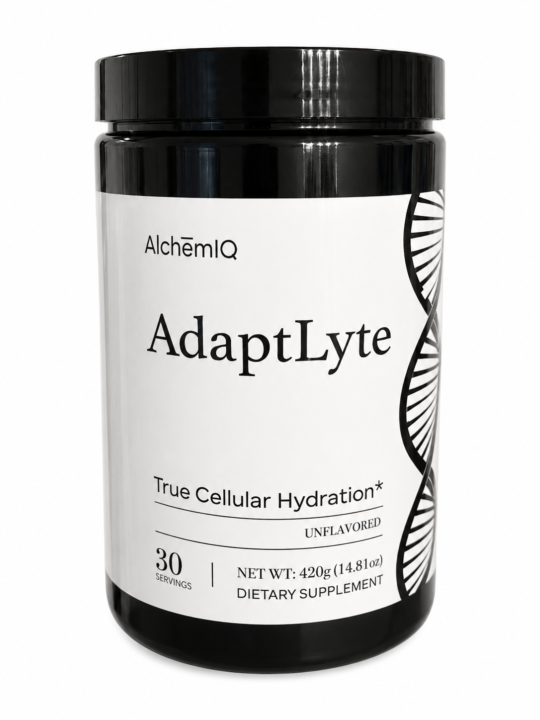
You probably aren't as hydrated as you think. “Drinking water” and “becoming hydrated” are two very different conversations Most people think hydration is solved at the kitchen sink. Fill the bottle. Drink the bottle. Repeat. Maybe toss in some electrolytes if training was hard or the sauna ran long. The internal scorecard says hydrated, the body says something else, and we keep moving. Here is the uncomfortable part. You can drink water all day and still have cells that are under-volumed, undercharged, and under-resourced. The water moves through you. It does not always move into you not where it counts. This article is about where it counts. The Two Compartments Almost Nobody Talks About When you drink water, that water enters the extracellular space first, the bloodstream and the fluid bathing your tissues. That is the easy compartment. It moves fast, it dilutes quickly, and you can pee most of it out within an hour if the terrain is not set up to hold it. The compartment that actually drives performance, recovery, and adaptation is the intracellular space. That is the water inside the cell. Roughly two-thirds of your body water lives there. It is the environment where mitochondria make ATP, where ribosomes build protein, where signaling cascades fire, where peptide messages get translated into actual biological responses. A useful analogy: extracellular water is the rain on the roof. Intracellular water is the rain that actually reaches the roots. You can have a lot of one and very little of the other, and the plant will tell you which one matters. The goal of real hydration is not to soak the roof. The goal is to get water to the roots. Cell Volume Is a Signal, Not a Side Effect This is the piece that reframes everything once you see it. A well-hydrated cell is not just a wetter cell. It is a cell with a different internal pressure and that pressure is interpreted by the body as a signal. The biochemist Dieter Häussinger’s work established that cell swelling, within normal limits, tends to bias the cell toward an anabolic, building, repairing state, while cell shrinkage tends to bias it toward a catabolic, stressed, breakdown state.
0 likes • 10d
@Anthony Castore Hey Anthony, how often should one take AdaptLyte? And timing? I’m guessing 1st thing in the morning daily… but then should we take another serving before, during or after workouts? Or would that actually be wasteful at that point because you already took it in the morning?

19d •
Want to come of TRT
What's the right way and dosage to do so? I'm reading HCG and enclomiphene but dosages and timing are all over the place. Looking for reco for someone who has done successfully. I'm 51, been on TRT for 2 years. Not seeing the great benefits other talk about, i.e. improved energy, fat loss, etc...want to give this a try. If it doesn't work I can go back on TRT. Thanks!
0 likes • 18d
I have no advice, as I am just 2 weeks into starting TRT…. But am curious as to what delivery method you use? Injections, topical cream, pellet? And frequency?
1-10 of 18

Active 7h ago
Joined Feb 4, 2026
Southwestern Ontario Canada
Powered by