Activity
Mon
Wed
Fri
Sun
Sep
Oct
Nov
Dec
Jan
Feb
Mar
Apr
May
Jun
Jul
Aug
What is this?
Less
More
10 contributions to Rishinjuku Karate
4d •
Tendon health
What do you guys do for tendon health? Our sport puts high pressure on our tendons, and making sure they're up for it might be just as important as strong muscles. In Japan most fighters don't carry around too much muscle, but they do lots of jumping rope, roadwork, sprints and jumps. Small tip: It's easy to add in some potentiation exercises (medicine ball, sandbag throws or jumps at the end of your warm up or jumps (lunge, squat, split squat, broad) at the beginning of your strength and conditioning sessions.
1 like • 3d
I don't really think about it, cause it doesn't bother me. I guess it's because I run, running will help a good amount for the tendons in the lower body and I lift heavy so my tendons in the upperbody are already used to a lot as well.
May 8 •
My current challenge
Due to an old injury, I always suffer from significant tension in my back and neck. This causes my lower back, upper back, and neck to stiffen up quickly. According to my current physiotherapist, the issue is that my left glute does not activate properly and is too weak, so it isn't doing its job correctly. I am currently working with weights to strengthen this left glute and the surrounding muscles. The goal is to get it functioning properly so that, hopefully, I can eventually continue sports and training without needing to visit the osteopath every month.
5 likes • May 9
@Filip Swennen Single leg romanian deadlift is one of the exercises i'm doing. 2nd: Weighted glute bridges 3rd: Side plank with leg lifts, bottom and top.
May 6 •
Strength and conditioning for fighters #1
This is the tl;dr version. I am in no way qualified for the advice I'm repeating here and would advise working with a professional s&c coach and consulting a medical professional before starting anything related to this kind of programming. But what I've learned so far is this: Two full body strength sessions per week are awesome. One is great. Three, four and five have diminishing returns. Meaning you'll be sore for your skills work. Always warm up properly. Then start off with plyometrics like jumps, hops and leaps. Next do your main three lifts, like squat, bench and row on one day. Deadlift (or rack pull), incline bench and a pull variation the other day. Add in some accessories (neck work, mobility exercises,...) throughout as circuits so you don't waste time waiting. And at the end to cool down. A good video on training splits for combat athletes: https://youtu.be/6FArXgCAeds?is=Vd6lUnpIqCcs_EwA
1 like • May 9
@Filip Swennen 1. Lunges (used to be back squat but with the imbalances i have to train unilateral) 2. One legged romanian deadlift (used to be normal romanian deadlift) 3. Barbell row 4. Pull ups /Pull down (i switch between the 2) 5. Barbell incline bench press 6. Overhead press
2 likes • May 9
@Serwan Scheppers I take around 8g of creatine a day. And yeah, 8 hours sleep would be great. I should start to prioritize it a bit more as well. But yeah, life... You take 10-20 grams daily? all year round?
May 7 •
Strength and conditioning for fighters #2
This is the tl;dr version. I am in no way qualified for the advice I'm repeating here and would advise working with a professional s&c coach and consulting a medical professional before starting anything related to this kind of programming. That said, here’s the basic framework I’ve learned so far: The body relies on multiple energy systems, and different types of conditioning train different systems. A good starting point is building a solid aerobic base first. Better baseline cardio improves recovery between rounds, between exchanges, and even between training sessions. It essentially gives you a bigger “engine” to support everything else. You can start with 3x 8 minutes with one minute of rest between rounds. And work your way up to 3x 15 minutes of your preferred zone 2 cardio. (Jogging, biking, swimming, assault bike, bag work, ...) Once that base is established, you can start developing: - Lactic capacity → the ability to sustain hard efforts while dealing with fatigue and acid buildup - Alactic capacity/power → short explosive bursts with high output and relatively low fatigue accumulation You can train these systems with tools like: - Assault bike - Row machine - Elliptical - Treadmill Personally, I’d prioritize them roughly in that order because they tend to give a strong conditioning stimulus with lower impact and lower injury risk compared to a lot of road running. One concept that really changed how I look at explosiveness is understanding the ATP-PC system. The body can only sustain maximal explosive output for roughly 6 to 10 seconds before those immediate energy stores are largely depleted. After that, power output drops and the body starts relying more heavily on other energy systems. That’s why true explosive training often uses: - Very short bursts - High quality output - Longer rest periods than people expect The goal is not just “being tired.” It’s training the ability to repeatedly produce high power while recovering efficiently between efforts.

3 likes • May 8
I gas out really quickly during sparring so I’ve been wondering where the problem is. I’ve been running for years, so the aerobic base is build up quite good. My tempo runs (training at 70-80% max hear rate) should cover the lactic capacity build up. I guess where it falls short is the Alactic, ATP system. Interval training is done mostly 80-90% of max heart rate so it doesn’t cover the Alactic system… Sprints will cover it but are very demanding for the body. In my opinion, the recovery time is just to long and not worth it. So I’ll have to work on the ATP system during training. However big lifts should also cover the ATP system no?
Apr 19 •
Day 7: 1R TKO
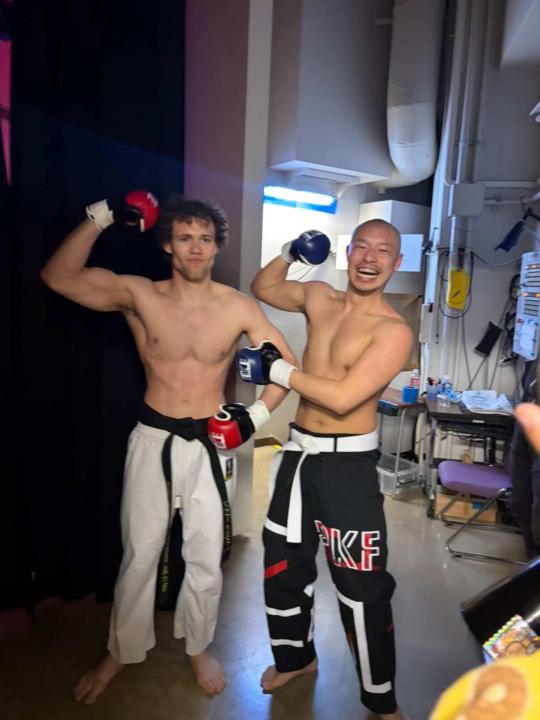
After an entire day of waiting.. And waiting.. And getting nervous... And then some warning up... And then some more waiting... And then some more nerves.. They announced a ten minute break 😫 And then the fight began. Professional card. Tatsujin Rules. Clinch, throw, ground and pound. Clinch, throw, ground and pound. Clinch, throw, ground and pound. T-K-O! Brent Dupuis won his pro debut match against an experienced Taiga Striker! And can now call himself a professional fighter. Flawless fight camp. Flawless weight cut. Flawless victory. Now, we feast! And Brent didn't event use the calf kicks we trained on the calf pad. Two weeks after our last pad session my leg still hurts...
5 likes • Apr 19
Awesome! Well done man!! Enjoy the feast! 😄
1-10 of 10

@dennie-giddelo-3578
“True success is not the absence of failure, it is the refusal to surrender.”
Active 2d ago
Joined Oct 2, 2025