Activity
Mon
Wed
Fri
Sun
Nov
Dec
Jan
Feb
Mar
Apr
May
Jun
Jul
Aug
Sep
Oct
What is this?
Less
More
Thrive Health Framework
44
Free
5 contributions to Thrive Health Framework

Sep 20 •
Resilience is how fast you bounce back
Drop a bouncy ball. It hits the ground and springs straight back up, close to where it started. Drop a beanbag. It hits the ground and just stays there. No bounce, no return. That's resilience. Not never hitting the ground. Bouncing back once you do. Everyone hits the ground. A bad night, a stressful email, a hard session, an argument. That part isn't in your control and it isn't a weakness. What's in your control is how much bounce you've got. An untrained nervous system behaves like the beanbag, it can sit flat for weeks after a hard hit. A trained one behaves like the ball, it's back up in minutes. Here's the one thing that builds more bounce: slow exhales. In for 4 seconds, out for 6, for one minute. It's the fastest lever you have on your own nervous system, and it works in the moment, not after the fact. Next time you hit the ground, don't just lie there wired. Do that for one minute and notice how much faster you're back up. That's the whole skill. Hit the ground, bounce back fast, repeat. Comment below: bouncy ball or beanbag, which one are you most days?


1 like • Sep 20
Definitely the bouncy ball 🥎
Jul 20 •
WHY YOU'RE NOT ACTUALLY UNWINDING AT NIGHT
Most people think they're relaxing in the evening. What they're actually doing is avoiding addressing what they're feeling and thinking from the day. Scrolling, watching TV, having a glass of wine. These things feel like switching off. But they're just a way of delaying the moment your brain goes quiet and everything you haven't dealt with starts coming to the surface. So instead of unwinding. You numb. And numbing is not the same thing as recovering. The thoughts, the stress, the unfinished loops don't go away because you distracted yourself. They just wait. And then they show up at 2am when there's nothing left to distract you with. Alcohol makes this worse. It might take the edge off in the moment but it fragments your sleep, suppresses the stages where your brain actually processes stress and emotion, and leaves you waking up with the same mental load you were carrying the night before... plus a worse baseline to handle it from. So what does actual unwinding look like? It's not about doing more. It's about creating the conditions for your nervous system to come down and actually processing what's been going on for you during the day. - Brain dump Before bed, spend 5 minutes writing down everything on your mind. Tasks, worries, things left undone. Get it out of your head and onto paper. Your brain holds onto unfinished loops because it's afraid of forgetting them. Writing them down tells it they're safe. And anything that needs to be done tomorrow, leave it there. It'll still be there in the morning. You don't need to solve it tonight. - Heat exposure A warm shower or bath in the evening raises your core body temperature. When you get out, your body begins to cool back down naturally. That gradual drop is one of the strongest signals your body uses to initiate and maintain deep sleep. Simple, effective, and it feels good. - Meditation Apps like Headspace or Calm are genuinely useful here, especially if sitting with your own thoughts feels uncomfortable at first. Even 10 minutes of guided meditation before bed reduces cortisol, slows the mind, and makes it easier to fall and stay asleep. This is a skill, the more you practice it, the easier it gets.
0 likes • Jul 20
Thanks Lachy this is a very timely reminder for me, new weeks, new night routine 😀
Mar 22 •
Plan for CHOAS not PERFECTION
Most people plan their week as if everything will go right. Then life happens. Work runs late - Sleep drops - Plans change - Energy is lower than expected. And the whole plan falls apart. Instead, plan your week for chaos. Assume things will not go perfectly. Build a structure that still works when they don’t. That might look like: - Having a minimum version of your training, not an all or nothing plan. - Keeping your meals simple and repeatable when things get busy. - Prioritising protein and fibre instead of trying to be perfect. - Maintaining some form of daily movement, even if it’s just a short walk. You are not trying to optimise every day. You are trying to stay consistent across the week. If a day goes well and you have more time or energy, you can always do more. But your plan should never depend on that. Consistency is not built on perfect weeks, its built on the weeks that don’t go to plan.
2 likes • Mar 22
Great advice, so easy to drop everything when the week becomes chaotic! My training and walks need to be a priority.
Feb 6 •
What to aim for when not tracking food
Start by prioritising two things. Protein. Fibre. Protein supports muscle, recovery, strength and appetite control. It helps maintain lean tissue when training or dieting. It also increases satiety, which makes appetite easier to manage. Fibre supports digestion, blood sugar stability, and fullness. There are two main types. - Soluble fibre slows digestion and helps stabilise blood sugar. You’ll find it in oats, legumes, fruit, chia seeds and psyllium. - Insoluble fibre supports gut movement and regularity. You’ll find it in whole grains, vegetables, nuts and seeds. Most people under eat protein and fibre. A simple rule: Include a source of protein and a source of fibre at every main meal. You do not need perfect numbers. You need consistent priorities.
2 likes • Feb 6
Hitting goals with the protein, I need to make more of a concerted effort with fibre. Thanks for the reminder 😃
Feb 2 •
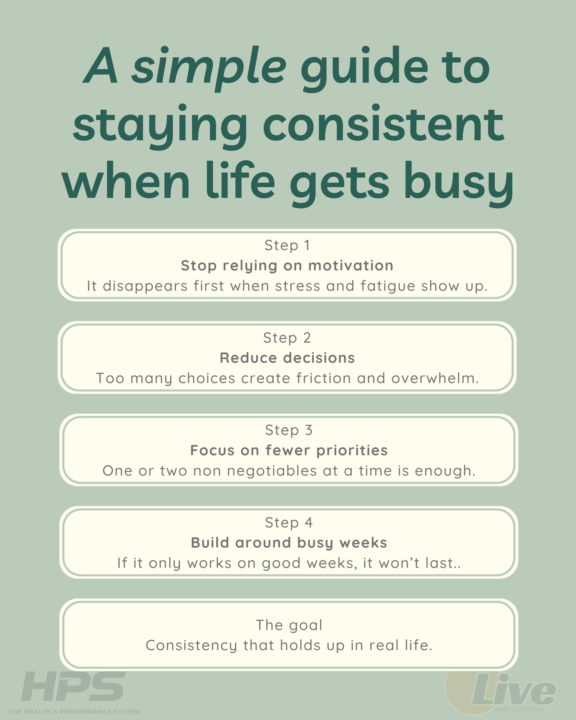
Simple Guide to Staying Consistent
This applies to training, nutrition, movement, sleep, or recovery. One focus at a time is how consistency is built.
2 likes • Feb 2
Love this 👏 for me motivation can fade but good habits and planning for busy weeks keeps things moving forward
1-5 of 5

Active 31d ago
Joined Jan 26, 2026
Colac, Victoria