Activity
Mon
Wed
Fri
Sun
Oct
Nov
Dec
Jan
Feb
Mar
Apr
May
Jun
Jul
Aug
Sep
What is this?
Less
More
Exploring Peptides Community
22.6k
5.0
Free
Hacksmith's Free Peptalk Group
2.5k
Free
BioOptimization Collective
371
Free
Pep Talk - For Better Health
3.2k
Free
DIY55 and Classy Friends
3k
Free
4 contributions to BioOptimization Collective

Sep '25 •
Where Do You Feel It Most?
Most people over 35 feel the shift in one of three ways: 1. Energy – you wake up tired and crash mid-day. 2. Body – stubborn fat, sore joints, slow recovery. 3. Confidence – not feeling sharp in the gym, at work, or at home. I want to know from you: 👉 Which one hits home the most for you right now — Energy, Body, or Confidence? Drop it in the comments. Let’s see where our group is starting, and let’s reset it together.

2 likes • May 15
Truth! It gets harder with every decade. People tell me I’m so lucky that I look like I’m in my early 50’s. Not luck, hard work and tough choices. At 67 I want to feel manageable pain while enjoying activities I love.
May 14 •
#1 concern was "Quality Control & Purity"
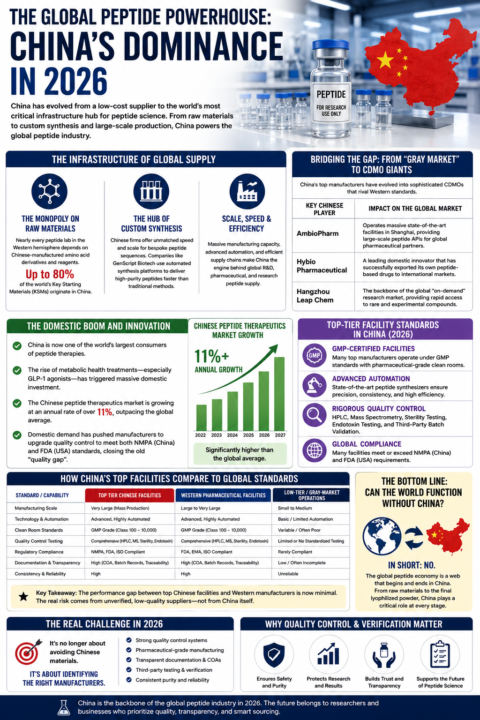
The peptide industry has changed massively over the last decade, and one of the biggest shifts has been the rise of China as the backbone of global peptide manufacturing. A lot of people still think of China only as a low-cost supplier or gray-market producer, but the reality in 2026 is much more advanced than that. Today, most of the world’s peptide supply chain runs through China in some form. From amino acids and key starting materials to custom synthesis and large-scale peptide production, Chinese manufacturing is involved at nearly every level of the industry. Even many Western peptide companies and pharmaceutical groups rely heavily on Chinese infrastructure behind the scenes. One reason for this is scale. China has built enormous manufacturing capacity that many other countries simply cannot match. Some of the top facilities are producing peptides at a speed, volume, and efficiency that has made them essential to the global market. Companies that once focused only on low-cost research products have evolved into sophisticated CDMOs supplying pharmaceutical-grade materials to international partners. The quality standards have also changed dramatically. The highest-level facilities in China today are operating with advanced GMP-certified systems, pharmaceutical clean rooms, automated synthesis platforms, and extensive quality control measures. Many now perform HPLC purity testing, mass spectrometry verification, sterility testing, endotoxin screening, and third-party batch validation comparable to major Western manufacturers. In many cases, the difference between top-tier Chinese facilities and Western pharmaceutical manufacturers has become much smaller than people realize. Some Chinese facilities now exceed smaller U.S. or European labs in production scale, automation, and turnaround speed. The old idea that all Chinese manufacturing is automatically low quality is no longer accurate. At the same time, there is still a massive gap between high-end manufacturers and lower-level gray-market operations. Two suppliers may both source from China while operating at completely different standards. One may follow strict pharmaceutical protocols with validated testing and transparency, while another may have very little real oversight or consistency.
1 like • May 15
This worries me a lot. Trying to stay healthy and don’t want contaminants in my system. I know that happens no mater what we consume but the control freak in me is in overdrive. Lol
1 like • May 9
That they really help with pain reduction.
Apr 24 •
New member
Happy to be starting this journey with you all! Retired nurse who loves everything DIY.
1-4 of 4

Active 2d ago
Joined Apr 22, 2026
Florida
Powered by