Activity
Mon
Wed
Fri
Sun
May
Jun
Jul
Aug
Sep
Oct
Nov
Dec
Jan
Feb
Mar
What is this?
Less
More
Owned by Dave
Creative Infusion Team brings bold thinkers together to spark guerrilla marketing, sharp strategy, AI and unstoppable momentum for your business.
Memberships
Skoolers
191.9k members • Free
57 contributions to Creative Infusion Team

22d •
What's the plan
@Dave Siefkes ? Guerilla Marketing is exciting, fun, fast, where is the action?

0 likes • 22d
Don’t forget to check out the CASE STUDY on Blockbuster Video and Netflix. Do you know the reason that the video industry settled on the VHS style tape, instead of the superior quality BetaCam? It was the porn industry. They decided that they were going to only release on VHS. Blockbuster didn’t want to stock two different formats of the same movie, so they standardized what the porn industry was using and that’s how that happened. I was working for United Artists early in my career. That’s when RCA introduced their VHS VCR. It was single event, manual tune recording. No remote. It was $800. In 1978, it was $800. I bought one.
0 likes • 16d
I’d love to see your response to the 3-Habit Customer Acquisition case study.
16d •
The 3-Visit Habit System for Customer Acquisition
GUERRILLA MARKETING CASE STUDY How to Turn a $1,200 Customer Acquisition Cost into $5. Most businesses chase attention. The smart ones engineer return behavior. Let’s break down how John Taffer builds loyalty on purpose. Not emotionally. Structurally. The Principle Three perfect visits create about a 72 percent likelihood of another visit. Not one visit. Not a promotion. Not a grand opening splash. Three. And he does not leave it to chance. He scripts it. Visit 1. Flawless and Marked The service is perfect. Then the server asks, “Is this your first time with us?” If yes, a red napkin is presented and explained. Now the guest is identified. Not as a transaction. As a first timer. After the visit, a postcard is mailed. Free rib dinner. Any day. No restrictions. No blackout dates. No games. Now they come back. Instead of spending $1,200 in advertising to reacquire that customer, it costs about $4 in food. Think about that. Visit 2. Relationship Layer They return for the ribs. Service is flawless again. At the end of the meal, the manager visits the table. He asks how everything was. Then he says, “Next time you have to try our chicken.” He flips his business card over and writes $5 off a chicken dinner. Now he is not management. He is their guy. They are breaking even on the chicken. They do not care. Because the objective is Visit 3. Visit 3. Cement the Habit They return. The experience is clean again. At the end of the meal the manager says, “You have to try my cheesecake.” He writes on the back of his card. Free slice of cheesecake. Now it is personal. Now there is relationship equity. After that third visit, there is about a 72 percent likelihood of another visit. Habit formed. The Real Math Traditional acquisition can run $1,200 to build a loyal customer. Taffer spends about $5 in controlled incentives. He redirects advertising money into behavioral sequencing. He does not market louder. He markets through certainty. Why This Is Guerrilla There are no billboards involved.
1
0
25d •
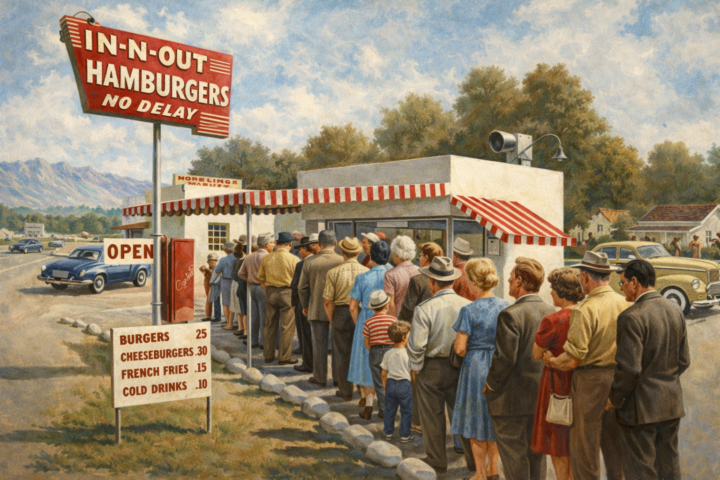
Guerrilla Marketing Object Lesson… “The Line Outside the Door”.
In 1948, Harry Snyder and his wife Esther opened the very first In-N-Out Burger in Baldwin Park, California. It wasn’t a big restaurant. It wasn’t fancy. It barely had space for customers. But something unusual started happening. There was always a line outside the door. Cars stacked up. People waited. Drivers passing by kept seeing the same thing: A crowd. And that crowd triggered a simple human thought: “If all those people are waiting… it must be good.” The line itself became the advertisement. No marketing budget. No billboards. No TV ads. Just a visible signal that something worth waiting for was happening inside. The line created curiosity. Curiosity created trial. Trial created loyalty. That’s guerrilla marketing. The Guerrilla Lesson People trust crowds more than advertising. A visible signal of demand can be more powerful than any marketing campaign. Psychologists call this social proof. We instinctively believe: If other people want it… it must be valuable. So the real question is not: “How do I advertise?” The better question is: “How do I create visible demand?” Modern Examples of “The Line Outside the Door” You see this everywhere: • Apple product launches • Nightclubs with velvet ropes • Food trucks with crowds • Restaurants with a wait list • Limited-release sneakers • Cruise deals that sell out The line signals value. And once the line appears… marketing becomes automatic. Action Items (Guerrilla Marketing in Practice) This week your mission is to engineer visible demand. Think about your business or project and answer these questions: 1. Create a Visibility Moment What could you do that would create a visible gathering of people? Examples: • A limited event • A special release • A one-day offer • A public demonstration • A live challenge • A pop-up experience 2. Limit Availability Lines form when something feels scarce. Ideas: • Only 20 spots available • First 50 customers • One-day event • A single location pop-up
1 like • 25d
My back yard was the 17th Tee at the Las Vegas Country Club. I could drive from my home to the back door of the Sahara in less than 5 minutes.
1 like • 25d
We leveraged this sell-out and generated increased ticket sales for the rest of the season.
28d •
DESIGNING AWAY CUSTOMER COMPLAINTS
B949 Passenger Experience Response. By Dr Dave Siefkes. I’ve been studying something interesting lately. When you look at airline passenger complaint data in the United States over the past year, a pattern appears almost immediately. Most complaints are not about safety. They are not about the age of the aircraft. They are not about how fast the airplane flies. They are about the experience inside the cabin. Passengers complain about tight seats. Passengers complain about fighting for overhead bin space. Passengers complain about lavatory lines. Passengers complain about unreliable Wi-Fi. Passengers complain about noisy cabins and uncomfortable temperatures. These are not complicated problems. But they are inherent problems when aircraft design decisions are made late in the process, or when marketing promises are disconnected from engineering reality. This is exactly why early integration matters. When a program starts with passenger experience integrated into the architecture from the beginning, the airplane itself begins to solve the problems that passengers complain about most. That is the philosophy behind the B949. The B949 Passenger Experience Response begins with the two issues passengers mention more than any others: seat pitch and seat width. Premium Economy on the 949 is built around a 39-inch seat pitch. That number is not random. It happens to match the spacing passengers enjoyed on the historic Douglas DC-3. In other words, the aircraft that defined early comfortable air travel had the same legroom that modern passengers would love to see again. Seat width is just as important. The 949 Premium Economy seat is designed at 21 inches wide, eliminating the shoulder compression that passengers frequently experience in narrow long-haul cabins today. When passengers feel physically comfortable, their entire perception of the flight improves. But seating is only part of the story. Another major frustration for passengers is the daily battle for overhead bin space. Anyone who has flown recently knows the ritual. Boarding begins. Passengers immediately scan for bin space. Bags are shifted, rotated, and sometimes rejected.
1
0
Mar 3 •
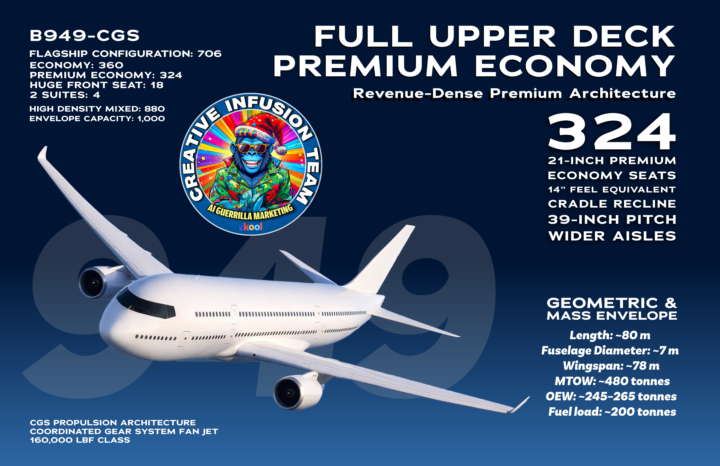
B949-CGS FULL UPPER DECK PREMIUM ECONOMY
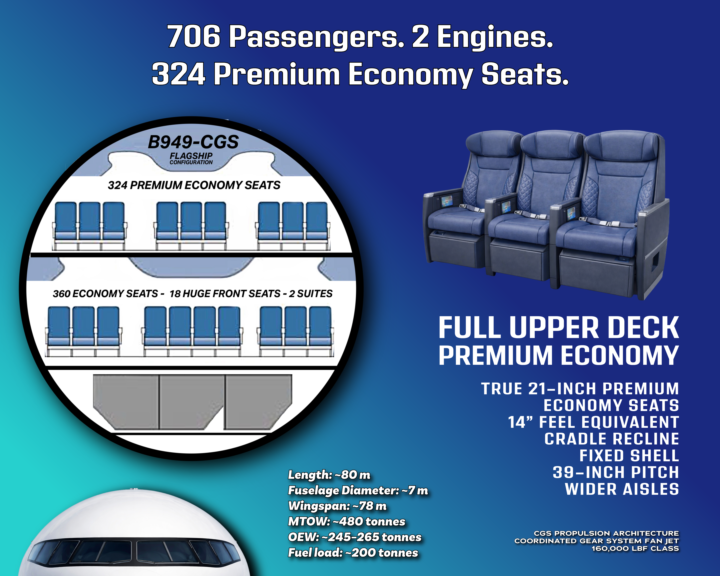
Twin Coordinated Gear System Fan Jet Engines. 706 Passengers. Comments?
0 likes • Mar 3
@Art Malik …and the other key point is… If the industry is to move forward meaningfully in the long-haul segment, propulsion confidence must be allowed to lead rather than follow, and program risk must be aligned earlier and more transparently between airframe and engine stakeholders. (JOA)
0 likes • 30d
The Three Hidden Sweet Spots of my 949 Program How the 949 Quietly Solves Three Major Industry Problems Most aircraft programs begin with engineering curiosity. The 949 begins with airline economics. When you look closely at the architecture of the aircraft, three powerful sweet spots emerge. Each one addresses a different structural problem in the global airline industry. Individually they are interesting. Together they create a compelling case for why an aircraft like the 949 could make sense. Sweet Spot 1 The Strategic Capacity Gap Today’s long-haul fleet falls into three clear categories. Small long-range aircraft carry roughly 250 to 300 passengers. Core widebodies carry about 300 to 400 passengers. These include aircraft such as the Boeing 787-10 and the Airbus A350-900. At the top sits the super-jumbo category, represented by the Airbus A380. But there is a major gap between the core widebody and the super-jumbo. The industry has never successfully filled the 500 to 650 passenger range with a modern aircraft. The 949 sits directly inside that gap. Its flagship configuration reaches about 706 passengers, yet the aircraft can operate comfortably in the 500 to 650 range depending on cabin configuration. This creates a new category: a very large aircraft that still behaves like a modern twin-engine widebody. This solves the first industry problem. Airlines need more capacity on key routes, but they do not want another super-jumbo. Sweet Spot 2 The Slot Economics Multiplier The world’s busiest airports cannot add flights. Airports such as London Heathrow Airport, Tokyo Haneda Airport, and New York JFK Airport operate under severe slot constraints. When airlines cannot add departures, the only way to grow is to increase passengers per movement. Most long-haul flights today carry between 300 and 400 passengers. The 949 concept allows airlines to move close to 700 passengers with a single departure while still maintaining twin-engine operating economics. The aircraft also aligns with a major revenue shift in the industry. Premium Economy demand is growing faster than traditional business class on many routes. The 949’s upper deck Premium Economy architecture places roughly 324 seats in the cabin that airlines are finding to be the most stable yield category.
1-10 of 57

@dave-siefkes-2437
Creative Infusion Team is a guerrilla marketing think tank creating breakthrough strategies, bold ideas, and huge growth for brands ready for success.
Active 4d ago
Joined Nov 26, 2025
Powered by