Activity
Mon
Wed
Fri
Sun
Aug
Sep
Oct
Nov
Dec
Jan
Feb
Mar
Apr
May
Jun
Jul
What is this?
Less
More
Memberships
Castore: Built to Adapt
1.1k members • Free
BC
Bio Collective
245 members • Free
Powerhouse Fitness for Women
19.1k members • Free
SJ Customer Support & Research
509 members • Free
Aminos Academy
2.1k members • Free
Research Peptide Community
1.7k members • Free
Exploring Peptides Community
19k members • Free
Pep Talk - For Better Health
3.1k members • Free
BR
Brookes research and peptides
1k members • Free
2 contributions to Castore: Built to Adapt

14d •
The Fire You Cannot See: Why The Type Of Ketone You Use Matters
A man I coach sent me a photo last spring. Not a lift, not a plate of food. A handheld meter with one number glowing on it. 2.1. Underneath he wrote, "Dialed in." He had chased that number for weeks and finally caught it, and I was happy for him. I was also quietly certain it had told him almost nothing about what was happening inside his cells. That gap, between the number a device reports and the work a cell is actually doing, is the whole argument about ketones, and it is where nearly everyone gets lost. Two people can hold up meters reading the same 2.1 and be living in completely different bodies. One fed a fire. The other smothered it. The meter cannot tell them apart. So let me take you inside the cell the slow way, and let the fire teach the rest. Inside almost every cell sit structures called mitochondria, and it is fair, almost literally, to call them furnaces. They take fuel and oxygen and burn the two together to release energy, the way a wood stove turns logs and draft into heat. What comes out is not flame but a molecule called ATP, the cell's spendable currency. The intuition of a fire holds all the way down. A fire cares what you feed it, how fast you feed it, and how much air it can pull. Get any of those wrong and the same fuel that should warm the room fills it with smoke. Ketones are a fuel for that fire. Beta-hydroxybutyrate, or BHB, is the main one. Your liver makes it from fat whenever food runs short, and your heart and brain burn it gladly. The trouble starts the moment someone sells you BHB in a tub. Here is the first thing the meter hides. When you prick your finger, it reads how much BHB is floating in your blood that instant. It does not read how much is being pulled into a furnace and burned. Those are different questions, and confusing them is the original mistake underneath almost all ketone marketing. A reading of 2.1 tells you a certain amount of firewood is stacked in the yard. It says nothing about whether any of it is in the stove, catching, throwing heat. Dump more wood in the yard than the stove could ever take, and the surplus gets hauled off. In the body the haulers are your kidneys. Past a certain blood level you spill ketones into your urine, and the meter counts that lost fuel as a triumph your cells never touch.

1 like • 4d
@Anthony Castore this came at just the right time because I want to add AKG and ketones to the start of my mitochondrial protocol I am about to run but I am completely LOST trying to find the best form/brand of ketones! The brands are endless! Do you have recommendations?
May 16 •
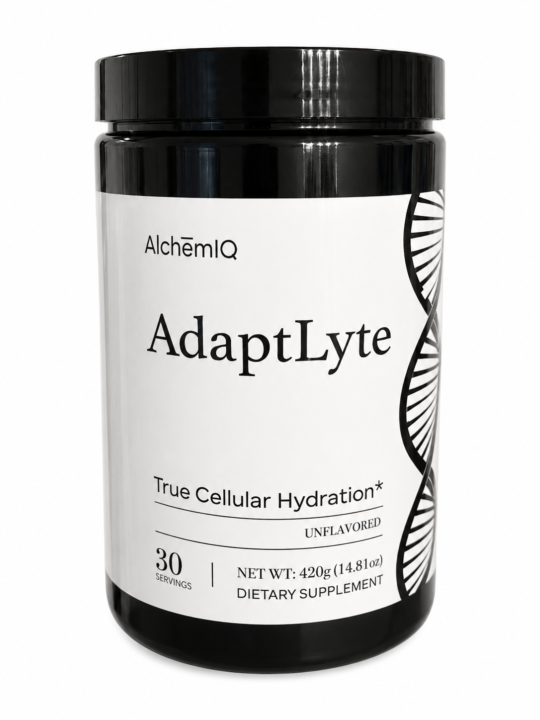
You’re Wasting Your Peptides…And It’s Not the Peptides’ Fault
You probably aren't as hydrated as you think. “Drinking water” and “becoming hydrated” are two very different conversations Most people think hydration is solved at the kitchen sink. Fill the bottle. Drink the bottle. Repeat. Maybe toss in some electrolytes if training was hard or the sauna ran long. The internal scorecard says hydrated, the body says something else, and we keep moving. Here is the uncomfortable part. You can drink water all day and still have cells that are under-volumed, undercharged, and under-resourced. The water moves through you. It does not always move into you not where it counts. This article is about where it counts. The Two Compartments Almost Nobody Talks About When you drink water, that water enters the extracellular space first, the bloodstream and the fluid bathing your tissues. That is the easy compartment. It moves fast, it dilutes quickly, and you can pee most of it out within an hour if the terrain is not set up to hold it. The compartment that actually drives performance, recovery, and adaptation is the intracellular space. That is the water inside the cell. Roughly two-thirds of your body water lives there. It is the environment where mitochondria make ATP, where ribosomes build protein, where signaling cascades fire, where peptide messages get translated into actual biological responses. A useful analogy: extracellular water is the rain on the roof. Intracellular water is the rain that actually reaches the roots. You can have a lot of one and very little of the other, and the plant will tell you which one matters. The goal of real hydration is not to soak the roof. The goal is to get water to the roots. Cell Volume Is a Signal, Not a Side Effect This is the piece that reframes everything once you see it. A well-hydrated cell is not just a wetter cell. It is a cell with a different internal pressure and that pressure is interpreted by the body as a signal. The biochemist Dieter Häussinger’s work established that cell swelling, within normal limits, tends to bias the cell toward an anabolic, building, repairing state, while cell shrinkage tends to bias it toward a catabolic, stressed, breakdown state.
1 like • 16d
I want to find out how to purchase! Just listened to you on DDT Method!
1-2 of 2

Active 16h ago
Joined Jun 26, 2026
Powered by