Activity
Mon
Wed
Fri
Sun
Nov
Dec
Jan
Feb
Mar
Apr
May
Jun
Jul
Aug
Sep
What is this?
Less
More
Bedrock Nation
177
Free
13 contributions to Bedrock Nation
Jul 18 •
7/18/26 Food For Faith: Finding Faith in Tragedy
On 6/30/26, my 33 year old brother, Daniel, died unexpectedly in a tragic car accident. There are moments in life that simply don't make sense. As Christians, we often want answers. We want to understand why tragedy happens, why prayers seem unanswered, and what God is doing in the middle of our pain. But sometimes, this side of heaven, those answers don't come. In this week's Food for Faith, I'm sharing from a very personal place—not because I have everything figured out, but because I believe faith isn't about having all the answers. Faith is choosing to trust God's character when we cannot understand His plan. The Bible is filled with people who walked through suffering, loss, and uncertainty. Joseph. Shadrach, Meshach, and Abednego. Even Jesus in the Garden of Gethsemane. Their stories remind us that God's greatest work is often happening in the moments that make the least sense to us. Romans 8:28 tells us that God works all things together for good for those who love Him—not that all things are good, but that nothing is beyond His ability to redeem. If you're walking through grief, heartbreak, disappointment, or a season that has left you asking "Why?", I pray this message encourages you. 📖 Scriptures referenced: • Isaiah 55:8–9 • Romans 8:28 • Genesis 50:20 • Daniel 3:17–18 • Matthew 26:39 I'd love to hear from you in the comments: Has there been a time when you couldn't see what God was doing, but later recognized His faithfulness? May this week's Food for Faith remind you that even when life doesn't make sense, God is still good, He is still present, and He is still writing a story that isn't finished yet.

1 like • Jul 19
I am so sorry for you loss! I cannot imagine how hard this is. I am at a loss for words. My eldest son is 33 and this is unimaginable.
Apr 25 •
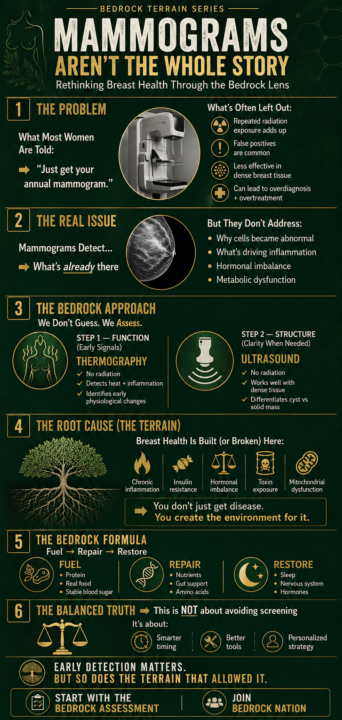
🧬 Mammograms Are Being Questioned — And It’s Time We Talk About Why
There’s a growing conversation happening right now around breast cancer screening. And it’s one that deserves more nuance than: 👉 “Just get your annual mammogram.” Because the truth is… Mammography is not a perfect tool. ⚠️ The Downfalls of Routine Mammography 1. Cumulative Radiation Exposure Mammograms use ionizing radiation. Is one scan dangerous? Mildly. But repeated exposure, year after year, decade after decade… 👉 That becomes a cumulative burden on the body. Especially for women already at higher genetic risk. (Like me!) 2. High False Positive Rates Up to 50–60% of women will experience a false positive over time. That means:• Unnecessary imaging• Biopsies• Anxiety and stress We’ve normalized a system that often creates fear… without clear answers. 3. Overdiagnosis Not every detected tumor is life-threatening. Some are slow-growing and may never cause harm… Yet are still treated aggressively. 👉 Detection without context can lead to overtreatment. 4. Not Effective for Dense Breast Tissue Many women (especially lean, athletic, or younger women) have dense breast tissue. Mammograms often: ❌ Miss tumors in dense tissue ❌ Provide a false sense of security 5. A System Focused on Detection — Not Cause This is the biggest issue. Mammograms look for :👉 What’s already there They do NOT address: • Why the tissue became vulnerable • What’s driving abnormal cell growth • The internal terrain that allowed it 🌿 Our Approach Is Different At Bedrock, we don’t rely on a single tool. We take a terrain + strategy approach. 1️⃣ We Assess Risk First Not every woman should follow the same screening schedule. Factors matter :• Genetics (BRCA, family history) • Metabolic health • Hormonal patterns • Lifestyle + toxin exposure 👉 “Assess, don’t guess.” 2️⃣ We Use Thermography as a Functional Tool Thermography looks at: • Heat patterns • Blood flow • Inflammatory changes ✔ No radiation ✔ Non-invasive ✔ Can detect early physiological changes This gives us insight into function before structure.
0 likes • May 13
I stopped doing Mammograms after the first one. That was in the early 2000s I believe. It was said I had "dense" tissue and they wanted me to come back for more. By that time, there was a message board online that I learned about the cons involved. I use to get pressured a great deal by friend groups and family to do this annual screening. So, I just ended up not stating my stance. I had one fiend that had breast cancer claim she wouldn't be alive without them; and, she's still a strong advocate for them. It's really sad people aren't willing to update their beliefs when new information is presented.
Apr 26 •
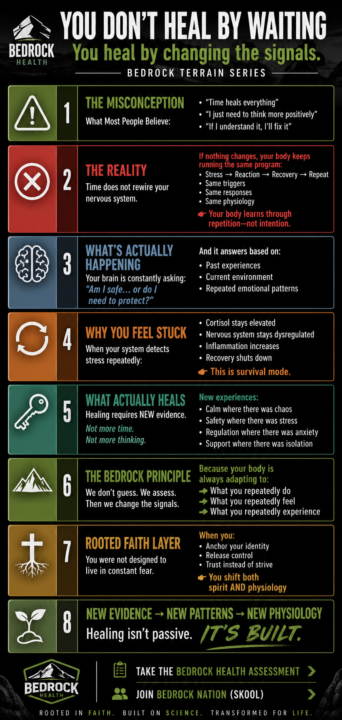
You Don’t Heal by Waiting — You Heal by Changing the Signals
You do not heal simply by waiting. You heal when your body experiences something different enough to stop expecting danger. 🧠 Your Body Is Not Broken — It’s Patterned Your brain and nervous system are constantly asking one question: 👉 Am I safe… or do I need to protect? And it answers that question based on: • Past experiences • Repeated environments • Emotional patterns• Stress physiology Not just what you think…But what your body has learned to expect. ⚠️ Why So Many People Stay Stuck If nothing changes, the system doesn’t change. If you stay in: • The same stress loops • The same relationships • The same emotional reactions • The same metabolic state Then your body keeps running the same program. 👉 Elevated cortisol 👉 Dysregulated nervous system 👉 Chronic inflammation 👉 Survival mode physiology Time alone does not fix that. ❌ What Doesn’t Create Real Change • Waiting• “Thinking positive”• Talking about it without changing inputs• Replaying the same patterns and expecting different outcomes Insight is helpful… But insight without new experience does not rewire the body. 🔑 What Actually Heals the Nervous System Healing happens when the body receives new evidence: • A calm response where there used to be reactivity • A safe conversation where there used to be shutdown • A supportive relationship where there used to be stress • A regulated moment where there used to be anxiety These moments matter because they shift: 👉 Nervous system signaling 👉 Hormonal output 👉 Brain pattern recognition 👉 Cellular environment This is terrain work. 🌿 The Bedrock Principle We don’t guess. We assess. And then we change the signals. Because your body is always adapting… The question is: 👉 What are you repeatedly teaching it? ✝️ The Rooted Faith Layer Healing is not just biological… It’s spiritual alignment too. Because many people are living in a constant state of: • Fear • Striving • Uncertainty • Identity confusion But Scripture reminds us: God did not design your body to live in constant fear.
1 like • May 13
I think it's time for an updated assessment. I'm down to the lowest weight I've been in decades. I'm at 143 and just purchased my first pair of size 6 yeans since High School. I religiously take my ID Life Nutrition, although admittedly fall asleep sometimes without taking the evening pack so inevitably end up with extras at the end of the month. I need to work on my evening routine. I've been doing the quarterly detox, the bioage, (so glad I took advantage of those deals, ID Life Load, the Bioptimizers, the IDLife collegen, plenty of Sallt, and calm. Also, I really think the Gut Stack has helped improve my gut function. I'm working on incorporating the other things such as the Brain Tap, lymphatic massage, and movement. My partner and I do a good amount of fishing and when we go, it's a long walk to the bathroom. I use to struggle and become winded. Now, it's an easy walk and I get some exercise in. I've also noticed and it was confirmed by my eye exam that my vision has improved. I'm so grateful and inspired.
May 4 •
Food for Faith 5/4/26: Surrender Sucks
I’m going to be really honest with you today… Life… just feels heavy right now. If I’m being real—what I want more than anything is to disappear for a while. To go quiet. To isolate. To just… hibernate until things feel better. But at the same time,I can feel God pressing on my heart… “Let go of control.” And I know that voice.I’ve taught that message.I’ve shared it.I believe it. But right now? I’m struggling to live it. Because the truth is—I don’t like how things look right now. This isn’t where I want to be.This isn’t how I thought things would go.This isn’t how I want to feel. And there’s a part of met that’s still clinging tightly to how I think this should all play out. And if I’m being even more honest… That tension? It’s making me feel bitter. Broken. Even… a little hypocritical. Because how do you tell people to trust God—when your own mind is fighting it? But I think this is the part we don’t talk about enough. Surrender isn’t a one-time decision. It’s a battle. A daily, sometimes moment-by-moment choice between control… and trust. And right now,I’m in that fight. Not on a stage. Not from a place of having it all figured out. But right in the middle of it. And maybe that’s the lesson. That faith isn’t proven when everything makes sense. It’s built when everything in you is resisting—and you choose to soften anyway. So today… I’m not coming to you with answers. I’m coming to you in the process. Learning—again—that God doesn’t need my control. He’s asking for my surrender. Even when I don’t like it. Even when I don’t understand it. Even when I’d rather run the other direction. And maybe you’re there too. Feeling stuck. Resisting what is. Holding to what you wish it looked If that’s you… You’re not alone. We’re both learning this together: Let go…so God can actually move. Scripture: 📖 Proverbs 3:5–6 📖 Matthew 11:28

1 like • May 11
This made me cry. And it makes me mad at myself for not being better. For living in fear, as I don't like what I see around me, either. I feel all alone, even though I know I'm not. I was meant to see this today.
May 6 •
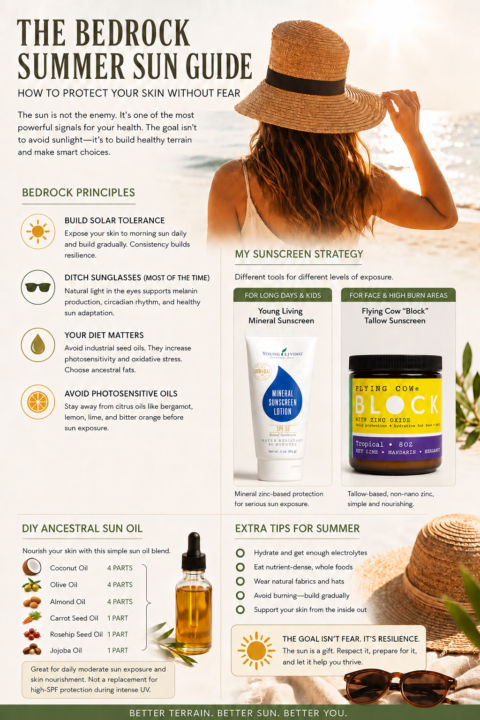
THE BEDROCK SUMMER SUN GUIDE
THE BEDROCK SUMMER SUN GUIDE How to Protect Your Skin Without Fear For years, we’ve been taught to fear the sun. Avoid it. Block it. Hide from it. But the truth is more nuanced than that. The sun is not the enemy. Sunlight is one of the most biologically important signals your body receives: * It regulates circadian rhythm * Supports mitochondrial function * Helps regulate hormones * Supports nitric oxide production * Helps produce vitamin D * Improves mood, metabolism, sleep, and immune function The problem is not the sun itself. The problem is modern terrain. Today’s skin is often: * inflamed * overexposed to processed seed oils * nutrient depleted * chemically burdened * disconnected from natural light cycles That combination changes how the body responds to UV exposure. So instead of fearing the sun… we should focus on building healthier terrain. ⸻ ☀️ BEDROCK PRINCIPLES FOR HEALTHIER SUN EXPOSURE 1. Build Your Solar Tolerance Gradually Your skin adapts to sunlight over time. One of the worst things you can do is: ❌ spend months indoors → then suddenly spend 8 hours in intense summer sun That is not ancestral living. Healthy sun adaptation looks more like: * daily morning sunlight * regular outdoor exposure * gradual seasonal adaptation * avoiding sudden overexposure The body builds resilience when exposure is consistent. ⸻ 😎 2. Avoid Wearing Sunglasses During Normal Daily Sun Exposure This one surprises people. Your eyes help regulate your body’s response to sunlight. Light entering the eyes influences: * circadian rhythm * melanin signaling * hormone production * seasonal adaptation Constantly blocking natural light with dark lenses may interfere with these adaptive signals. Now to be clear: This does NOT mean stare into the sun. And there are situations where eye protection absolutely makes sense: * snow glare * high-altitude reflection * boating/open water * safety/work environments But for normal daily outdoor exposure, allowing natural light into the eyes may support healthier light adaptation and melanin signaling.
0 likes • May 11
I've noticed that I burn less than I use to; and, I spent several hours at the beach yesterday. I do wear a hat and have an umbrella; but, I'm not burnt. I do need sunscreen; so, this is perfect timing to see this. I need to stock up for the summer.
1-10 of 13