Activity
Mon
Wed
Fri
Sun
Jun
Jul
Aug
Sep
Oct
Nov
Dec
Jan
Feb
Mar
Apr
What is this?
Less
More
Owned by Christopher
Birding expert and wildlife artist Christopher Cudworth brings birding to life
Memberships
Skoolers
192.9k members • Free
30 contributions to Art of Birding

5d •
Bluebirds are something else
There's a fact about blue birds (of any kind) that may surprise you. They're not really blue. Not like you might think, anyway. Their feathers capture all light spectrum, releasing only blue, so it's rather an illusion. But let's talk about bluebirds, the species. Specifically, Eastern bluebirds. There are Western bluebirds in North America, and Mountain bluebirds where you might expect to find them, high in alpine conditions in Colorado and other states. Those are both beautiful species too. Eastern bluebirds are the kind of unreal blue I really love. It's always been my favorite color since I was a child. I even liked blue Christmas lights the best. Yet that doesn't make it any easier to paint them. Bluebird blue falls into its own category, and it takes some paint mixing in watercolor or acrylic to create something resembling the correct color. Fifty years ago when I started birding, Eastern bluebirds were hurting as a species. Thanks to thousands of volunteers across the country, they're back! I love photographing them whenever I find them, and these days, it's thankfully quite often. Their modest calls are barely musical, but charming. I hope you enjoy them too. Look for them in open woodlands and forest preserves where big oaks offer them places to perch, fly down and catch bugs. The females are slightly less blue, and still pretty. They sometimes stay the winter here in Illinois, and their appearance when the snows first melt is a first sign of spring, a moment I captured in this painting. I've also shared a short video of a bluebird calling at Elburn Forest Preserve.
0
0

10d •
Birds aren’t perfect at everything
I looked out the window to find a house sparrow project gone wrong. I’ve seen overstuffed bird nests before, but this one beats all. I don’t know what the plan was here. Perhaps a sparrow with ADHD like me? Or else someone in the residence is a hoarder sparrow who can’t stand to give away good material? Or perhaps there’s a subplot. House sparrows often compete with house wrens for nesting boxes. Some wrens will make multiple nests just to keep other birds out. It’s all messy business in some corners of the bird world. #birds #birders #sparrows #bird

11d •
Snowy Egrets have yellow feet!
One of North America’s all-white egret species is best identified by its bright yellow feet.
1
0

17d •
"You old coot"
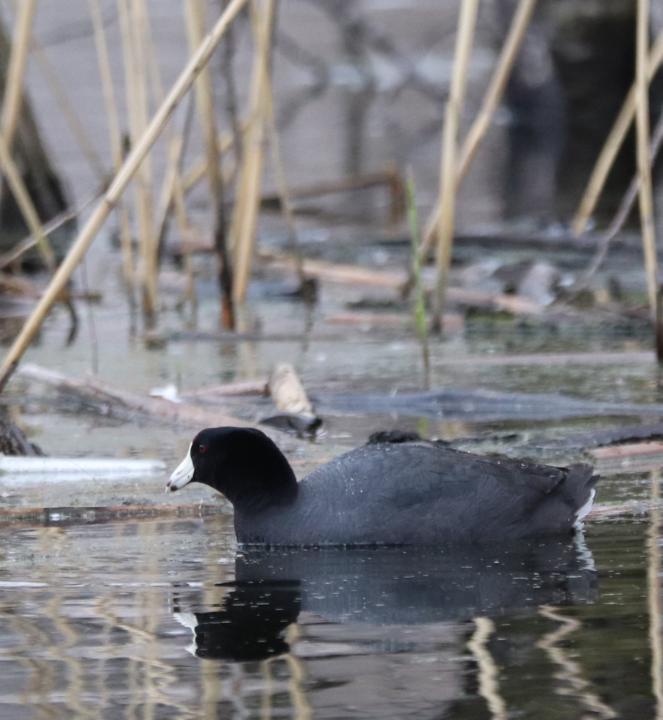
The wetland behind our home is busy with water birds of many kinds this spring. I took photos of the coots feeding in the shallows backing up to our home. They are quite beautiful birds when you take a moment to admire their black and grey plumage at close range. Their white bill is visible from quite a distance, and along with their bobbing swim motion makes them easy to identify from far away. Their voices are a mix of cackling notes and calls, which is perhaps why they're the source of the phrase "You Old Coot..." as described in this AI summary of that idiom's origins: You old coot" is an informal, often affectionate or mildly derogatory phrase used to describe an old man who is considered eccentric, stubborn, crotchety, or set in his ways. It typically implies someone who is harmless but cranky or simple. The term stems from a "coot" being a type of waterbird, with usage dating back to the 1700s. Key Aspects of "Old Coot" - Definition: A slang term for an old person, especially a man. - Characteristics: Often used to describe someone stubborn, eccentric, touchy, or possessing a negative outlook. - Usage Context: It can be used as a good-natured, playful jibe among friends or as a grumpier, slightly insulting remark. - Origin: It derives from a bird (the American Coot), which was historically considered a simple or "foolish" bird. There you go! If you like The Art of Birding please share with your network. Let's grow this community!
1
0
18d •
Female red-wing beauty
One of the first birds that confused my brothers and I when we started birding in the early 1970s was the female red-winged blackbird. We were all wedged into the maroon Buick Skylark to go "birdwatching" together after my brother came home from college having taken an ornithology course. We had the radio on the first few miles listening to "Where did our love go" by the Supremes https://www.youtube.com/watch?v=qTBmgAOO0Nw when someone looked out the window at a streaky brown bird perched on a bridge abutment. We passed our Sears 10 x 50 binoculars around in succession while leafing through my first copy of Peterson's Field Guide to the Birds, given to me by my Aunt Carol when I was five, and finally we figured out what this 'mysterious' bird really was. That' s how all birders start in this world. We learn the common birds and form a baseline knowledge of what we expect to find. Then we can separate female blackbirds from sparrows (that sharp beak tells all) and learn what habitats we expect to find them in. The Art of Birding is a cumulative process. Enjoy every step!
0
0
1-10 of 30
@christopher-cudworth-6093
I’m a licensed teacher, birder and competitive athlete. Also a writer, artist, and naturalist.
Active 2d ago
Joined Jan 13, 2026
North Aurora, Illinois