Activity
Mon
Wed
Fri
Sun
Aug
Sep
Oct
Nov
Dec
Jan
Feb
Mar
Apr
May
Jun
What is this?
Less
More
Owned by Travis
Learn how to find, fund, and buy profitable small businesses
A community for community owners who want to make a respectable income and low-stress living running ONE community for ONE hour per day.
Memberships
Software UGC
71 members • $299
Carl's Golden Ticket Auction
681 members • Free
Creator Marketing OS
139 members • Free
Recess
618 members • Free
Freedom Dads - Side Hustle Fun
17 members • Free
Genius Marketing
94 members • Free
7-Figure CashFlow Biz™
820 members • Free
Accelerator University
10.1k members • Free
Collab Club
308 members • Free
79 contributions to Make Em Beg to Buy

4d •
Over 10 years ago I nearly handed my business to an agency I couldn’t afford.
I had a few hundred quid. Agencies wanted a couple grand a month. Plus ad spend. Plus all the risk on me. Every pitch was the same: "We can scale this. We know exactly what to do. We'll make you loads." So I asked: if you're that sure, why won't you do rev share? Nobody had a good answer. So I built the audience myself. Badly. But the thing that grew the business wasn't the content. It was the replies. A trader emailed saying he kept opening Betfair with no clue what to trade. So I wrote: "Why most traders open Betfair and still don't know what to trade." More traders replied: "That's exactly me." That became the machine. Listen. Write. Reply. Write again. 300 people on the list. Tiny. But they talked back. And a small audience that talks back is worth more than a big audience sitting there like wet cardboard. The community was only £30/month. Easy to think that was the asset. It wasn't. The gold was distribution. Knowing what people cared about before I built the next offer. Finding sales messages hidden inside annoyed little replies. The first project I helped outside Betfair was photography. Different niche. Same machine. 50 people in fast. This was never a Betfair thing. It was a distribution thing. And distribution lets you move into better offers. Not £30/month. Maybe £1,000/year. Same logic, bigger problem, hungrier audience, better economics. Most people get this backwards. They think the offer is the machine. It's not. The audience is the machine. Because when you own the audience, you don't have to guess what people want. You don't spend months building something nobody cared about. Your audience tells you first — the pain, the objections, the thing they'd pay to stop dealing with. That matters more when you've got more money than time. You don't need another project to babysit. You need leverage. The thing that saves you from building the wrong offer. Not the membership. Not the content. Distribution. So the question isn't "what offer should I build?"


2 likes • 2d
Yes! Very few “see” this @Ryan Carruthers
1 like • Jan 12
@Monther Halema there are lots of tools in this world. People are overwhelmed when they focus on the tools WITHOUT knowing what they are trying to build. Once they know what they want to build… What tools they need becomes obvious. What do you want to build?
1 like • 13d
@Reetesh Bhardwaj wow! thank you!! I might need to print and frame this:-)
May 19 •
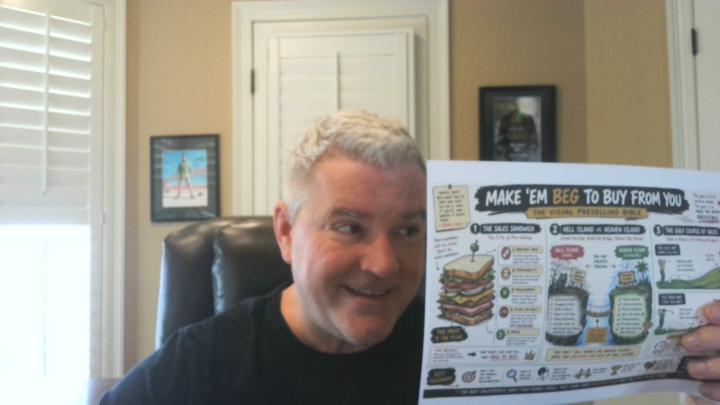
You want? (Visual Preselling Bible)
See pic. The whole Make Em Beg to Buy from You book is in a downloadable and PRINTABLE PDF! Would you like it? Sound off 👇
1 like • May 19
@Tony Teegarden Hee, hee! you're not wrong!
0 likes • May 19
@Matt C. Milne LOL, thanks man!
Feb 24 •
a few grand a day
I wake up. I grab coffee. I respond to a few emails. I respond to some DMs. I make a few grand. Good enough. I 💓pre-selling in email and communities. Then making an invitation. It's low stress. It pays well. I don't even need my own list or community to do it. 🪱Am I a weird, lazy slug? or is this something you'd dig too? 👉On a scale of 1 to 5... Where one is, I'd rather take a kick to my crotch than find out more about this. and... 5 is...I'd TAKE a kick to the crotch to do this NOW! Where ya at? 👇👇👇
Poll
41 members have voted
1 like • Feb 24
@Farooq Bey thank you for asking! It's rare I do any 1:1. See ☝️ I hang out and help in my communities though.
0 likes • Feb 24
@Alain Tanguay 😆

Feb 3 •
$1029 + Dozens of Ready to Buy Leads in 2 hours 10 mins
Last night something interesting happened. A friend of mine ran a quick auction in her FREE community. She had… maybe 55 people in there. She offered a license to one of her old courses. (One that’s quietly sold 900+ spots over the last couple years.) Then she did something very unsexy. She said: “Bidding starts at $1.” That was the auction. Just over 2 hours later: – One person had paid her $1,029 – The post had 249 comments – People were openly saying what they’d pay – Lurkers suddenly had opinions – And new people started joining just to watch This morning that little community is at nearly 100 peeps. Now… the $1,029 is nice. But that’s not the thing. The cool thing is what she actually has sitting in front of her. Those comments weren’t “engagement” but are people saying: “I want to license your stuff.” “I’ve got cash.” “And this is roughly what I’d pay.” Those are ready-to-buy-now leads. So while everyone looks at the $1k and goes “cool, quick win”… She’s about to make more than that over the next few days just by sorting and sifting through the bidders. She knows exactly: – who’s interested – who has money – and roughly their budget All from one post. Anyway… watching this play out made me realise how differently people look at this stuff. Some folks see it and go, “Yeah, Chris I already know all about auctions.” Some think, “Huh… that’s interesting.” And some think, “That’s dumb. I’d never do that.” So I’m curious… Where are you?
Poll
14 members have voted
5 likes • Feb 4
Right on @Chris Dyson! I love your breakdown. Auctions are a great PRE-SELL strategy. Nobody is more presold than when they’ve bid 2,3,4 or more times.
1-10 of 79
