Activity
Mon
Wed
Fri
Sun
Nov
Dec
Jan
Feb
Mar
Apr
May
Jun
Jul
Aug
Sep
Oct
What is this?
Less
More
🏠 Lower Taxes w/ Ryan
1.5k
5.0
$1/y
10 contributions to 🏠 Lower Taxes w/ Ryan

May 7 •
My Starter Post!
As a father of 2 little kids, I am looking for ways to make my earnings more diversified and resilient, to make sure I can take care of my family. I am just starting out, thinking of getting into STR, but want to make sure I set up the right structure from the get go. My challenge is, where to start, what is the right legal entity I need to set up for tax shield purposes, as well as which property(ies) to acquire.

3 likes • May 19
Hi Ricardo, that is a very lengthy question to answer via blog post. Might I suggest you join our Skool live Q&As held on Fridays?

May 13 •
STR owner-builder new construction
I'm building new construction STR on land I purchased 3 years ago. Plan is to have it completed and rented by December, do a Cost Seg Study and qualify for 100 active participation for STR loophole and bonus depreciation. I have two long-term rentals but I'm new to STR's and real estate investing/tax strategy. Any tax tips for new construction? I'm doing some of the labor myself.
1 like • May 19
Are you building the entire home from the ground up? When is the property expected to be completed?

Apr 27 •
Roth 401k
Good Monday morning everyone. A question about Roth 401k: Since these are post-tax contributions, is the government still our silent partner on this account? Is this included in RMD? When can we start taking distributions without penalty on this account? How is it different from a Roth IRA? @Ryan Bakke, CPA @Mason Kimball, CPA @Kevin Medina, CPA, MBA
0 likes • May 1
Hi @Ryan Bakke, CPA @Cristina Diaz mentioned she watched the podcast and you referenced a specific worksheet during the video, but I can't find it in Skool to send to her. Do you have a link to the spreadsheet?

Apr 8 •
Tax deduction question
Hi all, We recently changed the carpet in our STR with a different flooring. We did the work ourselves and we bought some equipment to use for the installation. Is the equipment tax deductible in this case? Thanks in advance
0 likes • Apr 9
@Esin Seref Dibirdi 100% correct. This can all be expensed on the P&L.
0 likes • Apr 10
@Esin Seref Dibirdi I know we answered this on the call, but the $2,500 is not an annual limit it is on an asset by asset basis. So any piece of equipment less than $2,500 in cost will be immediately expensed and anything greater than that needs to be added to the depreciation schedule and depreciated. However, the asset can be 100% bonus depreciated, so it has the same effect, but different reporting on the tax forms.

Mar 31 •
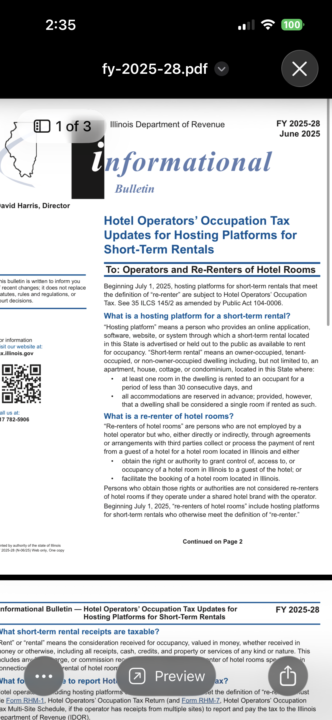
State OF IL HOOT
I had stopped Airbnb is from collecting and remitting Illinois Hotel Operators’ Occupation Tax (HOOT) for my listing, until recently they added themselves back and I cannot remove them. But I received guidance from IDOR saying that as of 7/1/25: - Airbnb is now a “re-renter” - Hosts are still responsible for the state tax - And our obligation isn’t eliminated even if Airbnb already paid So I’m confused: - Are we supposed to file/pay anyway (risk of double tax)? - Or just file and report $0 due? - Has anyone gotten clear guidance or handled this already? Feels like a disconnect between Airbnb and Illinois — would love to hear what others are doing.
2 likes • Apr 9
Hi @Jennifer Shear, I totally understand the confusion. IL is essentially creating a dual responsibility structure. Airbnb collects and remits; however, the host (you) are still required to file the returns. My advice would be to file the HOOT return and report the gross receipts and take a deduction and/or exclusion for the tax paid via Air bnb to eliminate any taxes due while still being in compliance with the filing requirements. You should not be double paying the taxes.
1-10 of 10