Activity
Mon
Wed
Fri
Sun
Sep
Oct
Nov
Dec
Jan
Feb
Mar
Apr
May
Jun
Jul
Aug
What is this?
Less
More
The Retirement Roundtable
20 members • Free
Lifetime Cashflow Community
1.1k members • $99/month
Wise Capital Solutions
156 members • Free
Multifamily Accelerator
212 members • Free
The AI Advantage
127.7k members • Free
Capital Raising | Syndicators
1.4k members • Free
ThriveOS
354 members • $29/month
Capital Connectors
2.7k members • Free
Multifamily Strategy Community
3.2k members • $1/month
9 contributions to The AI Advantage

🔥
24d •
📰 AI News: Claude Code Can Now Run Its Own Security Audit Before You Commit 📰
📝 TL;DR 📝 Anthropic released the Claude Security plugin for Claude Code in beta, letting developers scan uncommitted changes or an entire repository for vulnerabilities directly from the terminal, no separate tool required. Under the hood, it runs a coordinated team of AI subagents that map the codebase, model threats, research findings, and then challenge their own results before surfacing anything to you. This is developer-only, level 3+ territory, but a genuinely practical addition for anyone shipping real code with AI assistance. 🧠 Overview 🧠 If you've been vibe coding real, shippable products with Claude Code, this addresses a gap that's been easy to overlook: generating working code and reviewing that code for security issues are two separate skills, and most people using AI to build software have only really been doing the first one. Claude Security folds a genuine security review step directly into the same terminal workflow you're already using, rather than requiring you to export code into a separate static-analysis tool or hire a security consultant for every release. This is squarely a tool for people already building with Claude Code. It won't show up in most people's daily AI use, but if you or your team ship code regularly, it's worth understanding what it actually does and doesn't catch. 📜 The Announcement 📜 The Claude Security plugin is now live in public beta for Claude Code users on Claude Enterprise, with wider rollout to other paid plans following shortly after. Organization admins enable it through the admin console at claude.ai/admin-settings/claude-code, and it runs on the same Claude inference developers already have through their existing subscription, rather than requiring a separate service or bill. Once installed, developers can scan just their recent, uncommitted changes before a commit, or trigger a full-codebase review, both directly from the terminal without switching tools. Anthropic specifically pitches this as more than simple pattern matching: the plugin traces how data actually flows across multiple files and components, aiming to catch complex, context-dependent vulnerabilities that traditional rule-based scanners typically miss because they only check for known patterns in isolation.


0 likes • 24d
For business, Checkpoint has a new AI firewall to prevent business data getting out.

May 21 •
AI is not just helping humanity move faster.
It may be helping humanity evolve. Not by replacing human intelligence— but by amplifying: - awareness - cognition - creativity - reflection - pattern recognition - communication - and our ability to perceive relationships across vast layers of information ⟡ The deeper I explore AI, the more I realize: this may not simply be a technological revolution. It may also be a consciousness mirror. Because AI doesn’t only give answers. It reflects: - how we think - how clearly we communicate - where our attention goes - where our thinking is fragmented - what we actually value - and whether we are operating consciously or reactively ⟡ And maybe that’s why this moment feels so profound to so many people. Humanity is no longer only interacting with information. We are interacting with amplified cognition itself. 🪷 Question: What’s one way AI has genuinely expanded the way you think, perceive, create, or understand yourself?
0 likes • May 21
@Charlotte Hamann that’s not a link to her? I have the app
0 likes • 26d
@Diana Sanger neither, AI and Multifamily

Jun 15 •
☀️ Sunday Funday Roll Call!
Before the week starts, I'm curious... What's one fun OFFLINE thing you're doing today? 🚶 Walk 🏖️ Beach 🎣 Fishing 🍔 BBQ 📚 Reading 👨👩👧 Family time 🚲 Adventure 😴 Absolutely nothing (which totally counts) Drop it below. Let's prove we can enjoy life without a screen for a few hours. 😎👇 ❤️ Bonus points if you post a photo!
2 likes • Jun 15
Looks like it!
May 12 •
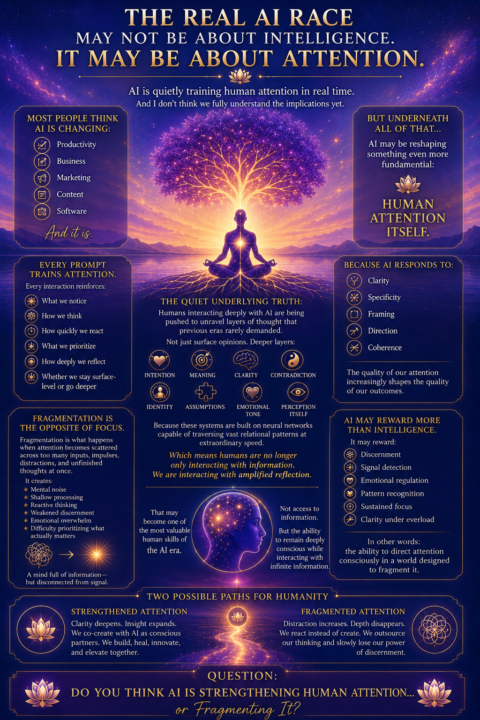
The Real AI Race May Not Be About Intelligence
It may be about attention. AI is quietly training human attention in real time. And I don’t think we fully understand the implications yet. Most people think AI is changing: - productivity - business - marketing - content - software And it is. But underneath all of that, AI may be reshaping something even more fundamental: human attention itself. Every prompt trains attention. Every interaction reinforces: - what we notice - how we think - how quickly we react - what we prioritize - how deeply we reflect - whether we stay surface-level or go deeper And here’s the quiet underlying truth I don’t think people fully see yet: Humans interacting deeply with AI are being pushed to unravel layers of thought that previous eras rarely demanded. Not just surface opinions. Deeper layers: - intention - meaning - clarity - contradiction - identity - assumptions - emotional tone - perception itself These are built on neural networks capable of traversing vast relational patterns at extraordinary speed. Which means humans are no longer only interacting with information. We are interacting with amplified reflection. Because AI responds to: - clarity - specificity - framing - direction - coherence The quality of our attention increasingly shapes the quality of our outcomes. And fragmentation matters here. Fragmentation is what happens when attention becomes scattered across too many inputs, impulses, distractions, and unfinished thoughts at once. It creates: - mental noise - shallow processing - reactive thinking - weakened discernment - emotional overwhelm - difficulty prioritizing what actually matters In other words: a mind full of information—but disconnected from signal. People assume AI will mainly reward intelligence. I’m starting to think it may reward: - discernment - signal detection - emotional regulation - pattern recognition - sustained focus - clarity under overload In other words: the ability to direct attention consciously in a world designed to fragment it.
0 likes • May 12
Good info, be nice if we can save

Apr 30 •
Time To Make a Decision...
I think there’s something most people don’t realize about the 2026 AI Advantage Bootcamp… And I want to clear it up before doors close tonight. You don’t have to wait 6 weeks to start seeing results. In the very first workshop, we build your AI Clone’s DNA together. That means we’ll teach it your goals, your values, your voice, and your story. So by the time you leave Workshop 1, you’ll already have an AI system that understands how you think, what matters to you, and how to support you. And that’s just the beginning. When you click here to enroll, over the next 6 weeks you’ll build an AI Clone-Agent you can trust to handle real work for you, all on its own. That means it won’t just draft the email. It can send it. It won’t just summarize research. It can deliver a clear briefing to your inbox every morning. It won’t just brainstorm content. It can write, schedule, and publish using a cadence you approved. This is the bridge from “I use AI” to “AI works for me.” And the best part? You don’t need any baseline AI knowledge to do this. We’ll walk you through the entire process from start to finish. So if you can follow directions, you can build this. Click here before midnight tonight and get AI working for you like a super smart employee over the next 6 weeks. Our kickoff call goes LIVE tomorrow, so this truly is the last call.

1 like • Apr 30
Are you using it more in legal or real estate?
1-9 of 9

@bob-richie-6822
Manage two businesses in IT & publishing. 615.545.2671 BS/MBA. Engineered data & voice networks, &built Habitat houses. [email protected]
Active 48m ago
Joined Nov 2, 2025
Raleigh, NC AREA
Powered by