Activity
Mon
Wed
Fri
Sun
Jul
Aug
Sep
Oct
Nov
Dec
Jan
Feb
Mar
Apr
May
Jun
What is this?
Less
More
Memberships
The Free Reiki Basics Course
1.1k members • Free
Modern Reiki
37 members • $30/m
21 contributions to Modern Reiki

Dec '25 •
Holiday stress and a racing heart
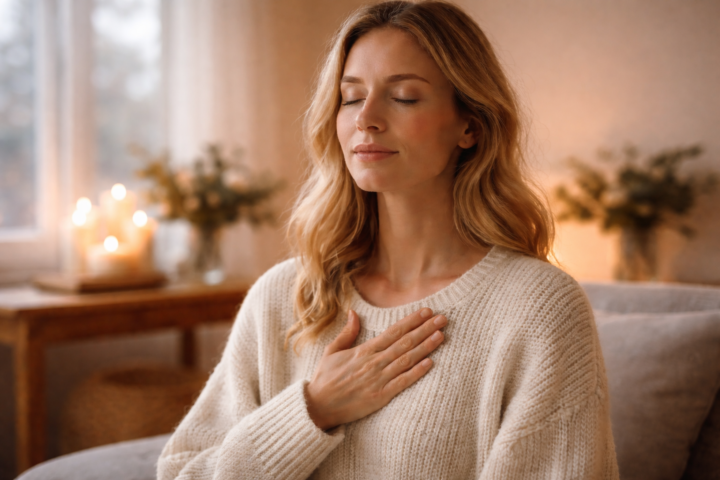
How to lower your heart rate through breath and the nervous system? The holiday season brings warmth and connection, but also busyness, expectations, and constant stimulation. For many people, this shows up as an elevated heart rate, restlessness in the body, and the feeling of always being “on.” This is not a weakness, but a completely normal biological response of your nervous system. By understanding how this system works, you can also consciously guide it back into calm. The autonomic nervous system: two natural states Your autonomic nervous system regulates processes you do not consciously control, such as heart rate, breathing, and recovery. It consists of two complementary systems that continuously alternate. 1. 🫁The sympathetic nervous system - action & alertness🫁 This system becomes active during stress, pressure, or a sense of urgency. - Increases heart rate and breathing rate - Sharpens focus and alertness - Prepares the body for action - Temporarily suppresses recovery and digestion This system is essential for daily functioning. Problems arise only when it remains active for too long. Something that often happens during the holidays. 2. 🫁The parasympathetic nervous system - rest & recovery🫁 This system is responsible for relaxation, repair, and regeneration. - Lowers heart rate and blood pressure - Deepens the breath - Activates digestion and the immune system - Brings the body back into balance True rest arises when this system takes the lead. Breathing as the switch Your breath is a direct gateway to the nervous system. - Fast, shallow breathing; sympathetic activation - Slow breathing with a longer exhale; parasympathetic activation Especially the exhale sends a signal of safety. By lengthening it, you invite the heart to slow down. ❤️Attention follows energy❤️ What you give your attention to gains influence. By gently bringing your focus to the heart area, you amplify the calming effect of the breath. There is nothing you need to visualize or “do right.” Simply being present with the rhythm that emerges is enough. The heart naturally adjusts.

4 likes • Dec '25
And after that holliday: take some me-time! Time to be alone and to process. To do what you want. I love those more 'quiet' days in between Christmas and the New Year, making sure my calendar is clear.
Dec '25 •
Quantum physics
Reading a fantastic book from the Danish author Henning R. Jensen on Quantum Physics. I think this is fantastic reading material for people within our community. Why don't we learn things like this when we are young, in school? So happy I found him and sharing this with you. Put it on your wish list! You can also find him on Youtube etc. The book explains how we are influenced by the energy around us and how we ourselves influence our surroundings with our energy. Very accessible.
4 likes • Dec '25
Well........Quantum fysics is actually a science. Spiritual people are often cornered for people 'who live in space' and are a bit out of touch with reality, as they are 'floating' somewhere. But the book describes how are emotions/feelings have an impact on our well being and that of others. It is actually measurable! We are all connected, the book explains how this works. The author offers a lot of practical advice for life. How to raise your frequency, how to love yourself and be good to yourself, and how to protect yourself from negative energy. Justin taught us this as well. So I see a lot of similarities with the course.
Oct '25 •
Sharing an experience
There is something I would like to share. I gave Reiki to a person who is in her mid sixties and is struggling with memory loss. It was a beautiful session. Lots came up that we - afterwards - talked about and I am quite sure I have been of service here. To me, her energy felt 'brittle'. I saw a wobbly bird nest all the time, with twigs that were breaking off. In her head, everything felt very brittle.The word that came to me spoke loud: FRAGILE. There was a lot of sadness, fear, grief and all of this is very understandable. Big release of emotions, lots of tears. After the session, I recommended her to take rest, drink lots of fluids. A few hours later I saw her again, she was in the jacuzzi. I will never forget her face: it was illuminated, shining, radiating with joy, clear, no fear. She looked so happy and content, she was beaming light!!! I could tell the session had been succesfull! Than I saw her again a few hours later: her eyes had dimmed, the tremendous glow and radiation had gone. It is my gut feeling she is on the onset of dementia and it will go fast. Any thougts or comments?
1 like • Oct '25
A description of her behaviour, confirmed by her husband: loss of memory (forgetting groceries while having a grocery list, forgetting to return objects that she is using), fear of losing directions, no longer driving a car, apathy, depression, no interest anymore in fully living life. It is as if she is not participating in her own life any longer. She wants the presence of her husband ALL the time, and starts to feel insecure if he is not around. Also: losing focus. Mwah.... it is hard to describe, really. It is just a gut feeling I have. To me it felt so unusual, I have never felt a body like this before. So fragile......

Sep '25 •
How energy gets stuck ⛓️✨
There are different patterns and reactions that can cause energy to get stuck in the body. Which of the following do you think impacts people the most?
Poll
25 members have voted
5 likes • Sep '25
All of the above are true if you were to ask me: childhood trauma, victimized thinking and a toxic environment work somehow - and over time - simultaneously to make you feel miserable and keep you in a low frequency. By opening up to another kind of truth - the one of the spiritual world - and listening deep within, you can find out what is healing to you. That takes courage, time, study, meditation, letting go of old ideas/concepts that no longer work, maybe a spiritual teacher etc. Once you made it trough all that, you have raised your frequency and you will start to feel much better. Your healing journey is an interesting one! Yes, I agree with Jim Benskin that Reiki is a gift. It is beautiful to hold space and return to be your true and authentic self. Thank you for this wonderful post/topic. Love it.

Jun '25 •
What I feel.
i got today mine attunement and it was so special to experience. i am going through an emotional time and this was truly a gift, i felt the energy and a warmth on my knee, and I interpret that as it being okay to take my next step Thank you @Justin Peach 🙏🏼💛
3 likes • Jun '25
Beautiful. I also had the most wonderful attunement. It is an experience to look forward to.
1-10 of 21

@birte-bender-5055
International Senior Communication Consultant & Creative Spinner. Global mindset and 'can do' mentality. Energy Healer and Lightworker.
Active 2d ago
Joined Jan 2, 2025
ENFJ
Amsterdam
Powered by