Activity
Mon
Wed
Fri
Sun
Oct
Nov
Dec
Jan
Feb
Mar
Apr
May
Jun
Jul
Aug
Sep
What is this?
Less
More
Owned by Ashley
Lasting freedom IS possible. Get Christ-centered coaching to live your best life!
Building Digitally W/Christy
134 members • Free
Skoolers
157k members • Free
Generational Revival
27.3k members • Free
Houseplant Enthusiasts
16.9k members • Free
Owen Army
103 members • Free
3 contributions to Owen Army

Jan 13 •
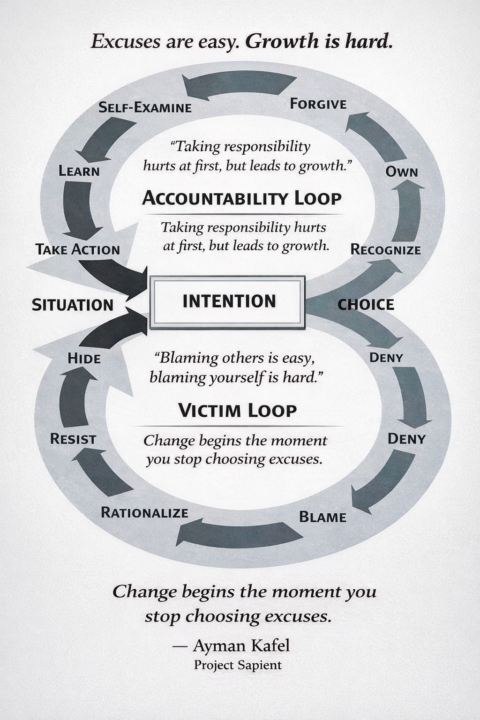
Accountability Loop and Victim Loop
I’ve seen this loop more times than I can count. ➡️ Not on a whiteboard. ➡️ Not in a classroom. But in living rooms at 2 a.m., on the side of the road, in kitchens turned into crime scenes, and in the aftermath of choices people refuse to own. This image captures something policing teaches you very quickly: Every situation gives you two paths. 🔁 One is the Accountability Loop. 🔁 The other is the Victim Loop. In policing, we respond to the situation—the call for service. What happens next is rarely about lack of options. It’s about intention. I’ve stood across from people who: • ignored every warning • denied obvious facts • blamed everyone but themselves • rationalized harmful behavior • resisted help • hid behind excuses Not because they couldn’t choose differently—but because accountability is uncomfortable. ▪️The victim loop is seductive. ▪️It protects the ego. ▪️It removes responsibility. ▪️It gives people someone else to blame: the system, their upbringing, their partner, the economy, the police, society. And the longer someone stays in that loop, the harder it becomes to break free. The accountability loop is harder—but it’s the only one that leads anywhere worth going. It requires: • recognizing reality • owning your role • making a choice • taking action • learning from failure • self-examination • forgiveness (of self and others) I’ve watched people change their lives when they step into that loop. I’ve also watched people burn every bridge available because they refused to. This isn’t just policing. ‼️It’s leadership. ‼️It’s parenting. ‼️It’s relationships. ‼️It’s life. And if we’re honest, this image is also a mirror for society right now. We increasingly reward excuses, elevate victimhood, and treat accountability as cruelty instead of growth. We explain behavior away instead of confronting it. We externalize everything—then wonder why nothing changes. Policing doesn’t create this reality. It just encounters it earlier and more often than most.

1 like • Jan 23
Is it okay if I share this with my Skool Community? Giving you credit, of course.
1 like • Jan 24
@Ayman Kafel thank you! This is week for our Freedom Walk (similar to AA's step 4) Accountability is a huge theme this week.
Dec '25 •
Emotional Regulation as Crime Prevention
I want to dive deeper into something that sits at the core of policing, training, and the human experience—but rarely gets the airtime it deserves: Emotional regulation is one of the most powerful forms of crime prevention we have. Not technology. Not policies. Not equipment. Human regulation. Human capacity. Human control. Because when you strip away all the noise, most of what law enforcement deals with is emotion without direction: People who never learned to pause. People who never learned to sit with discomfort. People who never learned to name a feeling before acting on it. People who were raised in environments where chaos was the norm and regulation didn’t exist. Every cop knows this pattern: Somebody can’t handle anger → becomes an assault Somebody can’t handle shame → becomes a lie, a cover-up, or avoidance Somebody can’t handle fear → becomes violence or self-destruction Somebody can’t handle stress → becomes addiction Somebody can’t handle grief → becomes isolation or suicide And this isn’t just individuals. This is generational. This is cultural. This is systemic. If we taught people how to regulate emotions early on: We would see fewer: • Domestic incidents • Fights • Road rage • Juvenile crimes • Relapses • Overdoses • Suicides • Mental health crises • Officer-involved uses of force • Broken relationships and broken families This isn’t hypothetical — it’s observable reality on every shift. Emotional regulation isn’t soft. It’s tactical. It’s the ability to: – Stay stable under pressure – Recognize the difference between a feeling and a fact – Think while the nervous system is screaming – Decelerate when everything inside wants to accelerate – Not weaponize emotion in conflict – Recognize when you’re escalating someone else without realizing it – Use calm as a strategy, not a luxury This is the same skill that makes elite operators effective in combat. It’s the same skill that makes high-level negotiators successful. It’s the same skill that keeps officers alive during critical incidents.
1 like • Dec '25
All of this! Yes!! As a recovery coach I stand behind this. Emotional regulation is actually something I coach on, its a big deal. I will shout this from the roof tops! Its the "why" behind the what.

3 likes • Nov '25
This is awesome!!
1-3 of 3

@ashley-lehmann-8051
Founder, Freedom Life: Recovery Coaching. As a recovered addict & trauma survivor I want you to find your freedom too!
Active 45d ago
Joined Nov 4, 2025
Powered by