Activity
Mon
Wed
Fri
Sun
Sep
Oct
Nov
Dec
Jan
Feb
Mar
Apr
May
Jun
Jul
Aug
What is this?
Less
More
Owned by Anthony
Master B2B sales. Use AI to sell smarter, close bigger deals, earn more, and become the trusted advisor clients choose first.
Master AI, build powerful agents, automate workflows, and future-proof your career with real-world AI skills.
Memberships
The AI Advantage
127.3k members • Free
AI Automation Vault
26.2k members • Free
Sales Community for Closers
1.1k members • Free
AI Automation Club
1k members • Free
Free Skool Course
71.4k members • $1
AI Bits and Pieces
832 members • Free
Skoolers
161.5k members • Free
AI Automation Society
433.9k members • Free
5 contributions to AI Bits and Pieces

9d •
The other 80%
I have a joke at work. I call it "the other 80%." Since I started using AI for documents, code, and other projects, I've noticed it scaffolds so fast — and so densely — that it's created a strange paradox around the old 80/20 rule. This joke applies to plenty of other things too, but let's stick with AI. What does it mean? a) It's amazing how quickly you can get almost there the 80%, yet how slowly you actually get there. Hence "the other 80%." b) After scaffolding, it feels like you're 80% done. In reality you may be closer to 20%. What you made may look wonderful and seem wonderful, but hold it up to a quality, context, and clarity lens and often it's more sizzle than substance. c) By the time you've reviewed, updated, and simplified everything, you're drained (but satisfied) — and your tokens are gone. 🙂 **Have I solved it?** Not exactly. But here are a few patterns that are helping: **1) Create lots of skills.** Skills travel better than memory. My rule now: anytime I have to haggle with the AI more than once or twice over the same thing — a missing font, the wrong tone in a document, an ugly table — I stop and say "record what you just did to fix that into a skill, so you know better next time." **2) Create lots of support docs.** AI is great at this. If you're reading this here then you probably already know about markdown. When I'm working on something, or building a spec for an app, I'll tell it at frequent intervals to update the docs and the skills. That keeps those files relevant and lets the AI capture the small details as it goes. **3) Build help and instructions into the thing itself.** When I scaffold, so much gets created that it overflows my mental model, fills me with doubt, and slows me down. Now, if I'm building an app, my pages get little "?" bubbles with the what and how of a given thing. For example, at work right now I'm analyzing phone data for abandoned calls — accounting for short abandons, filtering out internal calls, outbound, extension-to-extension, voice mails. Who can remember all that detail a month from now? Build it in. Then as you iterate, your own notes show up in easy-to-find places. If you're having AI build slide decks, ask it to populate the notes fields so later you can re-absorb your original intentions.

1 like • 6d
Very interesting insight, I couldn’t agree!

🔥
6d •
ChatGPT Work v. Claude Cowork: Which Should You Choose?
In Part 1 and Part 2, we used 🐠 Dory and 🖖Spock to explain the difference between Chat and (Co)work. That leads to the next logical question: 🤔 Okay, but which Spock do I use—ChatGPT’s Work or Claude’s Cowork? Personally, I use and like both. The honest answer is that ChatGPT Work and Claude Cowork are built around the same core idea: Give the AI a goal, provide the right context, and let it complete the work. Both can research information, analyze files, create documents, build spreadsheets and presentations, use connected tools, and work through assignments involving several steps. The meaningful difference is where each one feels most at home. Claude Cowork: Best When Your Work Lives in Files and Folders Claude Cowork is especially comfortable when your work lives in files and folders. You can connect a folder on your computer and ask Claude to: - Read and compare several files - Edit or create documents - Rename and reorganize files - Build spreadsheets and presentations - Research missing information - Deliver the finished materials for your review It can work directly with the material inside that folder rather than requiring you to open each file, copy the information into a conversation, and direct every step. Claude Cowork is no longer limited to the desktop. Cowork sessions can also run remotely and be accessed through web and mobile as availability rolls out (more on that later). However, its ability to work with selected local folders remains one of its most recognizable strengths. Claude can also use connectors and plugins: A Claude plugin can package skills, connectors, and sub-agents into a reusable workflow. When a direct connector or tool is not available, Claude can use your computer by navigating applications, clicking, and typing. ⚠️ Note: Claude Cowork requires a Pro level subscription. ChatGPT Work: Best When Your Work Lives Across Connected Apps ChatGPT Work is especially comfortable when your work is spread across connected business tools.

1 like • 6d
@Michael Wacht Brilliant post as always. ChatGPT works if your data lives in apps. Claude Cowork if your data lives in folders. Both are great; they're just optimized for different habitats. ChatGPT thrives across your connected business tools (Slack, CRM, email, etc), while Claude feels most at home working directly with your local files and folders. The real win: you're no longer just chatting with AI; you're delegating to it. That's the shift that makes you look and feel like a genius ( it's an ego thing 😀) And honestly? Using both isn't indecision; it's strategic optionality. 😉
🔥
7d •
❤️Learn with Your Whole Heart Giveaway 🎉 Results! 🎉
Your feedback is helping shape the future of AI Bits & Pieces, and I appreciate everyone who took the time to vote. Top Three Topics, by votes: 🥇 Introduction to ChatGPT Work / Claude Cowork — 5 votes 🥈 What Is an AI OS (Second Brain)? — 3 votes 🥉 How I Used Obsidian to Create an AI OS — 3 votes We’ll begin creating content around all three topics. 🎁 Giveaway Winner! Congratulations to @Garry Cole, who was randomly selected by AI from all eligible participants! Garry will receive a $25 Amazon eGift Card. ❤️ Winning Charity The winning charity is Winning Futures (@Kristina Marshall)! As promised, AI Bits & Pieces will make a $25 donation to Winning Futures in honor of this giveaway. Thank you again for being part of this community. Congratulations to Garry Cole and Winning Futures! 🎉
1 like • 7d
Congrats to the Winners!
🔥
10d •
Part 1 - 🐠 Chat is Dory. Cowork is Spock.
Since I started using Claude Cowork more regularly, I noticed something strange: My creative writing seemed to suffer. The ideas were still there. The information was accurate. The structure was often better. But the writing felt more formal, organized, and buttoned up. It did not always sound like me. So I asked Claude Cowork: “Why does my creative writing seem to suffer in Cowork compared with Chat?” The answer helped me realize that I was not necessarily using the wrong AI. I was using the wrong environment for that stage of the work. Chat is Dory. 🐠 It follows ideas wherever they go. It: explores, wanders, changes direction, and occasionally stumbles into something unexpectedly good. That makes Chat especially useful for brainstorming, finding your voice, testing language, and developing an idea before you know exactly where it will end. Cowork is Spock. 🖖 It wants the facts, the files, the instructions, and the desired outcome. It is, more structured, logical, organized, and focused on completing the assignment. In other words: Chat is often better for finding the voice. Cowork is better for turning that voice into finished work. Neither one is better. They are simply better at different stages of the process. My current approach is simple: - Use Chat to discover what I want to say. - Use Cowork to organize, refine, research, and complete the work. The mistake was expecting Spock to think like Dory. In Part 2, I will look at why Chat and Cowork feel so different from a feature and product-design perspective.

4 likes • 10d
@Michael Wacht i totally agree. I have experienced similar outcomes. I use chat as boxing counter part to exchange jab, learn how to duck and take punches back, because my opponent is unpredictable, but helpful in term of practice, learning when to go into offense or defense. The chat thinking angle broaden my perspective and and shorten my learning curve. But I never allow myself to simply accept the push back, I have a brain, experiences, emotional intelligence, successes and tons of lessons drawn from failure's. Hence, I do the work, forge the path and use chat to explore areas my brain wave never experienced before. Cowork, I see it as an executive assistance capable of putting my scattered ideas and bullet point into an organized system that flow well and easy to understand. Cannot wait to read your next post on the subject. Keep up the good work.
1 like • 10d
@Michael Wacht Good luck with your book; I know it's the hardest thing to do. I struggled writing my first book back in 2010. It's gotten much easier today. No more mental blocks: AI can show you a multitude of creative paths in minutes, paths that used to take hours of research, digging for the right ideas, concepts, or references, and long hours in library halls. Writing a book has become a breeze. But writing a quality one still takes time and huge effort in the research, and the interviews still have to be done right. The key to a best seller is differentitiation gaps not just innovation I wish you the best of luck. I know it's a big endeavor.
🔥
21d •
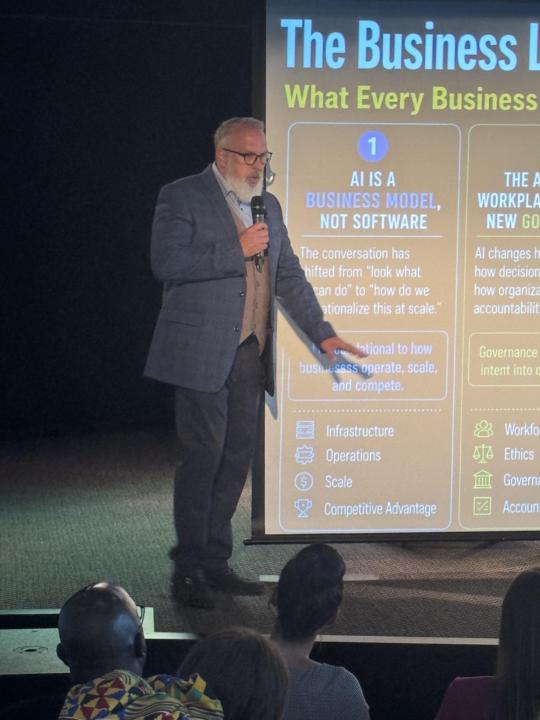
🎤 Speaking to 125 Small Businesses with NFL Great Led to an AI OS Deal
🏈 My friend @Herman Moore called me, former NFL wide receiver, Detroit Lions. "I'm speaking tomorrow to 125 small business owners. Want to join me and talk about AI?" One day's notice. I built one slide with five points. My strategy, let the room decide which ones we went deep on based on body language and reaction. No fixed script, just reading the energy and following it. Herman worked that stage right alongside me. Great public speaker, no surprise there given his career. We had an easy back-and-forth in front of the audience. 25 minutes on stage. Plain English, no hype. Here's what those 25 minutes turned into: - 12 post talk conversations - 5 leads - 2 solid appointments Results: 1. The Deal: AI OS. A 50-hour build. Not a prototype, not a pilot. A real system going into a real business. 2. The Opportunity: AI Executive Coaching. One business wants me in the room at the executive level as a fractional CAIO, not as a vendor they call when something breaks. 3. The Second Opportunity: Enterprise AI Enablement. AI opportunity mapping, then AI education for their front office professionals. Now here is the important part. I didn't walk in with just a polished pitch. I walked in with the practical AI knowledge that I get from AI Bits and Pieces, and advanced development knowledge from AIS+, and AI for Life where I learn to build complex and trending AI solutions. This is where I: try new things, explore advanced ideas, learn from other professional builder, sharpen the saw, ...and stay ready for that moment you may not expect. If it sounds like a full time plus job... it is. However, this is what enables me to walk in with one slide, a friend who trusted me enough to hand me a mic, and 125 people willing to listen for 25 minutes.
2 likes • 21d
Very impressive way to go!
1-5 of 5
@anthony-chaine-1047
Helping B2B/B2C sales professionals become trusted advisors, win complex deals, make money, and build lasting client relationships. Author | Speaker
Active 1h ago
Joined Jul 13, 2026
Powered by