Activity
Mon
Wed
Fri
Sun
Jun
Jul
Aug
Sep
Oct
Nov
Dec
Jan
Feb
Mar
Apr
What is this?
Less
More
Owned by Alice
Year-round IRS compliance and tax strategy for Expats and Content Creators to develop clean income systems and quarterly planning before tax filing.
Discover, develop, write, and elevate your authentic story to heal, create income, and legacy in a community of like- minded women.
Memberships
Prompt-Shop-in-a-Box
1.4k members • $99
Your First $5k Club w/ARLAN
27.9k members • Free
Global TAXpreneur CEO Academy
7 members • Free
Finish Line Community
16 members • Free
AI Cash Skool
2.8k members • Free
Skoolers
193.1k members • Free
Course From Scratch
757 members • $1,997/y
38 contributions to Global TAXpreneur CEO Academy

9d •
WISP Requirements
If you don’t already have a Written Information Security Plan (WISP), now is the time. Under the FTC Safeguards Rule, maintaining a WISP isn’t optional, it’s required. More importantly, it’s one of the most effective ways to protect your clients and your business. A strong WISP helps you: - Identify risks before they become problems. - Prevent data breaches, not just respond to them. - - Stay compliant with IRS and FTC data protection requirements. - Act quickly and confidently if something goes wrong. - At a minimum, your WISP should include: 1. Risk Assessment – Identify internal and external risks to client data. 2. Safeguards and Controls – Encryption, firewalls, and access controls. 3. Data Handling Policies – How data is stored, accessed and disposed. 4. Incident Response Plan – Clear steps for responding to breaches, including reporting procedures and client notifications. 5. Employee Training – Ensure your team understands security best practices and phishing awareness. 6. Ongoing Reviews – Keep your plan current and effective. Failure to have a WISP can lead to fines, legal issues, and reputational damage. More importantly, it can leave your clients exposed. Putting a plan in place now gives you confidence that you’re ready, no matter what happens. Protect your business. Protect your clients. And stay ahead of the risk. Resources: Pub. 5708, Creating a Written Information Security Plan for Your Tax & Accounting Practice Pub. 5709, How to Create a Written Information Security Plan for Data Safety (one-pager)

0 likes • 12h
Thanks, I am using this in my community.
0 likes • 3h
@Sheronda Ervin I am sorry, I thought this was information that you shared from the IRS.gov site.
16d •
How to maintain, monitor and protect your EFIN
Below is a follow-up to the post on if or when you should get a new EFIN? I couldn't find the original post in the feed to add this as a reply. This is from IRS Publication 3112. I think the trainer was referring to #6. Maintaining your EFIN Once you’ve completed the EFIN application process and received your EFIN, it’s important that you keep your account up to date at all times. This includes: 1. Reviewing your e-file application periodically. Your e-file application must be updated within 30 days of any changes such as individuals involved, addresses or telephone numbers. Failure to do so may result in the inactivation of your EFIN. 2. Ensuring proper individuals are identified on the application and updating as necessary. The principal listed on the application is the individual authorized to act for the business in any legal or tax matters. 3. Adding any new principals or responsible officials. 4. Updating any business address changes, including adding new locations. 5. Your EFIN is not transferable; if you sell your businesses, the new principals must obtain their own EFIN. 6. There must be an EFIN application for each office location; if you expand your business, an application is required for each location where e-file transmissions will occur.
0 likes • 15d
Oh okay, this is the CPA academy course I took, "GETTING STARTED WITH E-SERVICES". I asked the question and that was the answer they gave. Thanks for the follow-up.
19d •
Post Your Questions
With next week being the last week of the official tax season, post your client questions. Post new things you've learned and want to share. Post your wins this week!!!! Start preparing for Extension Season. There is a second tax season. The Due Date is 10/15.
0 likes • 17d
Happy Monday everyone, I took a class last week on e-Services. We had talked about e-Fin in one of our classes and if it had to be renewed. I learned that your e-fin is tied to your address and if you move you need to get a new e-fin. If the address that you are using is a virtual adress and will remain the same in your new location, then you would not need to get a new e-Fin.

Mar 30 •
Just for fun
Prompt structure: Create a Barbie style image of a boxed toy doll based on the attached reference photo. The doll should have ___________-style features.. Please include the name ____ at the top of the box, and the slogan _________ at the bottom. Style, the dolls hair to match the reference image. Include accessories that reflect what the doll does, like a laptop, a stack of papers, a desk phone, a stainless water tumbler, all styled in ______ tones. Place the accessories neatly inside the box next to the doll. The box should be vibrant. Barbie pink with a clear plastic front.
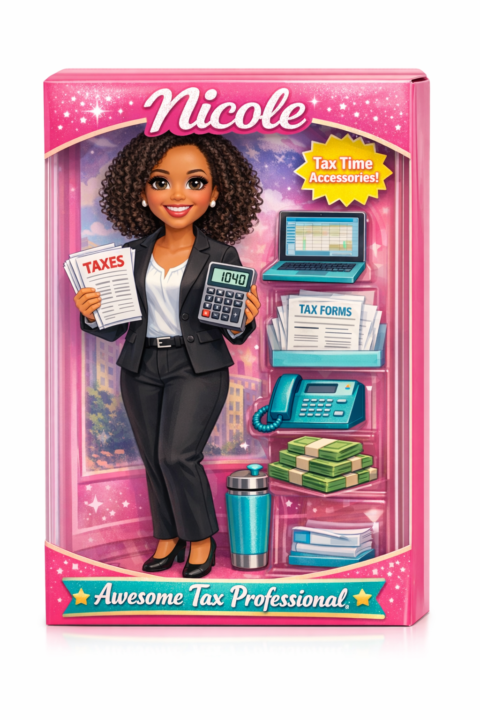
0 likes • 30d
😍Look at you all Barbie-up. I see someone other than me like playing with prompts.
1-10 of 38

@alice-walker-5786
I help writers, speakers, and course creators uncover & develop clarity to write their signature story and turn it into income.
Active 2h ago
Joined Dec 10, 2025
USA