Activity
Mon
Wed
Fri
Sun
Nov
Dec
Jan
Feb
Mar
Apr
May
Jun
Jul
Aug
Sep
Oct
What is this?
Less
More
wavelength
17
Free
10 contributions to wavelength

0 likes • Apr 12
The honest answer is 2 hours after I wake up, whenever I wake up.

Mar 10 •
Question of the day
Do you like to work from home, or in office, or something else?
Poll
5 members have voted
1 like • Mar 26
@Erica Woodward this is what I mean lol.
1 like • Mar 26
@Erica Woodward I will do the work well, thoroughly, slowly, and until it's finished. But I also feel like this 🤣🤣🤣
Mar 18 •
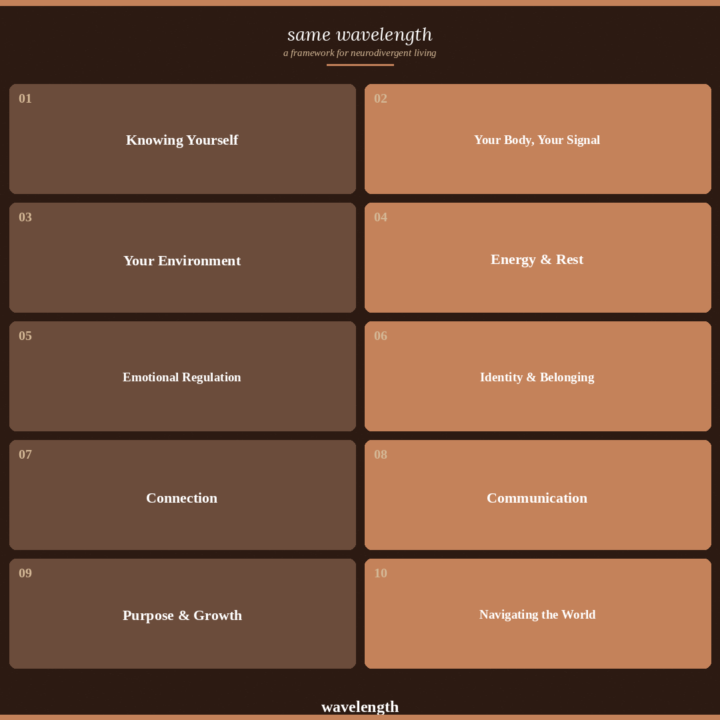
Wavelength framework
Long post ahead. I’ve been on a creative reset this past week to refocus and recharge for what’s ahead. As I prepare to open this space more publicly on April 1, I want to share the framework I’ve been building and get real feedback before I take it further. This is the foundation of what I would call mindful living, built through a neurodivergent lens. Not as isolated skills or another list of things to “fix,” but as an integrated way of understanding how you move through the world and what actually supports you. Each area represents a core domain of functioning, approached through awareness, alignment, and support: Knowing Yourself — Understanding who you actually are underneath the mask. Your values, your needs, your identity, separate from your diagnosis, your roles, and what everyone else needed you to be. Your Body, Your Signal — Your body has been sending you information your whole life. This is about learning to read it. Interoception, sensory experience, and your nervous system as data, not dysfunction. Your Environment — Your surroundings are either working for your brain or against it. Sound, light, texture, routine, clutter. This is about designing a life that supports you instead of draining you before you even start. Energy & Rest — Rest is not a reward for productivity. This covers what drains and restores a neurodivergent nervous system, including social, sensory, and emotional recovery, and how to stop operating from depletion. Emotional Regulation — Not control. Understanding, tracking, and building a relationship with your emotions that does not leave you flooded or shut down. Identity & Belonging — Especially in late diagnosis, this is the rebuild. The grief, the relief, and the process of understanding who you are and where you actually belong. Connection — Building real relationships on your own terms. Not performing. Not masking your way through interaction. Finding your people and allowing yourself to be known. Communication — Expressing needs without over-explaining, shutting down, or needing days to recover from one interaction. Navigating conflict and asking for what you want in a way that works for your brain.
Poll
2 members have voted
0 likes • Mar 25
I think communication needs to be different. Different word maybe? I'm very tired and I can't think. It's close but not quite right. Because what you put after communication is not how I would think of the word communication. It's also not the literal definition of communication. That's why I don't think the word is quite right. Communication and something else? I don't know if I'm making any sense. I like the core domain and the definition that you gave, I just think it could be labeled differently.
Mar 18 •
I take things literally examples
This is kind of hard to explain. I know it's common for autistics to take things literally. When I first hear the words, or read the phrase, my brain interprets it literally. And then there's a pause, and then I figure out what the context is. Context could be the speaker, the medium, the previous conversation, where I am physically at, lots of things. I have noticed when I'm not paying attention and I'm answering automatically, I will answer literally. And then I'm embarrassed lol. Does anyone want to share any examples of this happening to you?
0 likes • Mar 18
I'm not in town right now, and a friend posted a story about the snow that Fort Wayne got the other day. So I sent a message and wrote, "Gross!" My friend replied to the message and said, "Yeah it's the worst. How Chicago?" I proceeded to tell the friend about why I was in Chicago and how hard the training is. Then after I was done, I realized that my friend was probably just asking what the weather was like in Chicago... Because we were talking about weather 🙄🙄🙄
0 likes • Mar 19
@Ruth Yaroslaski I was texting a different friend, and they said, "why wouldn't I want to go with you 😂?" So then I proceeded to tell them the reasons why they wouldn't want to go with me. And then I realized that my friend never meant for me to actually answer the question 🙄. And it happened when I wasn't really paying attention and I automatically answered. This is happened a ton of times, I don't always catch myself though. An autism test will ask you if you watch TV and practice what the people are doing or saying. I don't really remember doing that a lot, but I read a lot of books growing up. And I did the same kind of thing, but internally. And that is very much how I would describe my ADHD, my hyperactivity is internal. And then I thought, is this more common with women? Or is it more common with readers? And how many people are answering that question on the autism test with a no, but do the same thing that I did, "study" people and social situations through books? Has anyone ever asked that question?

Mar 5 •
PlayStation players?
Any other ps5 players out here? I enjoy black ops, wnba, fortnite https://profile.playstation.com/audreystyles
0 likes • Mar 6
I'm not a PlayStation person, but I have a Nintendo Switch! I do not have the coordination for first person shooter. I like cozy games.
1 like • Mar 18
@Audrey Leonard I love me some animal crossing. I also really loved Spiritfarer. I played it all the way through twice.
1-10 of 10

@alexandria-stalter-3436
I'm Alex. I'm an eldest-daugher-no-kids-late-diagnosed-AuDHD-divorcee. I love books, numbers, astrology, patterns, mushroom hikes and tacos.
Active 132d ago
Joined Mar 4, 2026
Powered by