Activity
Mon
Wed
Fri
Sun
Aug
Sep
Oct
Nov
Dec
Jan
Feb
Mar
Apr
May
Jun
What is this?
Less
More
Memberships
The AI Advantage
126.3k members • Free
AI Automation Society
418.3k members • Free
AI Automation Agency Hub
327.8k members • Free
AI Automation (A-Z)
162.8k members • Free
39 contributions to AI Automation Society

6h •
if you think AI is just about saving time on admin...
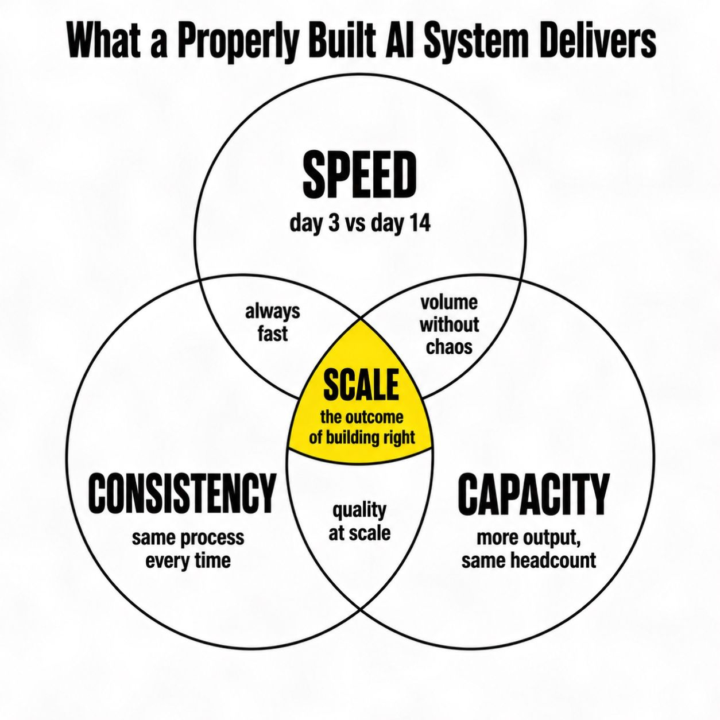
if you think AI is just about saving time on admin... you're missing the bigger picture. the businesses pulling ahead built 3 things. speed. new hire starts monday. most businesses spend 2 weeks getting them up to speed. with AI handling onboarding — documented, structured, automatic — same person is productive by day 3. every single hire. consistency. → same follow-up after every quote → same update during every job → same invoice the day work is done doesn't matter who's working. doesn't matter how busy it gets. the process has no off days. capacity. 40% more jobs than last year. same team. same hours. because the admin that used to eat 15 hours a week now runs on its own. put all three together and one word comes to mind - SCALE. the businesses building this now will be impossible to compete with in 3 years
15d •
The biggest benefit of AI in a small business isn't the time saved.
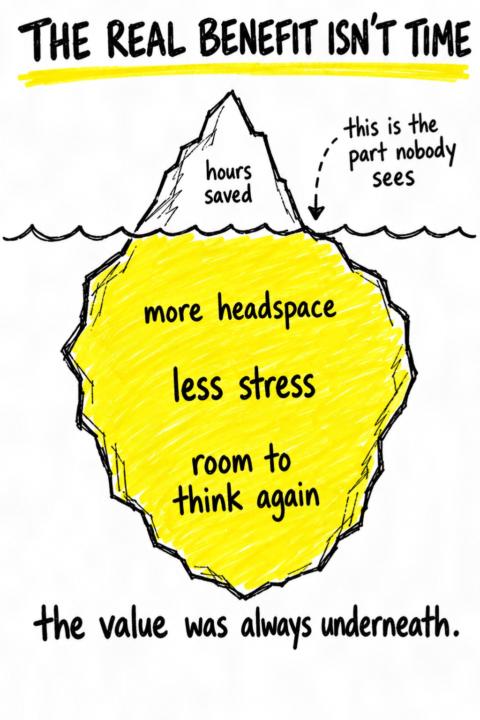
The biggest benefit of AI in a small business isn't the time saved. It's what owners do with that time once they get it back. Most conversations about AI focus on hours. 10 hours a week. 20 hours a month. Numbers that sound impressive on their own. But hours saved is not the actual win. The win is what happens next. One owner used the time to finally write the strategy he'd been putting off for 2 years. Another used it to take his daughter to school every morning instead of every other Friday. Another spent it on the one client relationship that was about to walk, and kept them instead. None of that shows up in a report about hours saved. That's where the real value of AI lives. Not in the time itself. In what becomes possible once the time exists. Most business owners have been so busy for so long that they've forgotten what they'd actually do with a free afternoon. The first few weeks after automating something, most owners don't know what to do with the space. Then they remember. The idea they shelved 3 years ago because there was never time, it's moving again. What would you do with your next free afternoon?
20d •
Every growing business hits the same wall.
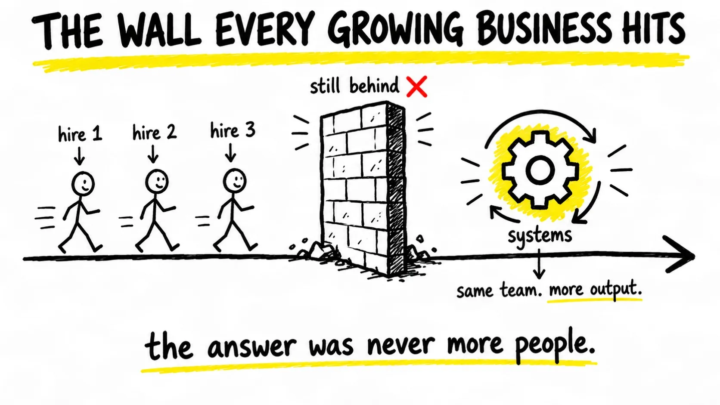
Every growing business hits the same wall. More clients coming in. Not enough hours to handle them. So the obvious answer? Hire someone. And for a while, it works. - Then you need to manage that person. - Train them. - Brief them. - Check their work. - Deal with their problems. And suddenly you're busier than before you hired them. That's not a people problem. That's a systems problem. The businesses that figure this out stop asking "who do we need to hire?" And start asking "what should never need a human in the first place?" Because most of the work that feels like it needs a person? It doesn't. It needs a system. - The follow-ups. - The reports. - The invoices. - The reminders. - The data entry. None of that needs a person. It just never got fixed. The businesses growing without constantly hiring aren't lucky. They built the system before they needed the headcount. That's the difference.
1
0
Jun 2 •
3 types of manual work exist in every business.
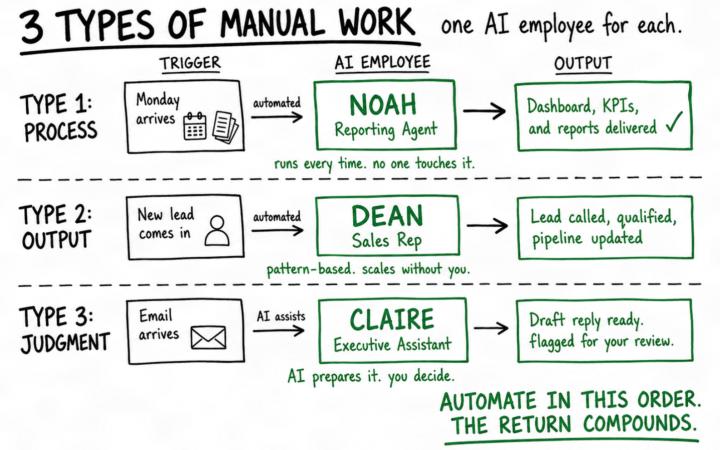
3 types of manual work exist in every business. (AI employees exist for every single one) There are 3 types of manual work in every business. Automate them in the wrong order and you spend months building something that saves minutes. Get the order right and the return compounds every week. Type 1 is process work. The same task, done the same way, every single time. Reports pulled every Monday. CRM updated. Follow-ups sent. No judgment required, just someone doing the same thing for the hundredth time. This is the one to automate first. Highest frequency, lowest complexity, clearest return. → Noah handles this. Every week he ships your dashboards, KPIs, and reports automatically, landing in the inbox before anyone asked for it. Type 2 is output work. Tasks that change each time but follow a familiar pattern. Lead calls, qualification conversations, outreach that needs a human touch but runs on the same structure every time. → Dean handles this. He calls your leads fast, qualifies them, and keeps the pipeline moving so you show up to every conversation with context already built. Type 3 is judgment work. The decisions that require the full picture. Client relationships, exception handling, strategic calls that need context no system can replicate. This is where the human stays. → Claire handles this layer. She triages your inbox, drafts replies in your tone, and surfaces only what actually needs your attention. Most businesses start with Type 2 because it looks more impressive. The real return is in Type 1, and the compound effect only builds when you get the order right.
May 26 •
Using AI turns one person into the output of five.
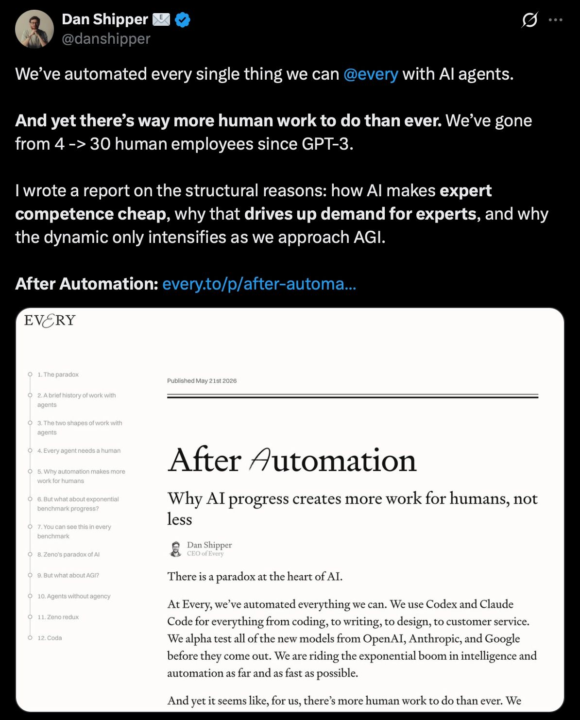
Using AI turns one person into the output of five. (most operators still aren't using it that way) Most operators use AI like a search engine. Open ChatGPT. Ask a question. Copy the answer. Move on. That's a transaction, not a workflow. Operators using it properly do something different. They've built feedback loops. The AI generates, they review and redirect. Every output gets sharper because they're guiding it toward what they actually want. AI lives inside their email, their CRM, their documents. It runs alongside everything they do. They direct it like a junior employee. With context, with standards, with feedback when the output misses. AI gives them the speed. They give it the standard. Dan Shipper's report on Every captures the math. The company automated aggressively and grew from 4 to 30 employees. Each person became dramatically more capable because they learned to direct AI properly. 5x output is a function of how well you're directing AI, judging it, and integrating it into how you actually work. What part of your day would change if you treated AI like the most capable assistant you've ever had?
1-10 of 39

@alex-naskidashvili-5764
Partner at @ Systems Dept. | Building AI Automations, Workflows and Systems
Active 5h ago
Joined Feb 7, 2026
Remote
Powered by