Activity
Mon
Wed
Fri
Sun
Aug
Sep
Oct
Nov
Dec
Jan
Feb
Mar
Apr
May
Jun
Jul
What is this?
Less
More
Memberships
SwimStrength University
87 members • $9/month
Recovery Academy
15 members • Free
Swimpros 🏊
1.5k members • Free
SwimStrength Community
462 members • Free
SwimStrength School
2.1k members • Free
MindGym (FREE)
1.2k members • Free
11 contributions to MindGym (FREE)
⭐
Feb '25 •
Your Kid is Doing This Crazy Thing Before Every Race… And It’s Slowing Them Down!
Your swimmer has a secret superpower. It’s NOT their dolphin kick. It’s NOT their flip turn. It’s NOT their ability to inhale pasta at inhuman speeds. It’s something way more powerful… 🔑 The Anxiety Advantage. The same thing that makes them nervous before races……is the SAME thing that can make them race their fastest times ever. Right now, they’re using it the wrong way. 😬 Instead of picturing themselves winning, they see themselves messing up. Instead of feeling excited, they feel sick to their stomach. Instead of trusting their training, they race like a panicked squirrel on an energy drink. Sound familiar? Here’s the good news: If they can visualize failure that well, they can visualize success just as well. They just need to learn how to flip the switch. I’m running a free 45-minute live training on Zoom to show swim parents exactly how to turn The Anxiety Advantage into their swimmer’s biggest strength. 📆 Sunday, March 2rd @7pm CET (6pm UK) Want in? I have 25 spots. No recording. Pls only comment if you're gonna show up. 👉 Comment “ADVANTAGE” below, and I’ll send you the link to register.
1 like • Feb '25
FIY, March 3rd is a Monday
Jan '25 •
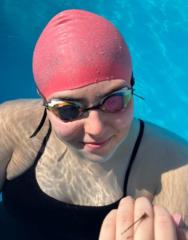
REYKJAVIK NATIONAL GAMES!
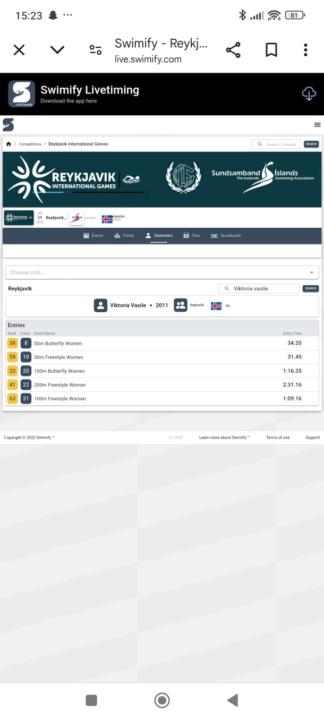
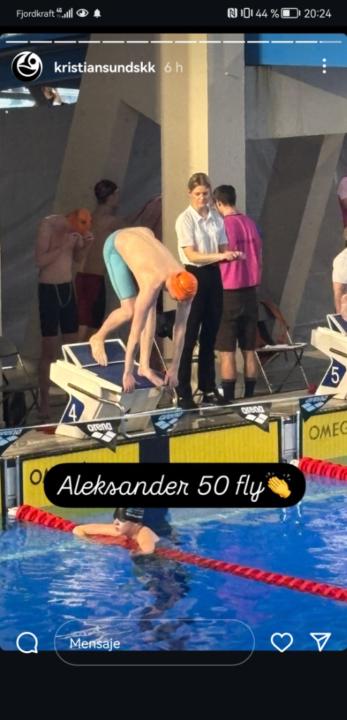
Just arrived at the swimming pool where the most biggest competition (I would say) is held! I am pretty nervous because it's a 50m pool, and usually my team trains in 25m and compete in 25m, with usually different times. I am not used to compete in 50m long course. I'll try my best to get closer and closer to my final time, and who knows, maybe I'll do better! But of course, you never know what you'll get; that is why I'll focus on my breathing and present. I hope everyone will have a good weekend! UPDATES 1: for 50 m butterfly I retain the last time at 25 m short course (34.40 to now 34.45 s) but improved by almost 2 s comparing the previous time at 50 m long course while for 50 m freestyle I also pretty retain the last time at 25 m short course (31.45 to now 31.79 s) but improved by almost 3 s comparing the previous time at 50 m long course. UPDATES 2: today I had 100 m butterfly and 200 m freestyle, 50 m long course. It was a bit harder and could not keep my time corresponding to 25 m short course. I tried hard but still being off about 4 s from the entry time. Not sure why but all my entry times were taken from my latest times obtained on 25 m short course and not on 50 m course, the last time I did on 50 m long course it was in March 2024. Comparing to those times, I improved my times for 100 m butterfly and 200 m freestyle by 7 s (from 1:27.37 to 1:20.40) and almost 10 s (from 2:45.30 to 2:35.79). I hope tomorrow to get a bit closer to my 25 m time for 100 m freestyle.
1 like • Jan '25
Good luck!
⭐
Dec '24 •
Why Does My Swimmer Fall Apart in the Call Room...?
You’ve seen it happen. The nerves take over. Fidgeting hands, darting eyes, shallow breaths. By the time they walk out, it’s like they’ve already lost the race in their mind. It’s frustrating. It’s heartbreaking. And you feel powerless to help. I know, been there :( But it doesn’t have to be this way. Join my live training "Call Room Mastery" and learn how to stay calm and confident when it matters most. Only 13 spots left. Don’t wait. 👉 Register here PS: If you can't make the live training, drop a ✅ in the comments and I'll send you the recording.

1 like • Dec '24
✅
⭐
Nov '24 •
Why Do Swimmers Fall Apart Under Pressure?
You’ve seen it happen. Your kid trains like a champ. They’re all fired up for race day. And then… total meltdown. Why does this happen? For a lot of swimmers, it comes down to one thing: worry. - “What if I don’t swim fast?” - “What if everyone thinks I’m terrible?” - “What if that kid in the next lane beats me?” It’s like their brain turns into a hamster on a wheel, running wild with “what-ifs.” And when their brain is stuck there, they can’t just swim. Here’s something else: A lot of this worry is tied to self-esteem. Basically, they believe their value as a person depends on how they perform. If they swim great, they’re awesome. If they mess up, they’re a failure. No pressure, right? This leads to overthinking, comparing themselves to everyone else, and choking when it matters most. So what’s the fix? Self-acceptance. Swimmers who accept themselves—flaws, bad races, and all—tend to handle pressure way better. They’re calmer. More focused. And they actually enjoy racing. Think about the top swimmers. They’re not just fast; they’re confident, humble, and don’t seem to let the pressure get to them. That’s because they don’t tie their self-worth to their times. How Can Your Swimmer Build Self-Acceptance? Here are some things that actually help: ✅ Focus on effort and improvement, not just medals or times. ✅ Track workouts to show how far they’ve come (even little wins). ✅ Set realistic goals that challenge them, but don’t overwhelm them. ✅ Teach them to appreciate swimming—good races, bad races, and everything in between. ✅ Remind them that swimming isn’t just a sport; it’s something they love. These are small changes, but over time, they can shift the way your swimmer thinks. When they stop worrying about what could go wrong and start trusting themselves, they’re free to perform their best. But what do YOU think? Does focusing on self-acceptance really help swimmers race better? Or is it unrealistic in a sport that’s all about winning? Drop your thoughts below—this is going to be a fun discussion. 👇
1 like • Nov '24
I agree, focus on the process rather than the result!
⭐
Nov '24 •
Client's Story: First European Champs
Since we got a lot of IM-ers in the MindGym I thought I share another one from the summer. This was a pressure cooker!!! @Gartmann Gartmann had trained well all season but this summer was going to be different: He qualified for the 2024 Summer European Championships in Belgrade. That was a big breakthrough for Gian-Luca Gartmann. And at the same time... It seemed scary. As the big race got closer, doubt and insecurity crept in... We mostly worked on his breathing, not freaking out during taper when something didn't go as planned, and visualization. He then went to Belgrade and crushed it at his first Euro Champs. So happy for him and he continues to perform great. We'll hopefully see him on TV at the World Champs in Singapore in the summer 2025 🚀😃 Here are all his PBs: https://www.swimrankings.net/index.php?page=athleteDetail&athleteId=4813079 And that's his personal website if you're curious: https://www.gianlucagartmann.com/

1 like • Nov '24
Switzerland is crushing it lately! 🇨🇭
1-10 of 11
@aleksander-mittet-7768
Masters swimmer hunting PBs in Norway.
Active 2d ago
Joined Sep 30, 2024
Norway
Powered by