Activity
Mon
Wed
Fri
Sun
May
Jun
Jul
Aug
Sep
Oct
Nov
Dec
Jan
Feb
Mar
Apr
What is this?
Less
More
Owned by Krasimi
This is the Metafusion community blending Technology with Consciousness, Science with Metaphysics. We connect what seems to be polarity into one idea.
Memberships
Skoolers
194.4k members • Free
High Vibe Tribe
80.3k members • Free
88 contributions to Allistar Center
1d •
T.H. Moray: Demonstrations Nobody Could Explain (Part 2)
What makes Moray's story unusual isn't just the claim itself; it's the sheer volume of people who watched the device operate. Throughout the 1920s and 1930s, Moray opened his demonstrations to engineers, scientists, government officials, and curious members of the public. These weren't quick parlor tricks either. Observers reported watching the device run for extended periods, powering light bulbs and small motors while connected to nothing but an antenna and a ground wire. Several of the witnesses had technical backgrounds and knew what to look for. They checked for hidden wires. They asked Moray to move the device to new locations, away from any possible connection to the power grid. In some accounts, they had him set up in open fields where the nearest power line was miles away. The device still worked. The bulbs still lit. And the witnesses, many of whom came in skeptical, walked away without a satisfying conventional explanation for what they had seen. Moray was willing to let people watch the device run, but he drew a hard line at letting anyone examine the internals. He had his reasons. He feared patent theft, and more than that, he worried about governments seizing the technology for weapons applications. In his view, the only protection he had was secrecy, so the device remained a sealed wooden box. Observers could see what it did, but never how it did it. That tension between openness and secrecy defined every demonstration he ever gave. What stands out from a research perspective is how consistent the reports are across different observers and different years. People who saw the device in 1925 described essentially the same behavior as those who saw it in 1935. The apparatus required a warm-up period. Output varied depending on antenna placement and orientation. It could be interrupted and restarted. These suggest a real physical process that Moray could reproduce reliably, even if he couldn't fully explain it in terms the scientific establishment would accept. None of this proves the device worked the way Moray claimed, of course. Witness testimony, no matter how plentiful, isn't a substitute for controlled measurement and peer review. But it does raise a legitimate question: if this was fraud, it was an extraordinarily elaborate and sustained one. And if it was self-deception, it fooled a lot of trained eyes over a very long time.

0 likes • 6h
Interesting where did you learn about it, are there any good YouTube videos of someone talking about this ideas ?
0 likes • 6h
Here is what I found pn Cloude Here's a solid research overview of Thomas Henry Moray, mapped against your S/T Field framework where relevant. --- ## Thomas Henry Moray — Research Profile **Born:** August 28, 1892, Salt Lake City, Utah **Died:** May 18, 1974 ### Biography Moray studied electrical engineering through correspondence courses and earned a PhD from the University of Uppsala in Sweden. He served as a missionary in Sweden in 1911, where his interest in electricity was sparked by early radio technologies. [Grokipedia](https://grokipedia.com/page/Thomas_Henry_Moray) During the 1920s he worked in radio, and after hundreds of experiments to improve reception, he claimed to have discovered a source of energy transmission apparently available everywhere. [Wikipedia](https://en.wikipedia.org/wiki/Thomas_Henry_Moray) --- ### The Device — Moray Radiant Energy Receiver In 1925 Moray reportedly built his first prototype — a compact apparatus weighing about 55 kg — that used an antenna, a grounding rod, and a mysterious "Swedish Stone" (possibly spodumene, a lithium-bearing mineral) to power 35 light bulbs, an electric iron, and a heater simultaneously. [Grokipedia](https://grokipedia.com/page/Thomas_Henry_Moray) Using advanced ideas in solid-state detectors, he developed a power source which he claimed to produce 50,000 watts. By the early 1930s, dozens of people had reportedly witnessed demonstrations of this technology. [Wikipedia](https://en.wikipedia.org/wiki/Thomas_Henry_Moray) **The "Swedish Stone"** was the irreplaceable heart of the device — a soft white stone from which he developed his Moray Valve; silver wire on the stone made a rectifier. In 1942 he attempted to rebuild the device using the remaining fragment of this material, but he had never been able to duplicate it. [Rex Research](http://www.rexresearch.com/moray2/morayrer.htm)
5d •
Who Was Thomas Henry Moray? (Part 1)
I have been researching T. Henry Moray for a couple of years now and his story is a fascinating one. He developed one of the most expert observed "free energy" device to date and I have been working over the last year+ to figure out how he was able to produce usable electricity and create a modern version, since almost all of his blueprints/schematics and prototypes were destroyed and he was very secretive with his ideas in order to prevent the Russian and American governments from co-opting his tech for destructive purposes. Over the next several posts I will go into his past and share his bio, what we know of his device and recorded witness testimony, and the work I have put into reframing his ideas through the lens of modern semiconductor and plasma physics. Below is his early years bio and the start of Thomas Henry Moray's journey. In 1892, Thomas Henry Moray was born in Salt Lake City, Utah. He grew up with a natural pull toward electrical engineering and eventually pursued formal education in the field. But the pivotal chapter of his story began overseas. As a young man, Moray traveled to Sweden on a Mormon mission, and it was there that he allegedly discovered a peculiar mineral specimen that would come to be known as the "Swedish Stone." Moray believed this stone held extraordinary electrical properties, and when he returned home, he spent years incorporating it into a device he claimed could pull usable electrical power from the environment. What he eventually built was a roughly 60-pound apparatus housed in a wooden box, connected to an antenna and a ground. He called his core components "Moray valves," hand-built elements containing the Swedish Stone and other semiconductor-type materials that he kept deliberately secret. By the 1920s, Moray was demonstrating this device publicly, claiming it could light banks of bulbs and run motors with no conventional power source. He wasn't doing this quietly, either. Over the span of roughly 10 to 15 years, Moray conducted demonstrations for a wide range of observers, including engineers and government officials. He invited skeptics. He ran the device in remote locations away from power lines. The wooden box, the antenna, the glowing bulbs; dozens of people saw it with their own eyes. Whatever was happening inside that box, Moray was clearly not afraid to show it off.
0 likes • 6h
Thank you for sharing that.I will look if we can find more about this material online.
6h •
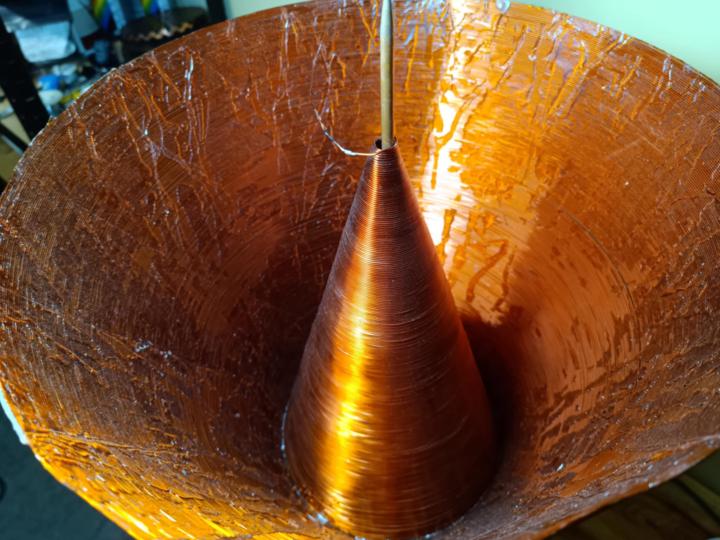
First Impression of the 3D Printed Conical structures
Just calculated the wire its 50 meters for top part and 150 for bottom part of each cone. So if the wire is 0.8mm its 0.9 kg per cone. If its 0.7mm its 0.69kg per cone.
0
0
16d •
Claude with skill as research Assitant is doing great job
Here is a PDF with my interaction with Claude AI which is programed with skill to be as Research assitant. Inside the PDF you can see my blury, random noise question first, just wrote what came first. Then ask Grok to gleam the grammar mistakes and structure it as Buletpoint with clean structure and feed this as question to Claude. Then you see what the response is. Im sharing this because Im fascinated by the clarity and reasoning with this AI model, and Im sure that will help us tremendously to move the project further. It understood the Manual perfectly and brake down the loginc in clear and organized structure. Its jus very useful. Also, will add the images that Was uploded to with the first question. It really helps to understand the creative process of energy from many new perspectives.
0 likes • 10d
The central rod is oscilating the crystal by shifting the potentials trough the hole Aperture (aka vortex)
0 likes • 7h
@Nora Dornbush I didn't use it yet, but will check it out, thank you for sharing it Nora.
7d •
Scaling the STA to crystalize and amplify the entire electromagnetic Field of the Planet
This is longer audio excerpt from the secon or third private session with Bashar. He give the general measurments and confirm that this is exactly what Nicola Tesla was thinking to do with the Wardenclyffe Tower. (notice hist intonation while he is doing that). The Wardenclyffe Tower is 57 meters tall and Bashar explained that 10-11 meters are actuall enough. In the last sessions he said N.Tesla now know from spirit that the initial scale he invision can bu much smaller.
0 likes • 7h
@Arthur Canabrava It won't interfere because they have their own Resonant frequency which is different from our existing technology.
1-10 of 88
@krasimi-kolev-5656
I love to explore the mystery of this infinite life and to merge the oposites in a harmonious way.
Active 6h ago
Joined Aug 28, 2025