Activity
Mon
Wed
Fri
Sun
Aug
Sep
Oct
Nov
Dec
Jan
Feb
Mar
Apr
May
Jun
Jul
What is this?
Less
More
Owned by Zigmars
Create, promote, and sell digital products with AI. One keyword. One click. A complete product ready to sell.
Memberships
Skoolers
164.7k members • Free
122 contributions to Digital Product Creators Club

3d •
Outline chapter count doesn't match selected chapter structure
I'm working on a contemporary romance novel, and I need a slower-paced outline to allow the relationship to develop naturally. To give the story enough room, I changed the chapter distribution from the default 12 chapters to 15 chapters, with the following structure: - Setup: 7 chapters - Confrontation: 5 chapters - Resolution: 3 chapters The interface correctly shows Total chapters: 15, and each story section also displays the chapter numbers I selected (7 / 5 / 3). However, after regenerating the outline several times, the actual outline still contains only the default number of chapters: - Setup: 3 chapters - Confrontation: 6 chapters - Resolution: 3 chapters So the outline always stops at Chapter 12, even though the project is configured for 15 chapters. Because of this, the story is compressed into only 12 chapters instead of the 15 I selected, making it difficult to properly pace the romance. Is this a bug, or is there another step I need to take to make BookNova actually generate all 15 chapters? Thank you!

4 likes • 13h
Copy/Paste from another support ticket answer with the same issue: "Hi, Thanks for the detailed report - that description was exactly what I needed to track this down. You found a real bug. When you set per-act chapter counts (like 2 in Setup, 3 in Confrontation, 1 in Resolution), the generator was quietly ignoring them and falling back to its automatic split, which is why you kept getting 4 chapters in a 1/2/1 layout no matter what you entered. You were right that it used to work - a recent change to how the outline is generated in the background stopped passing your chosen counts through to the generator. I have just deployed a fix. The per-act counts are now saved and honored exactly as you set them, so 2 + 3 + 1 will produce a 6-chapter outline with that split. Nothing is needed on your side beyond trying it again: - Open your book and go to the Chapter Outline section - Set the chapter count for each of the three acts (Setup, Confrontation, Resolution) - Click Generate Outline One note: regenerating the outline replaces any existing chapters, so if you have already written chapter text you want to keep, export the book first. If it still does not match what you set, reply here and I will look at your specific book right away. Sorry for the hassle, and thanks again for flagging it. Zigmars BookNova"
1d •
Looking for someone who can make a short review.
Friends! Is there anyone here who films and creates tutorials/reviews for web applications?
3d •
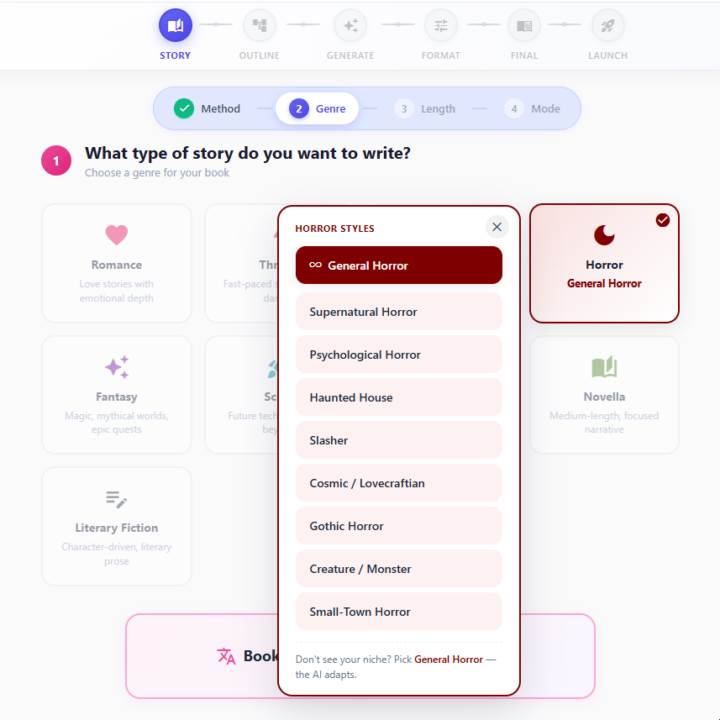
New genre just landed: HORROR 👻
You've been asking, and it's finally here. BookNova now writes full-length Horror, and it's not a bolt-on — it's a first-class genre with its own story engine, cover styling, and pacing built specifically for dread. And because horror is one of the most powerful, on-page genres in the room, I didn't want to give you one generic "scary" setting. You get 8 dedicated sub-genres, so the AI writes to the exact flavor you're going for: 👁️ Supernatural — ghosts, curses, things that shouldn't exist 🧠 Psychological — the horror that lives in your character's head 🏚️ Haunted House — the place itself is the monster 🔪 Slasher — tension, the stalk, the final survivor 🌌 Cosmic / Lovecraftian — vast, indifferent, unknowable 🕯️ Gothic — decaying estates, buried family secrets 🐺 Creature / Monster — something out there is hunting 🏡 Small-Town Horror — ordinary Americana turned wrong (the classic King register) Why now? Horror is having a serious moment. It's one of the fastest-growing, most bingeable categories on Kindle, KU, and BookTok right now — readers devour it and come back for the next one. If you've been sitting on a creepy idea, this is the moment to write it. ✍️ One more thing I'm genuinely excited about: you can now name your influences directly. Want something in the spirit of Stephen King, Shirley Jackson, Paul Tremblay, or another author you love? Say so. The engine uses those as tone anchors to shape the atmosphere, voice, and cover — so your book lands in the right corner of the shelf. 👉 Start a new fiction book, pick Horror on the genre step, choose your sub-genre (or "General Horror" and let the AI adapt), and go. Prefer to steer it yourself? Use "I Have My Own Story" and describe your premise in your own words. Go write something that keeps people up at night. 🌙 Can't wait to see what you make — drop your horror titles in the comments when they're done.
4d •
New feature just went live: Find & Replace across your entire book!
Here is the story behind it. One of you (Deborah 😉) - a writer right here in this community - reached out and said something simple but brilliant: "I love the books, but sometimes I just want to change a character's name or fix a small detail without regenerating the whole thing and spending credits." That is exactly the kind of feedback I build on. So I sat down and made it happen. Now you can search your whole book and change any word, name, or phrase - instantly, everywhere it appears. Rename a character, fix a recurring term, correct a small detail - done in seconds. No regenerating. No credits spent. Full control, right in your hands. It comes in two modes: Simple - find an exact word or phrase and replace it everywhere in the book. Smart - perfect for renaming a character. It updates every form of the name so nothing slips through and your book stays consistent from cover to cover. You will find it right in the writing view - look for the Find & Replace button, or just press Ctrl+H. This is exactly why I love building BookNova as a solo founder, together with you. You share an idea, and it becomes a real feature - fast. So keep them coming. The next feature might be the one you suggested. Go give it a try, and let me know what you think.

5d •
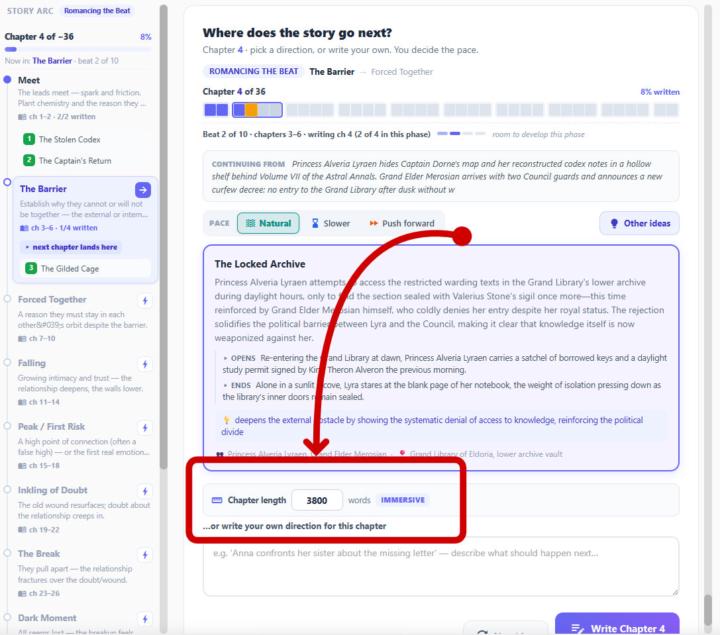
Feature preview - Sail Mode: variable chapter lengths, adjustable for every chapter
One of the features coming with Sail Mode (our chapter-by-chapter writing flow, currently in development) is per-chapter length control. Here's what it does and how it works. The idea In published fiction, chapters aren't all the same length. Length is used to control pace: tense or fast-moving scenes tend to run short, while setup, immersion, and emotional depth run longer — and the climax is often the tightest section of the book. A fixed word count per chapter (total ÷ chapters) hits a target length but produces an even, mechanical rhythm that real novels don't have. Sail Mode varies chapter length instead — automatically, with a manual override. The automatic part For each new chapter, Sail sets a target length from three inputs: 1. Pace — the pace you pick for the chapter (linger / natural / push) shifts the length. Lingering runs longer; pushing the plot forward runs tighter. 2. Story position — where the chapter sits in the arc. Opening/setup chapters get more room; chapters in the climax zone run shorter and faster. 3. Length budget — your book's overall target. If earlier chapters ran long or short, later targets adjust to keep the whole book on the length you planned. The result is a natural variation from chapter to chapter, with the total still landing on your intended book length. No setup required — it works by default. The manual part Every chapter shows its suggested length in the writing panel, labelled punchy, standard, or immersive. If you want a specific chapter shorter or longer, type in your own word count — that number is used for that chapter. A reset option returns it to the automatic suggestion. So the length is decided for you when you don't care, and editable per chapter when you do. Status Sail Mode is still in development; this feature will ship with it. More previews to follow.
1-10 of 122

Active 1h ago
Joined Feb 25, 2026