Activity
Mon
Wed
Fri
Sun
Mar
Apr
May
Jun
Jul
Aug
Sep
Oct
Nov
Dec
Jan
Feb
What is this?
Less
More
Memberships
#TheTechHustle Community 🤝🏽
292 members • Free
Closers.io - Remote Sales Reps
13.2k members • Free
Front End Now Community
171 members • $47/month
138 contributions to Front End Now Community

21h •
Most Frontend Developers Quit Right Before It Clicks
I want to talk about something that almost everyone learning frontend goes through — but barely anyone warns you about. Most people don’t quit frontend at the beginning. They quit after they’ve already made real progress. Here’s how it usually goes: At first: - HTML feels logical - CSS feels manageable - JavaScript feels challenging but exciting Then suddenly: - A layout breaks and you can’t explain why - Your JavaScript worked yesterday but not today - React introduces state, effects, rerenders… and your brain feels full That’s when the quiet thought shows up: “Everyone else seems to understand this faster than me.” If you’ve had that thought, pause. Because here’s the truth 👇 That moment isn’t failure It's a transition point. You’ve moved from surface learning into real engineering. And real frontend work is: - Messy - Non-linear - Full of “why is this happening?” moments This is the part where most people make the wrong decision. They assume: - Confusion = lack of ability - Slowness = being bad at coding - Struggle = proof they’re not cut out for it But the developers who actually make it didn’t avoid this phase. They: - Stayed when things stopped making sense - Learned how to debug instead of restarting - Built projects while feeling “behind” - Stopped mistaking discomfort for incompetence Frontend doesn’t get harder because you’re doing badly. It gets harder because you’re finally learning the right things. If frontend feels harder now than it did a few months ago, that’s not a red flag. That’s usually a green light. You’re past the fake progress stage and inside the part that actually compounds. If you’re in this phase right now, reply below: 👉 “Still here.” I want you to know you’re not alone and you’re closer than you think.
0
0
2d •
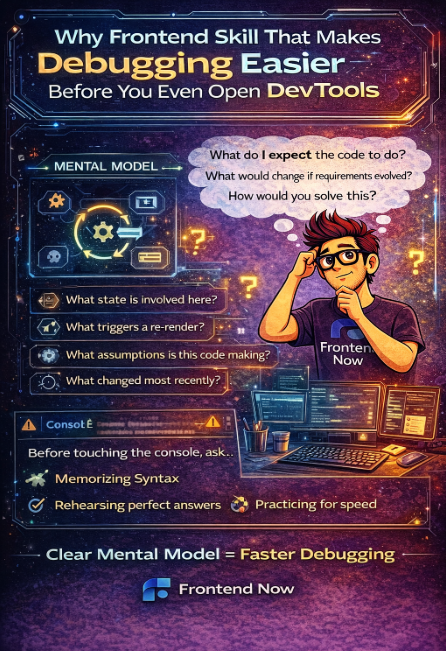
The Frontend Skill That Makes Debugging Easier Before You Even Open DevTools
When frontend bugs show up, most people immediately open DevTools. That makes sense, it’s a useful tool. But the frontend developers who debug fastest usually do something before that. They form a mental model of what should be happening. This is the skill that makes debugging feel calmer instead of chaotic. Before touching the console, experienced frontend developers ask a few quiet questions: What state is involved here? What triggers a re-render? What assumptions is this code making? What changed most recently? Those questions narrow the problem long before any logs appear. Most frontend bugs aren’t random. They’re the result of: - State changing when you didn’t expect it to - State not changing when you thought it would - Code running in a different order than you assumed - A dependency behaving slightly differently than before If you don’t have a mental picture of the data flow, DevTools just shows you symptoms, not causes. This is why beginners often feel lost while debugging. They jump straight to: - Console logging everything - Changing things “to see if it works” - Adding conditionals until the bug disappears That approach sometimes fixes the issue, but it doesn’t build understanding. It also makes the next bug harder. The habit that helps most is learning to predict behavior. Before running the code, ask: “If I click this, what state should change?” “If this value updates, what else re-renders?” “If this API fails, what does the UI do next?” When reality doesn’t match your prediction, that gap tells you exactly where to look. That’s efficient debugging. DevTools are powerful, but they’re multipliers. If your mental model is fuzzy, they amplify confusion. If your mental model is clear, they confirm or disprove hypotheses quickly. That’s the difference. If you want to improve your frontend debugging skills, don’t start by adding more logs. Start by slowing down. Explain what you expect to happen before it happens. Then observe what actually happens.
0
0
3d •
The 100-Day Frontend Developer Roadmap (What to Learn, When to Learn It, and What to Skip)
Most people who say “I want to become a frontend developer” don’t actually have a learning problem. They have a direction problem. They jump between: ● YouTube tutorials ● Random courses ● “What should I learn next?” threads And months later… they’re still unsure if they’re even on the right path. So let me ask you something honestly: Do you know what you should be learning right now or are you just staying busy so it feels like progress? That’s why we put together a 100-Day Frontend Developer Plan. No fluff. No trend-chasing. No “learn everything just in case.” It breaks down: ● What to focus on first (and what to ignore) ● How real frontend skills are built in the real world ● When freelancing actually makes sense (and when it doesn’t) ● Why skipping fundamentals is the fastest way to get stuck later It’s the roadmap we wish more beginners had before wasting months guessing. If you’re: ● Learning frontend and feeling scattered ● Unsure if your current path leads to a job ● Tired of watching content without confidence 👉 DM me the word “Roadmap” and I’ll send it to you. Sometimes clarity isn’t about motivation it’s about finally seeing the path laid out in front of you.
4d •
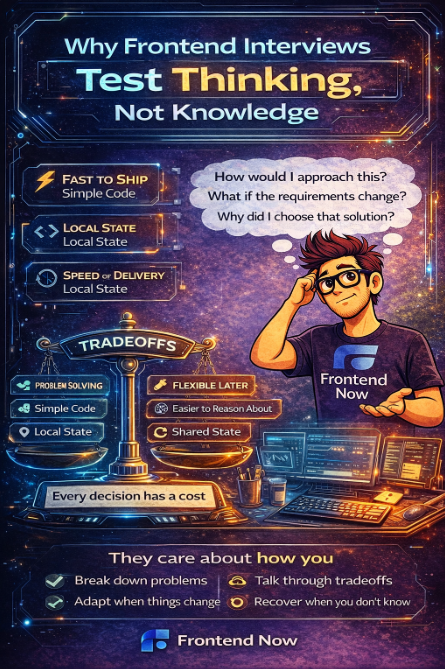
Why Frontend Interviews Test Thinking, Not Knowledge (And How to Prepare Properly)
One of the biggest misunderstandings about frontend job interviews is thinking they’re knowledge tests. They’re not. Interviewers aren’t trying to see how many APIs you’ve memorized or whether you remember the exact syntax for something under pressure. They’re trying to understand how you think. That’s why so many capable developers walk out of interviews feeling confused. They studied hard, reviewed concepts, and still felt like they didn’t “perform.” It’s usually because they prepared for the wrong thing. In real frontend interviews, what’s being evaluated is your reasoning. Interviewers are listening for: - How you break problems down - How you reason about state and change - How you handle ambiguity - How you explain decisions and tradeoffs - How you recover when you don’t know something That’s why you’ll often hear questions like: “How would you approach this?” “What happens if this requirement changes?” “Why did you choose this structure?” Those aren’t trivia questions. They’re thinking questions. This is also why memorization-heavy prep backfires. If your preparation is mostly: - Watching interview walkthroughs - Memorizing solutions - Practicing perfect answers You’ll struggle the moment the problem looks slightly different. Real interviews are intentionally messy. They want to see how you navigate uncertainty, not whether you’ve seen the exact question before. So how do you prepare properly? You practice explaining your thinking out loud. You get comfortable saying: - “Here’s how I’m breaking this down.” - “This assumption might change, so I’d design it this way.” - “I don’t know the exact API, but here’s how I’d reason about it.” That’s not weakness. That’s competence. Another important shift: stop aiming to be fast. Interviewers aren’t impressed by speed if it comes without clarity. They’d much rather see slow, structured reasoning than quick, brittle answers. Pausing to think. Clarifying requirements. Talking through tradeoffs.
0
0
5d •
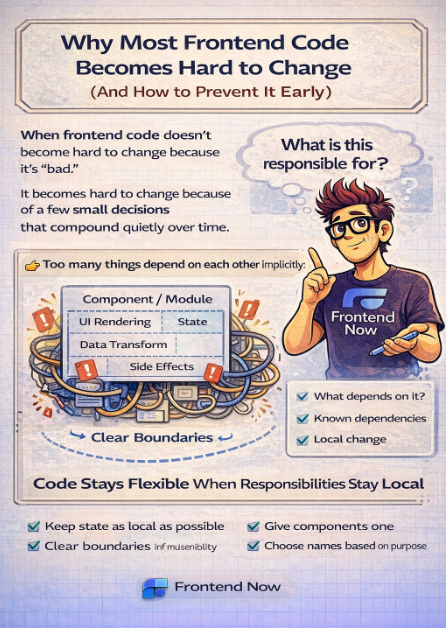
Why Most Frontend Code Becomes Hard to Change (And How to Prevent It Early)
Most frontend code doesn’t become hard to change because it’s “bad.” It becomes hard to change because of a few small decisions that compound quietly over time. Early on, everything feels flexible. You can tweak a component. Move some state. Add a condition. Then a few weeks later, even small changes feel risky. That’s not accidental. Frontend code usually becomes hard to change for one main reason: 👉 Too many things depend on each other implicitly. State is shared more widely than necessary. Components assume things about data shape or timing. Logic is spread across places without clear ownership. Nothing is wrong in isolation but together, it creates friction. Here’s a common example. A component starts simple: It renders UI and handles a bit of state. Over time, it also: - Fetches data - Transforms that data - Handles edge cases - Coordinates with other components Now changing one thing means understanding everything. The code still works but it resists change. The way to prevent this early isn’t adding more patterns. It’s being intentional about responsibility. Maintainable frontend code usually has: - Clear boundaries around state - Components with one primary job - Data flowing in predictable directions - Fewer hidden assumptions When responsibilities are clear, changes stay local. When responsibilities blur, changes ripple outward. Experienced frontend engineers constantly ask one quiet question while coding: “What will this make harder later?” That doesn’t mean overengineering. It means: - Keeping state as local as possible - Avoiding abstractions before patterns repeat - Naming things based on what they do, not how they’re implemented - Letting structure emerge from usage Those habits don’t slow you down, they protect future progress. If your frontend code keeps getting harder to change, here’s a simple habit to try: Before adding new logic, pause and ask: - Who depends on this? - What assumptions am I creating? - Could this responsibility live somewhere smaller?
0
0
1-10 of 138

@harry-ashton-2348
I help beginners land remote jobs in tech without a degree or previous experience 🚀
https://learnfrontendnow.com 💻
Active 3h ago
Joined Feb 4, 2025
Powered by