
Pinned

Jul 14 •
Think Better. Write Better. Build Better Books.
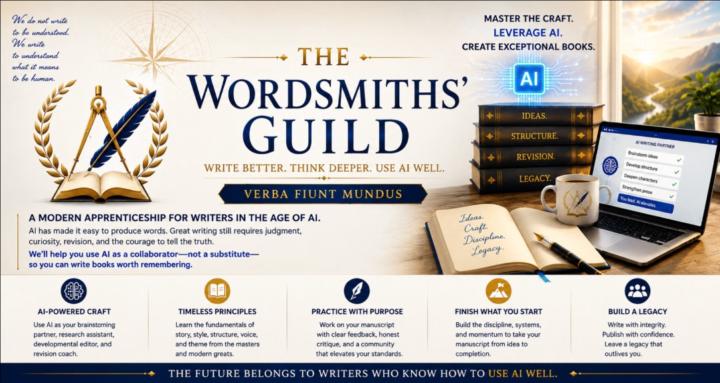
Welcome to The Wordsmiths' Guild. If you're looking for shortcuts, you're in the wrong place. If you're looking for someone to tell AI to write your book for you, you're in the wrong place. This Guild exists because writing has changed. For the first time in history, every writer has instant access to extraordinary tools. We can brainstorm with AI, research in minutes instead of days, pressure-test ideas, explore characters, analyze structure, and learn from the greatest writers who ever lived without leaving our desks. That changes everything. It also raises the standard. Yesterday's excellence is today's minimum bar. In the years ahead, there will be an explosion of books. Many will be technically competent. AI has made that possible. But competence isn't the goal. Meaning is. Craft is. Truth is. The writers who rise above the noise won't be the ones who produce the most words. They'll be the ones who think more deeply, write more intentionally, and create books that are genuinely worth reading. That's why The Wordsmiths' Guild exists. Everything we do here is built around three simple ideas: 🤔 Think Better. Great books begin long before the first sentence. Learn to ask better questions, explore ideas from multiple angles, research effectively, and use AI to challenge your thinking instead of replacing it. ✍️ Write Better. Master the timeless principles of storytelling. Character. Conflict. Theme. Dialogue. Structure. Voice. AI changes the tools, but great writing still depends on great craftsmanship. 🏛️ Build Better Books. A great manuscript doesn't happen by accident. Learn a complete system for planning, drafting, revising, editing, and publishing books that can stand the test of time. This isn't a community about writing faster. It's a community about writing better. Welcome to the Guild.
3
0
Aug 1 •
Accepting Feedback
I shared the first chapter of my novel, Catfish Air with this group, and mine, and some friends, and got excellent feedback. The best part is that I got proper, constructive feedback. Not a single person said, "Oh, gosh-golly-gee-wow mister, this is swell!" Every reader said things like, "These parts are great, but that didn't work for me," or "I like this a lot, but this bit didn't make sense," or even, "Please delete this entire section - it's way too much!" And guess what? I took it all to heart. Not in a bad way. I mean I took is seriously. I genuinely went back and reviewed what I'd written and incorporated the feedback, and I think I cracked the code! Up until now, I'd had the POV and the voice all wrong. It was too stiff like I was a puppeteer with some marionettes and describing what people were doing. Not gonna lie...it kind of sucked. But now I zoomed in, stepped inside a character, share back stories as I go along which allows me to avoid cardboard cut-out characters. Thank you all so much for your feedback! And, if you're interested, I've attached the new version of the first chapter. Fair warning...there's one character who is VERY inappropriate toward women - but give him some grace because it's all part of his character arc.
Jun 21 •
Hey Guild —
I have some news, and I want you to hear it from me directly. The Wordsmiths' Guild is growing up. Over the next few months, I'm finishing the full Journeyman curriculum — eight lessons, each one built around a concrete, nameable craft skill, each one including a writing assignment that I read personally and send back with feedback. When it's done, the Guild moves to a formal tier structure: Apprentice, Journeyman, and Master levels, each with its own curriculum, its own price point, and its own completion rewards. That goes live September 1. Between now and then, I'm building this in public — and you're invited to be part of it as it takes shape. Every course I'm developing, every mentorship session I host, every piece of curriculum in progress is available to you right now, at no cost. Come learn. Come ask questions. Come watch the thing get built. Here's what I want to offer you specifically, as a founding member: Submit proof of publication before September 1 — anything you wrote, finished, and put in front of readers; a blog post, an article, a book, a piece submitted somewhere — and you earn Founding Apprentice status. That means lifetime free access to all Apprentice-level curriculum, for as long as the Guild exists. No monthly fee. No expiration. Grandfathered in, permanently. Your free membership isn't going anywhere. Nothing is being taken from you. I just want to give you the chance to step into something more before the door closes. For the full picture — tiers, pricing, what's included at each level, and the completion rewards — head to the Classroom and open "The Wordsmiths' Guild: How It Works." To claim Founding Apprentice status: reply to this post or send me a direct message with your proof of publication before September 1. I'll see you in the sessions. — Shawn
Jul 24 •
Catfish Air, Chapter 1.
After I finished my last non-fiction book, I promised myself I'd focus on fiction. And I did. I spent a lot of time developing the outline, working on worldbuilding, character development, and story arcs. Let me know what you think. Chapter One. Balad Air Base, Iraq Technical Sergeant Virgil R. Mason set his coffee cup down next to his Rubik’s cube and wiggled his computer mouse to wake his computer. The large, black mirror glowed to life. His desk was cluttered with papers in loose piles. The office he shared with Master Sergeant Edmund Erwin was in an old Iraqi military building. There was no way to know why the Iraqis built, or what it was used for. But it was ideall for this small Air Force detachment. “Don’t forget we have the assignment brief at zero-nine,” said Master Sergeant Erwin. “I think she’s sending us to FOB Colfax this week. I heard her mention it to Captain Carlisle the other day.” Virgil’s computer came fully to life and he double-clicked the Outlook icon. He remembered years before they used to say that if you wanted to beat the air force, all you’d need to do is shut down the phone system. These days it was Outlook. “And if you want to do the half-marathon, let me know,” said Sergeant Erwin. “I haven’t done any distance like that in ages and I could use the running buddy.” Virgil nodded and grunted quietly, slowly sipping his coffee. This morning he was having Starbucks’ Veranda – the one with the little hummingbird on the bag. Previous teams who had been through this office set up a collection point for coffee from care packages. If he had to guess, there was maybe seventy or eighty pounds of coffee – mostly Starbucks. His favorite was the Veranda, and he was running low. There was plenty of the Pike’s Place and whatever other dark or medium roast coffees they made – some bags of whole bean and some ground. One thing that hadn’t come in a care package yet was a grinder, so the bags of ground coffee, especially Veranda, were under his personal protection.

Jul 25 •
My Rake's Progress
A Regency Romance - please read if you have time - I'm now on Chapter 25, and I have turned them into a StoryPods podcast justvtonpush myself to stop procrastinating and get myself heard. https://www.buzzsprout.com/2616649 Constructive feedback would be appreciated! Thank you in advanced Prologue April, London, 1809 The Chesterton's Soirée “Well, Horatia, my dear, let's finish your toilette, as you need to make an impression tonight. There will be several eligible gentlemen in attendance this evening. Lady Chesterton's soirée is always a popular event.” Chirped Lady Hazel Stanwycke, as she fussed around her eldest daughter, who now was staring in horror at the sickly pink evening dress that her mother's maid, Peggy, now held. “Mama, you're not serious that I wear this …. this sickly flounced gown. I will look like a fancy wrapped confection from Fortnum & Mason's!” “Darling, you will look glorious. Your father will be proud of how beautiful you will look. It includes everything that is fashionable.” “Maybe, but all in the same gown?” Horatia frowned, as if she had her way it would not have all the additional flounces, ribbons and feathers that had now been added to the beautiful simply elegant gown that she had last tried on at the modeste's. “All of this was not on this gown when it was last fitted!” “No, I asked Madame Crystelle to add them. The latest fashion, my dear.” With Horatia still frowning, in fact more of a scowl, her mother helped her into the awful gown. She looked in the mirror at the hideous sight. “I’m going to be laughed at, the laughing stock!” “No, the other young ladies will be jealous, Horatia, just you mark my words.” Horatia was not convinced. “Could I not just wear the ice-blue gown? That's so pretty.” “Definitely not, Horatia, you cannot be seen in the same gown twice in a row. Be sensible, this gown will get you noticed.” Horatia could not agree more, yes, noticed for all the wrong reasons! She was soon dressed and coiffeured, and descending the stairs down to her awaiting father. Her father’s eyes flickered a startled look, which he quickly hid, and broke into a radiant smile.
1
0
1-30 of 54
Suggested communities
Powered by