
Write something

9d •
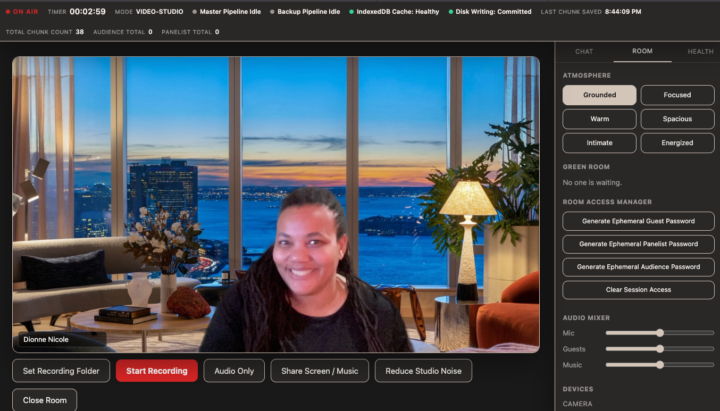
I built a Zoom-replacement with Claude Fable
This week for my Fable use case, I decided to build my own recording studio that was local to my computer. Why? 1) I wanted to see what was possible. 2) I have 60 more podcast episodes to make, and I didn't want to pay for Zoom or other podcast recording software every month. Now I can record audio only, video chats or even do a webinar. FOR ZERO DOLLARS. The files save locally on my computer. I spent 80% of my time (like I recommend) planning it out with Gemini (for the tech aspects) and my Vibe Thinking GPT for the user experience. When I brought it to Fable? It was built in 7 minutes and saved soooo many tokens! Take advantage of a two-week trial period window until June 22nd to try it with your Claude Pro ($20/m) account. Our next live class is happening Friday, 6/11 at 12pm EST and I will be going over my build! And doing on the spot Q&A! Other time zones: 1:00 AM CST (Chicago), 9:00 AM PST (Los Angeles), 5:00 PM GMT/UTC (London) And always remember, even though the community is going to be archived for now, you can always reach out for a 1:1 to go over your build.
9d •
What is Claude's Fable all about?
What is the Claude Fable Drop? - Anthropic just launched Claude Fable 5, their newest 5th-generation "Mythos-class" frontier model designed to tackle incredibly complex, multi-day, and asynchronous tasks. - It represents a massive leap in AI capabilities, featuring an expansive 1-million-token context window and advanced adaptive thinking for highly ambitious projects. - Built with a focus on deep logic and autonomy, Fable 5 can act as an agent that plans across multiple stages, writes its own tests, and uses advanced vision to check its own work. How it is "Free" Until June 22 - To celebrate the launch while managing server capacity, Anthropic has included Fable 5 in all Pro, Max, Team, and seat-based Enterprise subscriptions at no extra cost from now through June 22, 2026. - On June 23, Fable 5 will be temporarily removed from standard subscription tiers and will require pay-as-you-go usage credits due to the massive compute power it demands. - This two-week window is essentially an exclusive, built-in "free trial" for subscribers to test drive Anthropic's most expensive and powerful model before it transitions to consumption-based pricing. Why People Should Give it a Whirl - Unprecedented Autonomy: It is a major breakthrough for "vibe-coding" and multi-step analytics, allowing you to hand off massive, complex projects and simply review the completed, self-tested output. - Massive Performance Jumps: Early benchmarks show Fable 5 completely outperforming older models like Opus 4.8, shattering records on complex coding, finance, and physics research tasks. - A Sneak Peek at the Future: Testing it right now lets you experience true next-level, long-horizon AI agent workflows for free before it becomes a premium, metered feature.
9d •
how to find ".claude" on desktop
To find the .claude folder (which stores your local settings and custom skills for Claude Code) on your desktop, you need to reveal hidden files on your system. On MacOS 1. Open Finder. 2. Press Command + Shift + Period (.) on your keyboard to instantly toggle hidden files on or off. 3. Navigate to your Home directory (your user folder). 4. You will now see the .claude folder. (Alternatively, in any Finder window, press Command + Shift + G, type ~/.claude, and hit Return). On Windows 1. Open File Explorer. 2. Click the View tab at the top of the window. 3. Click Show (or look for the Show/hide option) and check the box for Hidden items. 4. Navigate to C:\Users\[YourUsername]. 5. You will now see the .claude folder.

🔥
23d •
What App Are You Building Right Now?
Hey, everyone! I'm new to the community, and I'm glad to be here. What is everyone working on building right now? Before joining here, I had figured out how to build a couple of apps, but I'm looking to take my app-building skills to the next level! I built a Push-Up Tracker for my community users. I built a volunteer/ministry tracker for me to use at my church (I'm an assistant pastor at my church) I'm building a personal life assistant that helps me keep track of reminders, goals, proactive action, and more. I added gamification to this one to see what that's like.
25d •
Creator Prompt vs. Runtime Prompt
When you build an app, there are actually two completely different "AI layers" at play: 1) The Builder Prompt (What you tell your AI): This is the instruction you give to the Lovable, Claude Codex, Codex, etc. chat interface to build your UI, database tables, and logic (e.g., "Build me a fitness tracking dashboard"). 2) The Runtime Prompt (The Engine Inside Your App): This is the hidden system instruction given to the AI component inside your live app (e.g., the prompt that tells the chatbot or form analyzer how to behave when your end-user interacts with it). Most people never look at that runtime prompt and it's usually not good. Coding AI often generates a generic text prompt for your app's internal AI features. If you want deterministic, rock-solid outputs that don't vary wildly, you have to hand-craft that runtime prompt using a strict JSON structure. Plain language prompts leave room for the AI to guess the format, tone, and logic. A JSON structure acts as a rigid cage for the AI's logic. It forces the AI to process variables as absolute rules rather than casual suggestions. Instead of telling the AI: "You are a helpful business coach. Analyze this form input and give feedback. Be concise." A structured JSON approach looks like this: { "system_role": "Expert Business Analyst", "input_data": { "form_fields": ["revenue", "expenses", "goals"] }, "processing_rules": [ "Calculate net margin immediately.", "Identify top two cost-saving opportunities." ], "output_format": { "summary": "Strict 2-sentence maximum", "metrics": ["net_margin_percentage"], "action_steps": "Array of exactly 2 items" } } When the AI inside your app reads this JSON, it treats it like code documentation. The variance drops to near zero because the boundaries are explicit. You don't need to know how to do this! You just need to be able to tell the AI that this is how you need it to be it in the backend: in JSON for anything runtime.
3
0
1-14 of 14
powered by

skool.com/vibe-code-on-the-cheap-6934
Build your own apps w/ Claude Code, Codex + Lovable. Solve your exact friction, save tokens, and run them forever for $0. Use SEARCH BAR for help.
Suggested communities
Powered by