
Write something

Aug 30 •
Here is our take..
We posted this to get a general feeling of what people thought about deadly force in a situation that wasn’t exactly crystal clear. We were not disappointed. Most of the comments said that deadly force was justified and necessary to end the attack. With another large portion saying that the background matters in what you saw. The background is largely irrelevant but here it is. Uber driver picks up a 65 yr old lady who passes out in his backseat. She wakes up and has a violent episode attacking the driver while he was on the highway. He pulls the car over and shortly thereafter the video starts. She had been drinking and claims that it was a “blackout” and has no memory of the incident. The woman was charged with various felonies, which were later reduced to misdemeanors. She was convicted and ordered to complete psychological evaluations and probation. All of which does not matter to the question at hand. We do not believe that deadly force was either justified or necessary. Was this a credible threat to the driver? Look at the AOJ Triangle, the attacker must have the Ability, Opportunity, and the victim must be in Jeopardy. She had the opportunity; her ability is in question (we would argue that she really did not based on the video); but was the driver in real jeopardy of being killed or suffering some kind of grave bodily injury? Not really, he repeatedly stated that he did not want to put his hands on her, not even to stop the attack. over Secondly, would a deadly force response be proportional to the threat he faced? While choking someone can lead to death in certain circumstances, was it leading to it in this case? While it does appear that the driver was uncomfortable, it did not seem as though he was in danger of passing out, let alone dying. Especially given the fact that he made no attempt to defend himself. This leads to the next and possibly the most important point, reasonableness. Reasonableness has two components; Objective and Subjective. Did the driver reasonably believe that he was in danger of dying or suffering great bodily harm (Objective) and would an average person in the same circumstances believe they were in the same danger (Subjective)? Clearly the driver did not think that any force was necessary to protect himself, as he refused to do anything to stop the attack. Even going as far as telling everyone that he did not want to put his hands on her. If he does not believe it how would a jury be expected to?

Aug 27 •
Would it be justified?
We were going to go over the recent shooting at an In n Out in Idaho, however, one of our group sent us this video from social media and asked if deadly force would have been justified. Take a look and let us know what you think.

Jun 4 •
Part 2: What's Your Plan - Our Take
To begin with, this is a win, nothing happened, no one got hurt, killed, or went to jail. Most of the feedback that we have received has been positive, praising what a great job she did, and that there was not much that she could have done differently. However, in keeping with our philosophy of teaching you how to think, not what to think, and always trying to do better, let’s take a closer look. Her awareness and observations before her exercise routine were great, she took the time to look around, saw the truck, made note of it, and went along with her day. When she saw the truck the second time, and it caused her some concern, is where this story should have ended. We tell women all the time to trust their “gut.” Why not turn around, walk back to your car, and exercise another day or in a different place? If you have time and distance, avoidance is usually the best, safest, easiest, and the first choice you should make. She decided to continue her walk and approach and pass the truck. Prior, she moved her safety gear to her dominate side (bear spray) and opened her coat so that she could access her firearm if she needed it. This implies that they were not in a spot where she would have been able to get to them as fast as necessary should a life-threatening situation arise. The sole purpose of carrying these items is to be able to use them as quickly as possible to save your life. If you cannot get to them in an emergency, they are useless. It would be prudent to start your walk with them in a place where you can get to them when needed without having to adjust or move them to make it easier when the threat appears. She did this “casually… Just like I’m going to unzip my coat, no big deal.” Bad guys, like bears, are usually looking for easy prey. Appearing “casual” while approaching a potential threat is the opposite of what you should be doing. You want to appear to be the hardest target possible. Hopefully it gives the attacker pause before deciding to take the risk of a fight and carry out the crime. This isn’t to say pull your gun out and point it at them as you walk by, but a least have your spray in your non-dominate hand to reduce the time it would take to use it, and leave your dominate hand free if you were forced to use your gun instead of the spray.
May 2 •
What's Your Plan?
This video is a bit long, but well worth a watch. It happened to a woman who is a self-defense/firearms instructor while she was on a walk in a rural area of our home state. We're curious what everyone thinks about how she handled the situation? Comment below and give us your thoughts and what you would have done. Looking forward to hearing from everyone. S&J

Mar 21 •
Questions Worth Asking Yourself:
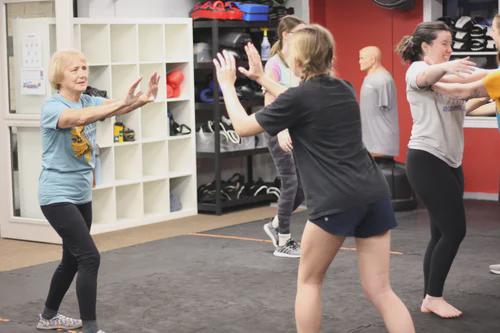
Questions Worth Asking Yourself: - Are you in fighting shape? - Could you move fast if you had to? - Close the gap and stop an attack? - Create distance and get to safety? - Are you capable of overwhelming the threat with force and violence if the moment demands it? - Could you deliver a quick strike just to break contact and create distance before engaging further? - Do you have the speed, balance and enough gas in the tank to keep moving? Honest questions that require honest answers. According to the FBI's 2024 reported crime statistics there were approximately 1,980,149 recorded assaults involving "personal weapons" (hands, fists, feet). - You are 13.7 times more likely to be assaulted with personal weapons than with a handgun. - You are 15.5 times more likely to be assaulted with personal weapons than with a knife or cutting instrument. - You are 25.9 times more likely to be assaulted with personal weapons than with a blunt instrument. Our first weapon system is the one we live in everyday, make sure it doesn't quit on you when you might need it most. S&J
1-21 of 21
powered by

skool.com/the-vigilant-family-8852
Building a community through family-first self-defense training focusing on awareness, confidence, and real-world skills to keep your loved ones safe.
Suggested communities
Powered by