
Mar 30 • General discussion
The Long Memory of America
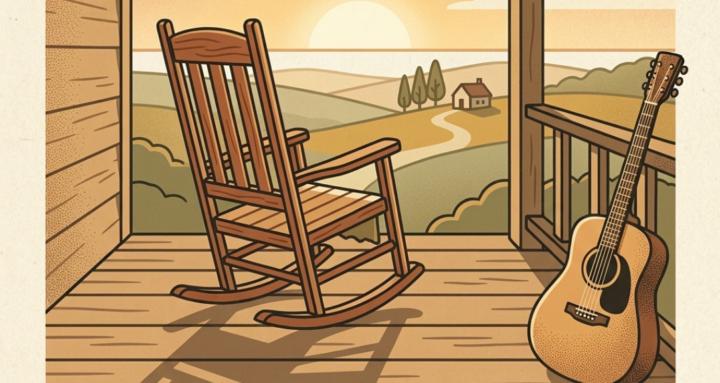
When the world feels loud enough to rattle the porch boards, I step outside with my coffee and let the quiet do the talking first. Out here, the sky doesn’t care who’s shouting on the news. The sparrows aren’t taking sides. And the old Japanese Maple in the yard—well, she’s seen more American history than any of us, and she’s still standing… even if she leans a little.
Lately, folks have been asking me what I think about these “No Kings” protests. Asking me if I think the protest is necessary, or if I think we’re drifting toward something dangerous, or even if the country is coming apart at the seams. And I get it. When the headlines read like a fever dream and the neighbors are whispering words like “authoritarian” and “overreach,” it’s natural to wonder whether we’ve wandered off the map.
Mostly, I shrug my shoulders. And here’s why. I don’t watch broadcast news. I don’t listen to it on the radio and if someone mentions ‘current events,’ I defer to others around me because I cannot and will not form an opinion based on news items that have been cherry-picked and given out in little sound bites that usually only tell half-truths. So, as is my custom, I decided to follow the rabbit down the hole.
America has been off the map before. More than once. And every time, ordinary people—porch‑sitting, hymn‑singing, casserole‑carrying people—have had to decide what kind of country they wanted to hand to their children.
So let me tell you what I see from my front porch.
I see echoes of three old American moments: the 1850s, the 1930s, and the 1960s, and I am struck by the similarities. Not carbon copies, but the same chord pattern played in a different key.
From the 1850s, We’ve Borrowed the Tension
The 1850s weren’t about policy. They were about the soul.
Back then, Congress passed the Fugitive Slave Act of 1850, a law that didn’t just regulate slavery — it reached into free states and demanded that ordinary citizens help capture escaped enslaved people. You can read the text yourself in the U.S. Statutes at Large, but the heart of it is simple: it forced Americans to decide whether they believed a human being could be owned. Frederick Douglass answered that question with fire in his 1852 speech, “What to the Slave Is the Fourth of July?” He didn’t mince words. He called the law “cruel,” “infamous,” and “a shameless hypocrisy.” That wasn’t a policy disagreement. That was a moral indictment.
Then came the Kansas–Nebraska Act of 1854, which tossed out the old Missouri Compromise and said new territories could vote slavery up or down. Abraham Lincoln, in his Peoria Speech that same year, warned that this wasn’t just a legislative tweak — it was a national turning point. He said the Act “aroused him as he had never been before.” And he wasn’t alone. The country split open. Pro‑slavery and anti‑slavery settlers flooded Kansas, and the territory descended into what newspapers called “Bleeding Kansas.” Congressional investigations documented the violence: burned homes, stolen ballots, militias forming on both sides. Again, not a policy debate. A fight over identity.
And then came the Supreme Court’s Dred Scott decision in 1857, which declared that Black Americans — free or enslaved — could not be citizens, and that Congress had no authority to restrict slavery in the territories. Chief Justice Taney wrote the majority opinion; Justice Curtis wrote a blistering dissent. But the message was unmistakable: the highest court in the land had taken a side in the question of who belonged in the American family.
By the time John Brown stormed Harpers Ferry in 1859, trying to spark a slave uprising, the country wasn’t arguing about tariffs or infrastructure. It was arguing about humanity, belonging, and the meaning of freedom itself.
And that’s why the 1850s feel so familiar.
Because today, we’re arguing about the rules of the house — who gets to vote, whose votes count, what truth is, who belongs, and how much power one person or one branch should hold. We’re arguing about whether the system still works, and whether the country we thought we lived in is still the country we have.
The specifics are different, but the shape of the tension is the same.
Just as the 1850s had disputed elections in Kansas, we have disputes over election legitimacy today — documented in Pew Research Center reports showing declining trust in electoral systems. Just as partisan newspapers in the 1850s fueled division, today’s social media echo chambers do the same — Harvard’s Shorenstein Center has the studies to prove it. And just as the old political parties fractured in the 1850s, our modern parties are splintering into wings and factions — something the Brookings Institution has been tracking for years.
No, we are not living in 1856. But we are living in a moment when the temperature is high enough to blister paint, and the arguments are about the foundation, not the furniture.
And if history teaches us anything, it’s this: when a nation starts arguing about its soul, the stakes rise, the rhetoric sharpens, and the porch becomes one of the last places where people can sit down, breathe deep, and remember that the story isn’t finished yet.
From the 1930s, We’ve Borrowed the Anxiety
The 1930s were a decade when the bottom fell out. Banks collapsed. Jobs vanished. Breadlines stretched around city blocks. You can open any newspaper from 1932 — the Chicago Daily Tribune, the New York Times, even the Evansville Courier and Press — and you’ll see the same thing: a country staring at its empty pockets, wondering what went wrong and who might fix it.
Into that fear stepped Franklin D. Roosevelt, who told the nation in his first inaugural address that “the only thing we have to fear is fear itself.” It was a beautiful line, but it didn’t magically refill anyone’s pantry. What it did do was signal something new: a president willing to use federal power in ways the country had never seen before. The New Deal rolled out alphabet agencies like a parade — the CCC, WPA, TVA — each one promising jobs, relief, or reform. Some folks saw salvation. Others saw overreach. But nobody saw business as usual.
And while America was wrestling with its own troubles, the world outside was turning darker. In Germany, Adolf Hitler rose to power in 1933. In Italy, Mussolini had already been in charge for a decade. Spain fell into civil war. The Soviet Union tightened its grip. Democracies were wobbling, and strongmen were stepping into the spotlight with promises of order, pride, and national rebirth.
You can read the congressional debates from that era — the Congressional Record is full of them — and you’ll hear the same worry repeated: What happens when people are scared enough to trade freedom for certainty? That was the question of the 1930s. And it’s a question that echoes today.
Because fear hasn’t gone out of style.
Today, the anxiety doesn’t come from breadlines but from layoffs, automation, rising costs, and the sense that the world is changing faster than ordinary folks can keep up. Back then, people feared losing their farms; today, they fear losing their footing in a world that feels like it’s running on a different operating system. The details change, but the ache is familiar.
And just like the 1930s, moments of fear make strong leaders look appealing. Not strong in the moral sense — strong in the “just let me handle it” sense. The kind of strength that promises to cut through the mess, silence the critics, and get things done. The kind of strength that asks for fewer questions and more obedience.
History shows us how tempting that can be. It also shows us the cost.
But here’s the thing the 1930s also teach us: fear doesn’t have to lead to surrender. It can lead to solidarity. Churches in that era fed the hungry, sheltered the homeless, and reminded people that their worth wasn’t tied to their wages. Musicians — Woody Guthrie, the Carter Family, Mahalia Jackson — sang hope into the dust. Neighbors leaned on each other because the government programs, big as they were, couldn’t reach every porch.
And that’s the part of the 1930s I hold onto. Not the fear. Not the strongmen. Not the political shouting matches. But the way ordinary people became extraordinary to one another.
When I look at today’s anxieties — the economic uncertainty, the political shouting, the temptation to hand the keys to someone who promises to drive fast and ask no questions — I hear the 1930s whispering a warning and an invitation. The warning is simple: fear can make us choose the wrong kind of savior. The invitation is gentler: fear can also make us reach for each other.
When the world feels shaky, the answer isn’t a bigger throne — it’s a longer table. It’s neighbors checking on neighbors. It’s churches remembering their calling. It’s musicians singing courage into the cracks. It’s communities choosing cooperation over coronation.
The 1930s can remind us that anxiety doesn’t have to hollow us out. It can deepen us. It can make us wiser. It can make us kinder. And it can teach us, all over again, that the strongest thing in a democracy isn’t a single leader — it’s a people who refuse to give up on one another.
From the 1960s, We’ve Borrowed the Streets
The 1960s were a decade when the country’s conscience woke up and refused to go back to sleep. You can open any newspaper from that era, and you’ll see photographs of people marching, singing, kneeling, sitting‑in, standing‑up, and refusing to move. The Civil Rights Movement wasn’t a side story; it was the story. And it wasn’t led by celebrities or politicians. It was led by ordinary people who had decided that dignity was worth the risk.
In 1963, more than 200,000 people gathered for the March on Washington. The National Archives still holds the program from that day — a simple sheet of paper listing speakers, songs, and prayers. It’s not flashy. It’s not complicated. But it changed the country. Dr. King’s “I Have a Dream” speech gets the headlines, but the whole day was a symphony of courage, from John Lewis’s fiery address to Mahalia Jackson’s voice ringing out like a trumpet.
And that was just one moment.
There were the Freedom Rides of 1961, where buses were burned and riders beaten for testing desegregation laws. There were the Birmingham Children’s Crusade marches in 1963, where police dogs and fire hoses met schoolchildren in Sunday shoes. There were the Selma marches in 1965, documented in congressional hearings and FBI reports, where peaceful protesters were clubbed on the Edmund Pettus Bridge. These weren’t policy debates. These were moral confrontations.
And then there was Vietnam — a war that stretched across oceans but tore open living rooms here at home. The Pentagon Papers, released in 1971 but chronicling decisions from the mid‑60s, revealed a government struggling with truth and transparency. Protests erupted on college campuses, in city squares, and outside the White House gates. Kent State. The Moratorium to End the War. The March on the Pentagon. The country wasn’t just divided; it was disillusioned.
Trust in institutions — government, media, even churches — began to crack. Gallup polls from the era show a steep decline in public confidence. And once trust breaks, people take to the streets because they no longer believe the system will listen any other way.
That’s the part of the 1960s that feels closest to today.
Because right now, we’re living in a moment when people don’t just disagree with policies — they doubt the institutions that deliver them. They question elections, courts, agencies, and the stories we tell about ourselves. And when trust erodes, the sidewalk and street become the last places left to speak.
But here’s the part of the 1960s I think is the most striking: the way faith communities showed up.
Black churches were the backbone of the Civil Rights Movement. They trained marchers in nonviolence. They held mass meetings that doubled as strategy sessions and revival services. They sang “We Shall Overcome” not as a slogan but as a prayer. The Southern Christian Leadership Conference, the Student Nonviolent Coordinating Committee — these weren’t political machines. They were moral movements rooted in scripture, song, and the belief that justice is not optional.
And while not every church joined in — some stayed silent, some resisted — the ones that stepped forward changed the nation. They proved that faith can be a force for liberation, not just comfort. They showed that the gospel has something to say when the streets are on fire.
Today’s protests — whether they’re about policing, immigration, executive power, or the fear that democracy is slipping — I see the same impulse that drove the 1960s: people insisting that the official story is not the whole story. People refusing to wait quietly for change that never seems to come. People who believe that showing up matters.
And just like the 1960s, the noise isn’t the problem. The noise is the evidence that people still care.
The real danger isn’t protest. The real danger is apathy.
The 1960s remind us that democracy is loud on purpose. It’s supposed to make room for voices that don’t fit neatly into the official script. It’s supposed to let ordinary people interrupt the powerful. It’s supposed to allow the streets to speak when the halls of power fall silent.
I don’t pretend to know everything of course, but I can tell you this: the noise of a nation wrestling with its conscience is far healthier than the silence of a nation that has given up.
Every time America has hit a crossroads, the same three groups have stepped forward:
- The fearful, who cling to whatever power promises safety.
- The cynical, who shrug and say nothing can be done.
- The faithful, who roll up their sleeves and insist that the story isn’t finished yet.
I don’t mean “faithful” in the narrow sense—though churches have played their part. I mean the people who believe in something larger than themselves. Folks who think the country is worth wrestling with, not abandoning. People who know that democracy is not a spectator sport.
In the 1850s, it was abolitionists and congregations who hid fugitives in their basements. In the 1930s, it was churches feeding the hungry and reminding the powerful that the poor were not expendable. In the 1960s, it was Black churches teaching nonviolence, singing courage into the bones of teenagers facing fire hoses.
Faith communities have never been neutral furniture in the room. They’ve either blessed Pharaoh or helped lead the Exodus.
I see a country wrestling with the same old temptation of the ancient Israelites: the desire for a king. Someone to fix it, settle it, silence it, simplify it. Someone to make the world less complicated, even if it means giving up a little freedom.
But America was built by people who had already tried kings and found them wanting. We don’t do crowns here. We do covenants.
And covenants require participation—messy, loud, inconvenient participation. Sometimes that looks like voting. Sometimes it looks like marching. Sometimes it looks like sitting on a porch with your neighbor and saying, “I don’t see it the way you do, but I’m not giving up on you.”
The “No Kings” protests aren’t perfect. No movement is. But they’re part of a long American tradition of ordinary people reminding the powerful that power is on loan, not inherited.
If I’ve learned anything as a pastor, a musician, and a man who’s spent a lifetime listening to stories on front porches all across the country, it’s this: Americans don’t want a king. They want a voice. They want dignity. They want to know the country they love still loves them back.
And when they feel that slipping, they stand up. Sometimes with a hymn. Sometimes with a protest sign. Sometimes with a quiet, stubborn refusal to bow.
So yes, this moment is serious. Yes, the stakes are high. But no, we are not doomed.
Because every time America has wandered toward a throne, somebody—usually a grandmother, a deacon, a schoolteacher, a factory worker—has stepped onto a porch somewhere, cleared their throat, and said, “Now hold on. We’ve been down this road before, and we don’t need a king. We need each other.”
And that, as far as I can see from my front porch, is still true.
1
0 comments
The Long Memory of America
powered by
skool.com/the-view-from-my-front-porch-4094
A quiet porch for honest stories, steady light, and good company. Pull up a chair and settle in as you are.
Suggested communities
Powered by