
Write something

2d •
Some children carry the ripple quietly.
Family transitions do not affect every child in the same way. In adoptive and blended families, the child who appears independent, helpful, or “fine” may still be adjusting to changes in attention, identity, family roles, and belonging. Quiet coping can be mistaken for resilience without support. Every child deserves the opportunity to speak honestly about what changed, what they miss, what they have gained, and what they need now. When adults make room for the less visible stories, families can move from simply managing change toward genuine connection and healing. The Ripple Effect Community exists to help families notice the whole family system—not only the child whose needs are easiest to see. Because the ripple moves through all of them. #TheRippleEffectCommunity #AdoptiveFamilies #BiologicalSiblings #FamilyTransitions #SiblingWellbeing #FamilyHealing
0
0

5d •
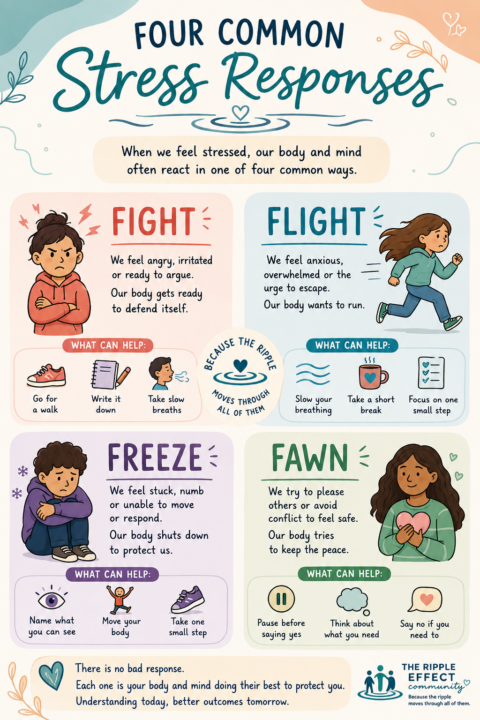
Stress does not look the same in every person.
One child may become angry. Another may avoid the situation. Someone else may shut down, while another keeps saying yes to prevent conflict. These responses fight, flight, freeze, and fawn are ways the brain and body may try to create safety during stressful moments. The goal is not to label the person. The goal is to recognize the response, respond with compassion, and help the person develop healthier coping skills. Take a moment to reflect: Which stress response do you notice most often in yourself or within your family? There is no shame in the response. Awareness is the first step toward change. Because the ripple moves through all of them.
0
0
12d •
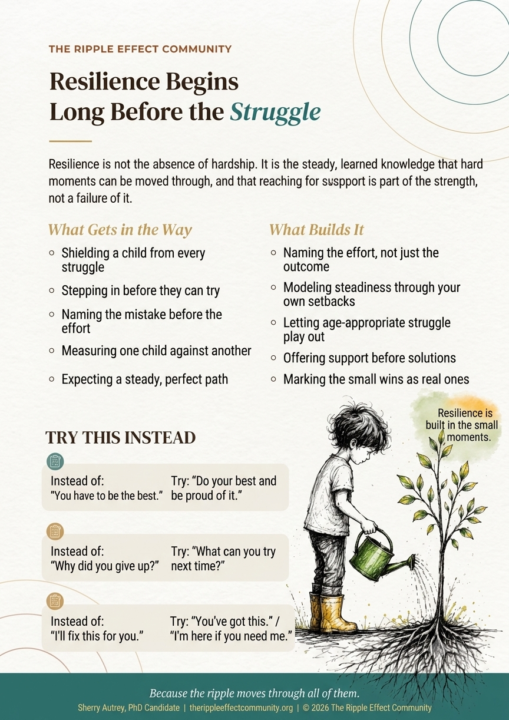
Resilience Begins Long Before the Struggle
Resilience Begins Long Before the Struggle Resilience is one of those words that gets used so often it starts to lose its shape. We tell children to be resilient, we praise resilient employees, we admire resilient communities after disaster. But resilience is not a personality trait a child either has or doesn't. It is a capacity that gets built, slowly, through repeated exposure to manageable struggle paired with steady support. What Resilience Is Not It is not toughness. It is not the absence of pain, fear, or failure. A resilient child still cries after a hard day. A resilient child still gets frustrated when something doesn't work. What resilience changes is what happens next: whether the child believes the hard moment is survivable, whether they trust that trying again is possible, and whether they feel safe enough to ask for help instead of hiding the struggle. Bowen's (1978) family systems theory offers a useful lens here. Family members do not develop in isolation; their coping capacities are shaped relationally, within the emotional climate of the household. A child's resilience, in this view, is never purely individual. It is co-built within the family system, including the unspoken expectations placed on children who are not the ones in active crisis. The Quiet Curriculum In families built through adoption, biological children are frequently part of a household where significant attention, resources, and emotional energy are directed toward a sibling working through trauma, transition, or developmental catch-up. This is not a critique of that attention; it is often necessary and appropriate. But it does mean biological children are absorbing a curriculum on resilience that no one is explicitly teaching them. They learn it by watching how their parents respond to a sibling's setback. They learn it by noticing whether their own small struggles get the same patience and curiosity, or whether they are quietly expected to manage independently because the family's bandwidth is elsewhere. Bronfenbrenner's (1979) social-ecological model reminds us that development happens within layered, interacting systems, and a child's resilience is shaped as much by the family's emotional bandwidth as by anything said directly to that child.
0
0
17d •
"The Sky Doesn't Ask Permission to Change."
Some evenings, the sky reminds us that change is rarely quiet. Tonight's clouds didn't ease into color. They burned into it, fast and wide, covering everything in sight. And yet, underneath all that motion, the shoreline stayed steady. The palms bent in the wind. The sand kept its shape. That is what ripple effects often look like in families touched by adoption. The sky changes. The emotional climate shifts in ways no one announced or asked permission for. And the people standing in it, especially the children already there, are left finding their footing in a landscape that suddenly looks unfamiliar. We talk often about the adoptee's experience, and rightly so. But today we are thinking about everyone standing on that same shoreline: the biological children who watched their family's sky change color too, often without anyone asking how it looked from where they stood. Their footing matters. Their experience of the shift matters. Because the ripple moves through all of them.
0
0

20d •
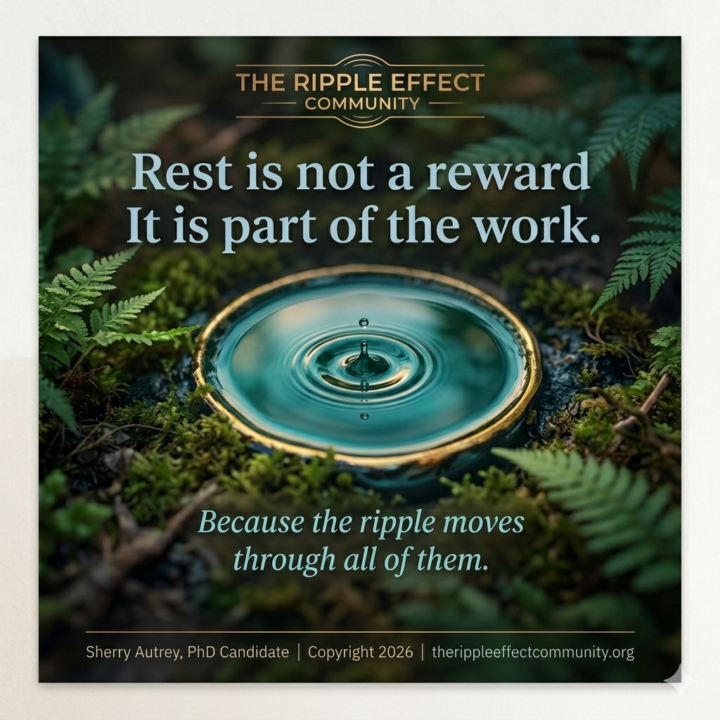
On Rest, and the Families Who Forget to Take It
There is a story many of us carry quietly: the idea that rest has to be earned. For those who have navigated adoption, family transitions, or the kind of change that reshapes everything around you, rest can feel almost forbidden. Like stopping means falling behind. Like exhaling means you have forgotten what you are carrying. But here is what the research on family systems and caregiver wellbeing keeps showing us: the people who give the most are often the ones who protect rest the least. Rest is not a pause from the work of showing up for your family. It is the work. Whether you are a biological sibling who grew up beside an adoption, a parent navigating a blended or adoptive family, or someone whose family story is still unfolding, you deserve permission to stop. Not when things are settled. Not when everyone else is okay. Now. The ripple moves through all of them. That includes you. Drop a word in the comments that describes what rest looks like for you today. Because the ripple moves through all of them.
0
0
1-21 of 21
powered by
skool.com/the-ripple-effect-community-5839
The Ripple Effect Community: a support and education platform designed to center the experiences of biological siblings within adoptive families.
Suggested communities
Powered by